Edit
U.S. lawmakers warn Vučić of sanctions despite his warming ties with Trump
The bill calls for sanctions and visa restrictions against individuals who undermine democratic processes, peace, stability and territorial integrity in the Western Balkans
A bipartisan group of U.S. lawmakers has introduced legislation that could open the door to sanctions and visa bans against individuals undermining democracy and stability in the Western Balkans, directly increasing pressure on Serbian President Aleksandar Vučić despite his traditionally warm relationship with President Donald Trump.
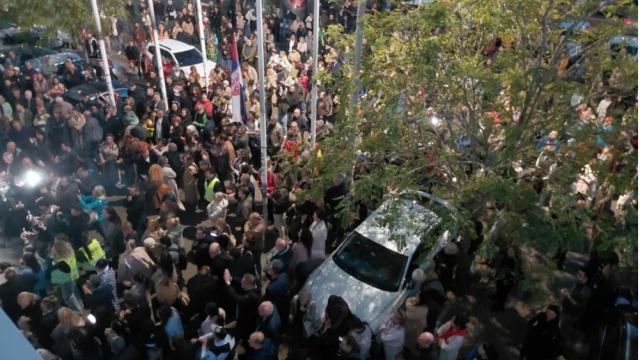
The proposed SRBIJA Act, introduced by Republican Joe Wilson and Democrat Bill Keating, comes as Vučić faces continuing student-led anti-corruption protests and prepares for new parliamentary and presidential elections.
The bill calls for sanctions and visa restrictions against individuals who undermine democratic processes, peace, stability and territorial integrity in the Western Balkans. Its text also directly raises concerns about Vučić’s government, including the use of excessive force against protesters, and calls for an investigation and accountability over the railway station tragedy in Novi Sad.
The protests began after 16 people were killed when a concrete canopy at the railway station collapsed in November 2024. Demonstrators argue that the disaster exposed wider problems of corruption and mismanagement in major construction projects.
“Under President Vučić, Serbia has deliberately drifted further from Rule of Law and nearer to enemies of freedom like War Criminal Putin, the Chinese Communist Party, and the terrorist regime in Tehran,” Wilson said. “Despite widespread protest of corruption, the Vučić government threatens to destabilize the region and beyond. The people of Serbia deserve better,” the Republican lawmaker added.
Keating said the legislation made clear that Vučić and other Serbian officials must demonstrate progress in fighting corruption and counter the influence of Russia, China and Iran. “Democracy, rule of law, and anti-corruption must remain key pillars in the U.S.-Serbia bilateral relationship,” he said.
The bill states that the United States has an enduring interest in “a stable, democratic, and sovereign Serbia” committed to regional peace and security, firmly anchored in Euro-Atlantic institutions and free from malign external influence.
A sharp contrast with Trump’s relationship with Vučić
The bipartisan pressure from Congress stands in contrast to Vučić’s relationship with Trump and the recent strengthening of contacts between Washington and Belgrade.
Trump has repeatedly presented his 2020 effort to normalise relations between Serbia and Kosovo as one of the important peace initiatives of his presidency. Vučić, meanwhile, publicly appealed to Trump in May by stressing what he described as strong support for the U.S. president among Serbs.
The two leaders have not appeared to meet in person since 2020, but Vučić hosted Trump’s son, Donald Trump Jr., twice in Belgrade this year.
In July, the United States and Serbia also held their first “strategic dialogue”, seen as a significant elevation of bilateral relations.
Wilson and Keating, however, have made the future of that dialogue part of their legislative pressure campaign.
The bill calls on the U.S. Secretary of State to raise four key issues with Belgrade: Serbia’s relations with Russia, China and Iran; guarantees for free and fair elections; progress on anti-corruption, public procurement and rule-of-law reforms; and the strengthening of democratic governance, press freedom and freedom of assembly.
If the Secretary of State cannot certify progress to Congress, the legislation would require the administration to end the strategic dialogue or cut funding related to it.
The initiative therefore creates a potential counterweight to the warmer tone that has characterised recent contacts between Vučić and Trump’s administration.
Vucic’s flattery worked: U.S. and Serbia launch strategic dialogue
Elections under scrutiny
Vučić, who has served as either Serbia’s president or prime minister for the past 12 years, announced in late July that he would resign within weeks and that new parliamentary and presidential elections would be held on 18 or 25 October.
However, concerns remain over whether the vote will be free and fair and whether the elections could instead be used to reinforce the ruling party’s control.
Freedom House rates Serbia as “partly free”, saying that during 2025 Vučić’s Serbian Progressive Party had steadily eroded political rights and civil liberties through legal and extralegal pressure on independent media, the political opposition and civil society organisations.
From Breitbart to Newsmax: Balkan leaders seek a shortcut to Trump
Sources: EUalive’s partner BGNES, The Hill
Caption: Serbian President Aleksandar Vucic speaks during a press conference with Ukrainian President Volodymyr Zelensky (not pictured) following their meeting in Belgrade, Serbia, 08 August 2026. Zelenskyy is in Serbia for an official visit. EPA/ANDREJ CUKIC
Updated: August 28, 2026 - 05:20