Edit
Hungary, Poland and Bulgaria lead charge against Macron’s policies amid French unrest
The tunes from Budapest, Warsaw and Sofia underscores deepening East-West and North-South divisions inside the EU
Hungary, Poland and Bulgaria have emerged as the most outspoken critics of the political model associated with French President Emmanuel Macron, linking recent violent unrest in French cities to long-term policy failures on migration, social cohesion and the costs of supporting Ukraine.
Their interventions follow a contentious EU summit in Brussels on 15–16 October, where a majority of member states pushed for tougher language on irregular migration, only for France and Spain to help water the conclusions down to a minimal text.
Hungarian Prime Minister Péter Magyar, commenting on videos of arson and vandalism in Paris, Lyon, Marseille and the historic town hall in Limoges during anti-austerity protests, wrote on social media: “Seeing this senseless destruction and unjustified violence, perhaps it is now clear to everyone why Hungary takes the toughest possible stance on migration.”
He added that Hungary “will not relax our efforts to protect our external borders or change our immigration policy” under any pressure, and that the “overwhelming majority of European countries have finally woken up” and want to break with “the permissive policies of the past.”
Magyar distinguished peaceful protest (a fundamental right) from vandalism and violence (a serious crime) and expressed solidarity with the French nation while arguing that Europe faces “serious trouble” and a shared duty to preserve the continent for future generations.
Polish Prime Minister Donald Tusk reinforced the hard line without naming France directly.
“Poland will not repeat the mistakes of other European countries, nor will it pay for them,” he posted after returning from Brussels. “We are firmly defending the border against illegal migration; we have our own asylum policy (we do not accept applications); we deport those who break Polish law. On security issues, we will be relentless. That is what I told the leaders of Europe in Brussels.”
Poland, along with Denmark and Italy, had pushed at the summit for language linking irregular migration to crime and social cohesion and warning against “pull factors.”
Bulgarian Deputy Prime Minister Ivo Hristov, speaking on Bulgarian National Television this morning, offered the starkest assessment of France’s trajectory.
Asked if he saw hope for France’s political future, he replied: “No, there is no way how I could be hopeful. This social bomb was ticking in France over 20 years. It started with an Intifada over a criminal case in 2007, it escalated into the Yellow Vest protests in 2017-2018, then the big battle over the pension reform, and this exploding was largely expected. When we have cases such the arsons in Limoges, Lyon, Marseilles, it means that we are faced with a social phenomenon.”
He described a “grey economy in France [that] creates a parallel state in which the state doesn’t dare to enter,” and warned of the “de-legitimation” of power in France.
Hristov said French voters would no longer be willing to fund support for Ukraine, noting that Macron is one of Ukraine’s strongest backers in Western Europe.
“The future of the EU is under question. Are we sure that the EU will survive in its present form after the turbulences it is confronted with? We should not be blind. Are we sure what will happen at the German elections? Bulgaria must be ready for all scenarios. We must destroy this ideological pattern in which every dissenting view is demonised,” he said.
He called for a realistic foreign policy that opposes war and escalation, stating Bulgaria is “against supplying weapons to Ukraine, against the continuation of the slaughter and bloodshed.”
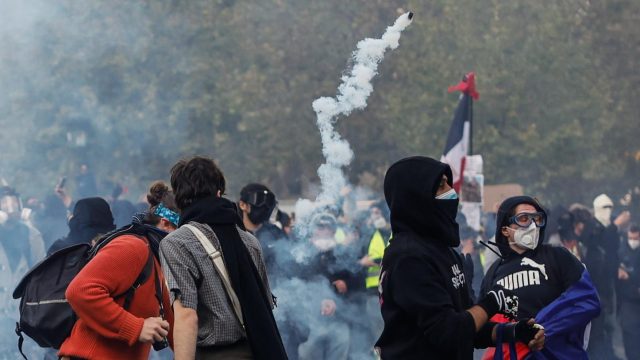
An embattled Macron, facing France’s worst unrest in years after Saturday’s anti-austerity protests erupted into widespread looting, arson and clashes that left nearly 2,400 people arrested and hundreds of police injured, has left the day-to-day handling of the crisis to Prime Minister Sébastien Lecornu. After a televised address on Sunday in which he condemned the “unbridled” violence, demanded accountability from those who destroyed property and acknowledged intelligence and security failings while refusing Interior Minister Laurent Nuñez’s offer of resignation, Macron departed Monday for a multi-day Gulf tour of Kuwait, the United Arab Emirates, Bahrain and Qatar.
The trip, focused on securing fuel and diesel supplies to ease price pressures linked to the Strait of Hormuz disruptions and the broader U.S.-Iran conflict, has drawn criticism at home for appearing out of touch and creating the impression of a power vacuum at the height of the domestic crisis.
Caption: France’s President Emmanuel Macron reacts ahead of an Interministerial Crisis Meeting chaired by him at the Elysee Presidential Palace, in Paris, France, 18 October 2026, the day after riots and looting on the sidelines of nationwide protests against the high cost of living. The French president was to give a televised address at 18:00 GMT on 18 October 2026, his office said, in the wake of violent protests that rocked the country. The broadcast was to take place after a meeting between Macron and various ministers, the Elysee said. EPA/LUDOVIC MARIN / POOL
Updated: October 19, 2026 - 12:32