Edit
EditRiga starts naming and shaming its companies trading with Russia and Belarus
The tightening of economic restrictions comes as Latvia seeks €7 billion from the long-term EU budget to mitigate costs of cutting ties with Moscow
Latvia has begun publicly naming and sahming its companies that continue to trade with Russia and Belarus, while at the same time asking the European Union for €7 billion to help offset the economic and security costs of cutting ties with Moscow.
The Central Statistical Office of Latvia began publishing on its website on 20 August a list of companies registered in the country that export goods to Russia or Belarus or import products from the two countries, Latvian public broadcaster LSM reported.
The information had previously not been publicly available because data held by the State Revenue Service was subject to confidentiality requirements. A change in the law adopted by the Latvian parliament on 18 June now requires the relevant information to be published monthly.
The list for July currently contains around 170 companies, including pharmaceutical and manufacturing companies such as Grindeks, Lauma Fabrics, Olainfarm and Olpha.
The legislation is explicitly linked to support for Ukraine. Its explanatory note says the changes are intended to support “Ukrainian society in the fight against aggressor states” and argues that Latvian-registered companies should not contribute to the budgets of Russia and Belarus while they continue their full-scale war against Ukraine.
The list is to be updated every month.
Some companies have already explained their activities. Pharmaceutical producer Grindeks, for example, said it had begun redirecting exports towards markets in the EU, North America and elsewhere, while noting that such a transition takes time in the pharmaceutical industry.
Latvia tightens trade restrictions
The move follows a separate decision by the Latvian parliament to ban imports of certain goods produced in Russia and Belarus. The restrictions can cover books and periodicals, particularly Russian-language publications, as well as video games, clothing, footwear, toys and sports goods.
The ban applies not only to goods imported directly from Russia and Belarus but also to relevant products entering Latvia through third countries. Transit through Latvian territory to other EU countries remains permitted.
The government is required to assess by 1 March 2027, and annually thereafter, whether the restrictions remain necessary for public security and support for Ukraine.
The government expects the measures to have the greatest impact on wholesalers, which will have to find new suppliers and revise contracts. Some sectors could face higher prices and longer delivery times, although the authorities believe alternative suppliers can be found.
Riga asks Brussels for €7 billion
The tightening of economic restrictions comes as Latvia seeks €7 billion in additional EU funding to cover part of the costs associated with strengthening national and European security and reducing economic ties with Russia.
Prime Minister Andris Kulbergs wants the money to be provided through the EU’s next seven-year budget framework, under the proposed European Competitiveness Fund.
The additional funding, he argues, should compensate Latvia for both higher defence spending and the economic consequences of sanctions and the collapse in trade with Russia.
“We are getting our budget deficit to the maximum […] and from that debt we’re paying […] the defense of the whole [of] Europe,” the prime minister said at the government chancellery.
He argues that Latvia deserves special consideration because of its geographical position and its role in defending the EU and NATO’s eastern flank. Much of Latvia’s increased defence spending, he says, ultimately flows back to the economies of wealthier western European countries through purchases of military equipment from Germany, France, Spain, Sweden and the Netherlands.
The €7 billion request would amount to almost half of Latvia’s projected €15.1 billion defence expenditure over the seven-year period.
Pressure over the cost of confronting Moscow
Latvia is among Europe’s strongest supporters of Ukraine and has sharply increased defence spending since Russia’s full-scale invasion in February 2022, while significantly reducing economic ties with Moscow.
But the economic and political costs are increasingly part of the domestic debate ahead of parliamentary elections in October.
Populist politician Ainars Šlesers has argued that Latvia should receive concrete compensation from the EU when it supports sanctions against Russia. He does not question support for Ukraine but says Latvia cannot indefinitely bear the economic consequences alone.
The pro-Russian Sovereign Power party goes further, calling for the restoration of relations with Moscow, although it remains politically isolated from Latvia’s main parties.
Kulbergs himself has maintained a hard line on Russia. He has called for a complete EU ban on visas for Russian citizens and supports using frozen Russian sovereign assets in Europe for Ukraine.
He also argues that relations with Moscow could eventually be restored, but only if Russia pays reparations to Ukraine and those responsible for war crimes are held accountable.
Sources: EUalive’s partner Suspilne , EUalive’s partner BGNES, Politico
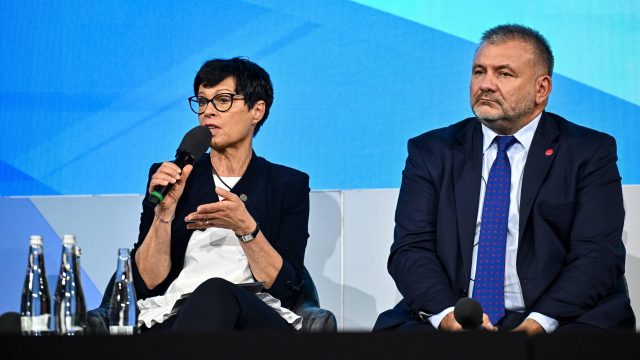
Caption: Prime Minister of Latvia Andris Kulbergs speaks during the opening session of the Ukraine Recovery Conference 2026 at the European Solidarity Centre in Gdansk, Poland, 25 June 2026. The Ukraine Recovery Conference, co-hosted by Poland and Ukraine, takes place on 25 and 26 June 2026. EPA/MARCIN GADOMSKI
Updated: August 21, 2026 - 11:09