 Edit
Cyprus Presidency proposes 2% cut to EU’s 2028–2034 budget package
Nicosia has rebalanced the proposal in response to concerns raised by the “frugal” countries pushing for tighter spending control
The Cyprus Presidency of the Council of the EU has tabled a revised negotiating package for the bloc’s next long-term budget (Multiannual Financial Framework 2028–2034), proposing an overall reduction of about 2% compared to the European Commission’s original draft.
Published on Thursday afternoon, the document marks a step forward in the negotiations by moving from broad ranges to specific figures across the main budget headings. The Presidency stresses that this is not a final proposal but a framework designed to help member states find common ground as talks enter a more political phase.
The revised package is roughly €32.8 billion lower than the Commission’s July 2025 proposal. In overall terms, it would represent about 1.23% of EU Gross National Income (or 1.13% excluding NextGenerationEU debt repayments).
The cuts are not applied uniformly. The Presidency has adjusted allocations based on the political importance, institutional constraints, and practical needs of each policy area, aiming to rebalance the proposal in response to concerns raised by several member states – widely understood as a concession to the “frugal” countries pushing for tighter spending control.
Key adjustments
- Cohesion, Agriculture & Fisheries (Heading 1): Remains the most sensitive area. The package partially restores funding for fisheries (raising it to €2 billion in current prices), though this is still 38.5% below current levels. Greater flexibility is introduced for agriculture, and attention is drawn to support for lower-income member states (GNI below 90% of EU average) in cohesion policy.
- Competitiveness, Defence, Security, Research & External Action: A uniform reduction of around 3.9% is proposed. These areas had seen large increases in the Commission’s draft; the changes are presented as a “moderation of growth” rather than outright cuts. Funding would still remain well above current MFF levels, preserving priorities such as defence readiness and strategic autonomy.
- Other Headings: Only a minor 0.5% adjustment, with protected items including overseas territories and the Euratom programme.
The framework keeps National and Regional Partnership Plans at the centre of spending delivery while strengthening the role of regions to avoid excessive centralisation. It also advances work on the new European Competitiveness Fund and the Global Europe external financing instrument.
European Council President António Costa has invited EU leaders to the European Council meeting on 18-19 June in Brussels. In the invitation letter published on Thursday, Costa highlighted the Multiannual Financial Framework (MFF) for 2028–2034 as a key agenda item. Building on the April debate in Cyprus, leaders will discuss the Cyprus Presidency’s first negotiating box with specific figures, aiming to make progress on core elements – including new own resources – to pave the way for an agreement by the end of 2026 under the incoming Irish Presidency.
The summit will also cover competitiveness, Ukraine, the Middle East, defence, migration, and other issues.
We reject the Council’s proposal, which is simply not fit for today’s realities. It does not reflect the needs of Europe’s people nor the position of the European Parliament, as the Union’s democratic and budgetary institution.
The Council's proposal sends entirely the wrong… pic.twitter.com/NsjaThJBHy
— Siegfried Muresan 🇷🇴🇪🇺 (@SMuresan) June 11, 2026
The article by EUalive’s partner Politis can be found here.
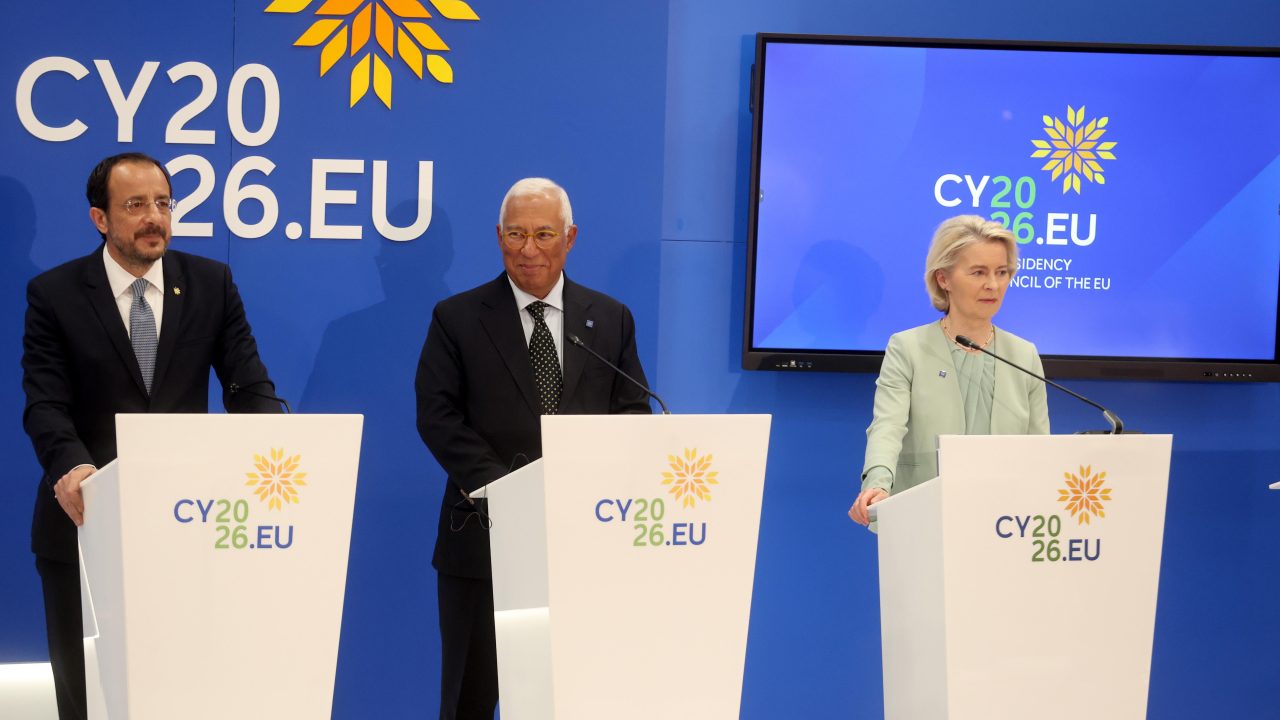
Caption: (L-R) Cyprus President Nicos Christodoulides, European Council President Antonio Costa, European Commission President Ursula von der Leyen take part in a press conference during an informal meeting of EU Heads of State or Government in Lefkosia, Cyprus, 24 April 2026. EU leaders are expected to address the current geopolitical developments and Europe’s response to it. EPA/GEORGE CHRISTOFOROU
Updated: June 12, 2026 - 07:04