 Edit
United Group founders sue BC Partners over planned Balkan media sale
A court challenge in London deepens scrutiny over the future of independent media in Serbia and political influence in the Western Balkans
The founders of United Group have launched legal proceedings in London to block the planned sale of some of the Balkans’ largest independent media outlets, escalating a dispute that has rapidly become about far more than corporate governance.
The lawsuit, filed by companies controlled by Dragan Šolak and chief executive Victoriya Boklag, targets entities controlled by private equity group BC Partners over the proposed disposal of United Group’s media arm, United Media.
At the centre of the case are television channels N1 and Nova, newspapers including Danas and Nova, and a wider portfolio of around 120 media assets across Southeast Europe. The founders argue that the sale would fundamentally alter United Group’s business model and cannot legally proceed without their consent under a 2019 shareholders’ agreement.
But the dispute lands in a far broader political context.
For years, N1 has been regarded by international media freedom groups as one of the few major independent broadcasters in Serbia, operating in an increasingly hostile media environment dominated by pro-government outlets and state influence.
The Media Freedom Rapid Response platform said earlier this year that N1 had become one of the most targeted media organisations in Serbia, documenting dozens of threats, intimidation campaigns and attacks against its journalists.
International watchdogs and journalists’ organisations have repeatedly warned about deteriorating press freedom in Serbia under President Aleksandar Vučić, particularly during the country’s prolonged political crisis and anti-government protests.
Major media ownership shift in the Balkans raises concerns over press freedom and EU standards
Against that backdrop, the proposed sale of United Media has triggered fears among journalists, civil society organisations and opposition figures that one of the last major independent media ecosystems in the country could come under indirect political influence.
The legal filing explicitly references investigative reporting by the Organized Crime and Corruption Reporting Project (OCCPR) and Serbian outlet KRIK concerning alleged discussions between telecom executives over weakening N1 Serbia.
The statement also raises concerns about the prospective buyer, European Future Media Investments, reportedly linked through investigative reporting to Alpac Capital. The filing points to controversies surrounding the company’s financing and alleged political connections linked to Viktor Orbán and Serbian authorities.
EUalive has sent written questions to United Media Group or Alpac Capital back on 19 May. No response came.
Media and journalists’ associations in Serbia have already warned of what they describe as a “coordinated takeover” of independent media. Several groups argued in recent weeks that changes inside Adria News Network, including management reshuffles, could pave the way for editorial pressure ahead of future elections.
Civil society organisations have also urged the EU to react, describing the possible transaction as one of the most serious threats to media pluralism in the Western Balkans in recent years.
The founders’ legal challenge attempts to stop the process before the transaction is formally completed.
Negotiations over the sale are already at an advanced stage, with draft agreements reportedly prepared and board discussions convened to approve the transaction.
Šolak and Boklag argue that BC Partners initiated the restructuring and disposal process without informing minority shareholders or obtaining their written approval, despite contractual provisions granting them consent rights over major changes to the business.
The claim seeks both a judicial declaration that the disposal represents a “material change” in United Group’s business and an injunction preventing the sale from proceeding without their consent.
The dispute also highlights the strategic importance of United Group in the regional media and telecommunications landscape.
Founded in Serbia in 2000, the company grew into one of Southeast Europe’s largest telecoms and media groups through a model combining broadband, mobile services and proprietary media content. Its news operations became particularly influential in Serbia and neighbouring countries because of their editorial independence and critical reporting on political power.
That model, the lawsuit argues, is now at risk of being dismantled.
In their statement, Šolak and Boklag strongly rejected suggestions circulated in parts of the Serbian media landscape that they support the proposed sale, arguing that the very existence of the London proceedings demonstrates the opposite.
The English court is now expected to decide whether the sale process breached shareholder rights and whether one of the Balkans’ most influential independent media networks can change hands without the approval of its founders.
Sources: Dragan Šolak and Victoriya Boklag’s statement, AP, Reuters, Guardian, N1
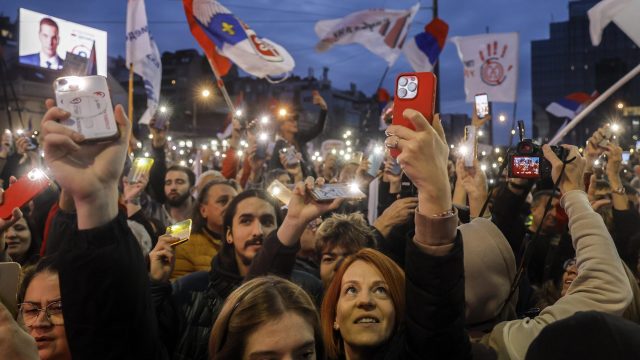
Caption: Media workers demonstrate against rising violence during a protest supporting press freedom in Belgrade, Serbia, 01 April 2026. The rally follows a series of assaults on journalists while reporting in the field. The Journalists’ Association of Serbia reports that the frequency of such attacks has reached a record high in the past 12 months. EPA/ANDREJ CUKIC
Updated: May 29, 2026 - 05:59