 Edit
Putin’s “military secret” is a policy Moscow already announced
The war in Europe is no longer confined to Ukraine. Looking the other way remains the Kremlin’s main asset
“That’s a secret. A military secret.”
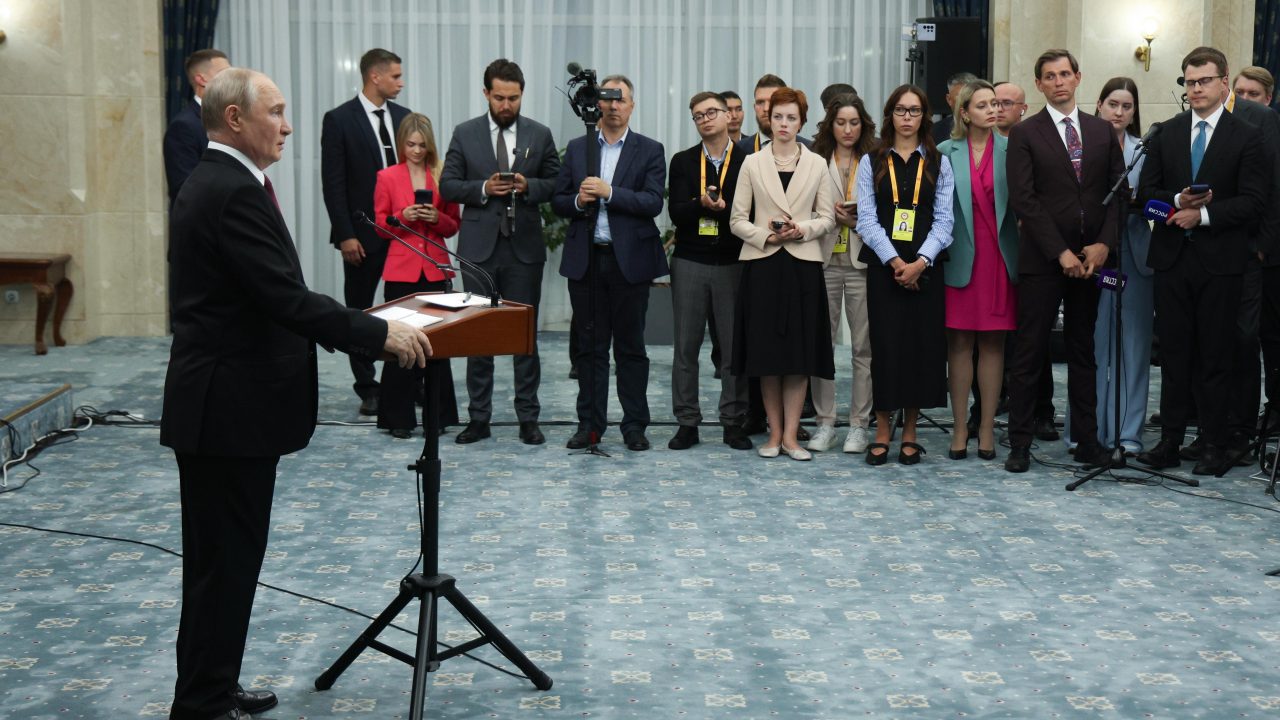
That was Vladimir Putin’s answer, delivered with a smirk after the Shanghai Cooperation Organisation summit in Kyrgyzstan, when a journalist asked whether British military-industrial plants on British soil could become legitimate Russian targets. He was clearer about Ukraine: any military facilities there, British or otherwise, already are.
JUST IN: President Putin on whether military equipment manufacturers in the UK providing weapons to Ukraine could become a legitimate target for Russia: “It is a secret. Classified.” pic.twitter.com/mMp5RYMDMw
— Kirill Dmitriev (@kadmitriev) September 1, 2026
The line sounded like a new threshold. It was not. It was theatre around a policy Moscow had already put on the table.
Last week, Russian Foreign Ministry spokeswoman Maria Zakharova said Britain was “one step away” from becoming a party to “terrorism,” and that Russian forces could strike British military sites “in Ukraine and beyond its borders.” Kremlin adviser Andrei Fedorov went further: factories producing drones and missile components for Ukraine “could be attacked, not by Russia, but… from unknown sources,” with cyber operations and “semi-military” action left open. As EUalive argued then, if Moscow wanted escalation, Europe should answer first with frozen Russian money, not by waiting for missiles.
If Moscow wants escalation, start with the money, not the missiles
Putin has now given that doctrine a presidential shrug. He did not withdraw it. He classified it.
The map is no longer only Ukraine
While European capitals parsed the smirk, the incidents continued – some already reported here, others now officially named.
On 4 August, an explosives-laden drone was found near a Ukrainian Antonov cargo aircraft at Leipzig/Halle airport, a hub for weapons and NATO logistics. Germany spent weeks hedging. On 1 September, Interior Minister Alexander Dobrindt and Foreign Minister Johann Wadephul stopped hedging: police work, the pattern of the act and intelligence findings established Russian responsibility. Berlin will close Russia’s consulate in Bonn and end the lease on a Russian cultural centre in Berlin. EU foreign policy chief Kaja Kallas said the attempt had “the hallmarks of state-sponsored terrorism.”
The same day, improvised explosive and incendiary devices were found at the Preilack substation in Brandenburg, near the Polish border and the Jänschwalde power plant. At least one detonated. Overhead lines were damaged. A generating unit went offline. No blackout followed, but the operator called it an attack. Attribution is still open. The geography is not accidental.
Explosion in Germany, sabotage in Poland: simple incidents, hybrid war or state terrorism?
Overnight on 31 August, a fire tore through a warehouse at WB Electronics in Skarżysko-Kamienna, a Polish plant that makes FlyEye and Warmate drones used by Polish and Ukrainian forces. Damage was put in the tens of millions of zloty. Prosecutors opened a terrorism inquiry and are examining possible foreign intelligence involvement. CCTV showed a masked person on the grounds. Donald Tusk said Poland had again been hit by sabotage “in the past dozens of hours,” listing Finland, the Baltics, Romania, Denmark and now Germany in the same breath.
That is only the latest cluster.
In August alone, a fire and explosions hit Bulgaria’s EMCO ammunition plant, which produces 155mm shells for Ukraine. Three days later, a blaze and blast struck the powder unit at KNDS Ammo Italy in Colleferro.
Explosion at Bulgarian arms plant revives Russian sabotage concerns
On 15 August, a building used by Estonia’s Milrem Robotics, a supplier of unmanned systems to Ukraine, was set on fire; Latvia later detained three men suspected of being recruited to help a foreign state. None of these cases is closed. Not all have been officially pinned on Moscow. The pattern is the point: logistics hubs, power nodes, and factories that keep Ukraine in ammunition and drones.
Estonia investigates suspected arson at Milrem Robotics facility amid Russia sabotage theory
Western intelligence officials have described a campaign calibrated to stay just short of NATO’s Article 5: deniable recruits, “unknown sources,” fires that can be written off as accidents until they cannot. Russia denies everything. Denial is part of the method.
The official line has already moved
For two years, European governments treated sabotage, cable cuts, parcel bombs, GPS jamming and factory fires as a grey zone – serious, but still something other than war. Leipzig changes the vocabulary. A NATO government has now said, in public, that the Russian state organised an explosive drone attack on its territory against aircraft used to arm Ukraine.
That is not “spillover.” It is a second theatre, run below the threshold of tanks and declared fronts. Putin’s “military secret” is useful precisely because it keeps the first theatre conventional and the second deniable. Factories in Britain, Germany, Poland, Estonia, Italy or Bulgaria need not be hit by a missile to be part of the war. A fire, a drone that fails to detonate, a substation that goes dark for a few hours – each tests whether Europe will treat the event as crime, coincidence or attack.
Most European politicians still prefer the first two.
They argue about legal immunities of central-bank reserves while some €210 billion in frozen Russian sovereign assets sit mostly in Belgium. Extraordinary profits have been used; the principal has not. Four governments have pushed to unlock it for Ukraine’s budget and defence. Others hide behind process: precedent, financial stability, the sanctity of reserves. Moscow reads that hesitation as permission to widen the target list from “unknown sources” to military objects beyond Ukraine.
Hardening plants and calling sabotage what it is are necessary. Matching every threat with a NATO military answer is not the only, or even the first, option. Converting immobilised Russian capital into Ukrainian munitions would land a blow on the exposed part of Putin’s war machine without firing a shot from Western soil. Leaving the money frozen, while factories burn and airports are probed, is a preference for procedure over power.
Putin’s real asset
The war in Europe is no longer confined – not even officially – to the territory of Ukraine. Germany has said so about Leipzig. Poland is investigating a drone plant fire as possible foreign intelligence work. Britain has been told, first by Zakharova and Fedorov, then by Putin himself, that its industry is on a list whose contents are “classified.”
What remains confined is the political response.
As long as the dominant reflex in European capitals is to look the other way – to wait for perfect attribution, to treat each fire as a local accident, to debate frozen assets as a banking problem rather than a war problem – Moscow will keep the cheaper war. Hybrid pressure costs little. Ambiguity is free. A presidential smirk costs nothing at all.
That smirk is not the strategy. Europe’s aversion to naming the strategy, and acting on it, is Putin’s main asset.
Caption: Russian President Vladimir Putin (L) answers questions from journalists following the Shanghai Cooperation Organization (SCO) summit in Bishkek, Kyrgyzstan, 1 September 2026 (issued 2 September 2026). EPA/VYACHESLAV PROKOFYEV / POOL
Updated: September 2, 2026 - 12:34