 Edit
EditFrance answers Russia’s missile theater with its own
Macron’s M51.3 launch from Le Vigilant, days after fresh Kaliningrad nuclear warnings, shows how Moscow’s habit of public ballistic tests and deterrent signalling has become contagious
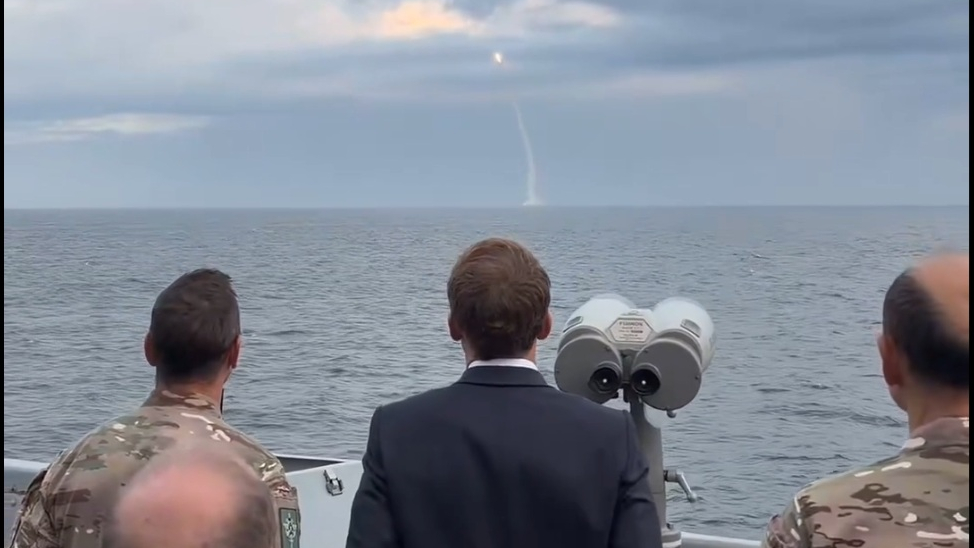
France’s first submarine launch of the M51.3 on 6 October 2026 was framed by President Emmanuel Macron as a demonstration that “the message has been sent loud and clear” wherever it needed to be received.
The unarmed acceptance firing from the SSBN (nuclear-powered ballistic-missile submarine) Le Vigilant, watched by Macron from the frigate Auvergne off Brittany, certified the boat after overhaul and the upgraded missile’s operational readiness. Official statements avoided naming Russia; the timing and Macron’s language did not.
Days earlier, Moscow had warned NATO that any attempt to isolate Kaliningrad could trigger the use of its full arsenal, including nuclear weapons, and Vladimir Putin reiterated that a direct attack on Russia or the exclave would raise the question of employing every weapon available. Those statements followed months of Russian nuclear signalling: a large strategic exercise in May that included live launches of a Yars ICBM and a Sineva SLBM, claims about the Sarmat, and repeated public references to nuclear options tied to the war in Ukraine and European security. French officials and coverage noted the test occurred against that backdrop of heightened tensions.
Macron’s accompanying remarks—“To be free, one must be feared. And to be feared, one must be powerful”—and his emphasis on doubled defense spending, new strategic submarines under construction, and a hypersonic program for the air leg of the deterrent, mirror the style Russia has used for years: visible ballistic launches and explicit or implied nuclear capability as instruments of political messaging. The Russian proverb “a bad example is always contagious” captures the symmetry critics and observers have noted. Both sides present the launches as routine technical validation conducted without warheads and within treaty limits; both also ensure the events are publicized so that adversaries and allies register the underlying deterrent claim.
France maintains an independent force of roughly 290 warheads and positions the ocean component as the core of its credibility; Russia holds the world’s largest arsenal and has used exercises and tests to underline willingness to escalate. The October firing adds one more data point to that exchange rather than a break from it.
Caption: Screenshot from video posted from Macron’s account on X.
Updated: October 7, 2026 - 17:15


