Edit
EditAnalysis: Vučić prepares for many more years in power
While debates on electoral lists continue, many fear the Serbian President is laying the ground for widespread electoral fraud
Serbian President Aleksandar Vučić has intensified efforts in recent days to secure his continued dominance in politics beyond the upcoming elections, according to an analysis by EUalive’s partner in Serbia, BETA agency.
Recent changes to judicial legislation, which the European Commission has demanded be reversed due to concerns over judicial independence, have been followed by proposed amendments to three key electoral laws. These developments have sparked widespread apprehension among segments of the public who expect that Vučić is laying the groundwork for extensive electoral manipulation.
A calculated return to Novi Sad
Vučić has sustained a deliberate campaign to reinforce his position, exemplified by an unannounced visit to Novi Sad on 8 February. This marked his first appearance in the city center since 5 November 2024, when he visited a local branch of the Serbian Progressive Party (SNS) amid the largest protest the city had seen up to that point. That demonstration followed the tragic collapse of the railway station concrete canopy on 1 November 2024, which claimed 16 lives and ignited nationwide outrage over perceived corruption and negligence in public infrastructure. Since then, Vučić has limited his public engagements in Novi Sad to peripheral neighborhoods, avoiding the central areas where public sentiment remains volatile.
Accompanied by SNS leader and former Novi Sad mayor Miloš Vučević, Vučić attended the seventh Homeland Fair, an exhibition showcasing products from Serbs in the Croatian Krajina region. He delivered a brief address to attendees before stopping at a fast-food stand to eat traditional street food, and later sharing lunch with party officials at a restaurant in Petrovaradin Fortress.
Notably, the visit was not announced on the president’s official website, the provincial government portal, or any ministerial sites; the public learned of it only afterward through social media posts.
The event appeared meticulously staged as a political performance aimed squarely at Vučić’s core supporters. By choosing Sunday morning, when streets are typically quieter – he minimized the risk of spontaneous public encounters while allowing controlled filming for dissemination among loyalists. As he departed the fair, organized groups of supporters applauded him enthusiastically, while a heavy police presence cordoned off sections of the city center. Well-informed observers noted the brevity of his city-center exposure, the lack of prior notice, and the tightly managed environment, yet these details remain obscure to most of his electorate, who receive information filtered through pro-government media outlets that portray the visit positively.
Through this appearance, Vučić sought to reassure his base that stability has returned and that the disruptions following the canopy tragedy are behind them. The focus was on consolidating existing support rather than attracting new voters. He appears to rely on a strategy of negative campaigning against opponents to discourage turnout among undecided or opposition-leaning citizens, thereby preserving his electoral edge through demobilization rather than expansion.
Vučević’s constant presence during the visit carried added significance. As a prominent advocate in recent months for Vučić transitioning from the presidency to the prime minister’s office, Vučević has publicly championed the idea that Vučić’s leadership is without alternative.
Vučić recently urged party members to refrain from openly pushing for his candidacy as prime minister, claiming he had not yet decided and emphasizing that he would not continue in any role without the same energy and enthusiasm he has shown thus far. Such statements subtly prepare the terrain for exactly that shift, framing it as a reluctant but necessary step.
This narrative aligns with a concurrent media campaign in pro-regime outlets, which has highlighted an alleged scandal involving government use of artificial intelligence to draft Serbia’s development programs. Reports claim Vučić reacted with fury, insisting he would personally oversee such work. Whether the story holds truth or serves purely as propaganda remains unclear, but it reinforces a portrayal of Vučić as the sole competent figure capable of steering the nation, while depicting ministers as inadequate and disengaged. These elements collectively build momentum for his potential move to the premiership after his presidential term concludes.
Concerns over electoral legislation changes
While opposition groups, students, and civil society debate strategies for electoral lists for the forthcoming general elections, a significant portion of the public harbors justified fears that Vučić is orchestrating fraud on an unprecedented scale. Past elections have featured irregularities such as candidacy manipulations, restricted media access, vote buying, voter pressure, and improper involvement by state officials. The current trajectory suggests even more systemic interference.
Last week, draft amendments to three electoral laws – the Law on the Constitutional Court, the Law on Election of Members of Parliament, and the Law on Local Elections, were forwarded to members of parliament. Authorities describe these as fulfilling recommendations from the OSCE’s Office for Democratic Institutions and Human Rights (ODIHR). In reality, they incorporate only a fraction of the 24 ODIHR suggestions, and their substance appears to exacerbate rather than resolve electoral vulnerabilities, creating a facade of compliance.
Opposition-aligned observers interpret this as a follow-up to recent judicial amendments that undermined court independence, now extending control to the electoral framework under the pretext of international alignment. Key provisions raise serious alarms. The drafts would permit so-called “phantom tickets” – lists from essentially fictitious parties or movements, to participate without hindrance. Previously exposed abuses involving forged support signatures would become obsolete under a new rule allowing voters to endorse multiple lists simultaneously, a practice never before permitted.
This change could enable ruling-party supporters to bolster numerous additional lists, granting those entities seats on electoral commissions that adjudicate results and thus potentially influencing outcomes decisively. Furthermore, the amendments would facilitate greater exploitation of national minority electoral privileges. They would relax criteria for minority-list status, limiting scrutiny to only the list leader and top candidate rather than all members, and eliminate consultations with national minority councils. Such lists require far fewer signatures to register and a mere 0.3 percent of votes to secure parliamentary seats, compared to the three percent threshold for others.
Should these measures pass, prominent ruling-coalition figures could run on minority tickets without penalty, amplifying advantages for the incumbents. Another troubling proposal would restrict opposition participation in electoral commissions and polling boards by mandating certification from the Republic Electoral Commission for all members – a requirement affecting tens of thousands of roles. Although slated for implementation in 2028, the precedent of last-minute alterations (as seen with judicial reforms sponsored by SNS deputy Uglješa Mrdić) leaves open the possibility of earlier enforcement.
These combined initiatives – public reassurance tours, media orchestration of Vučić’s indispensability, and legislative tweaks that ease manipulation, paint a picture of strategic entrenchment. Vučić’s actions suggest not merely preparation for elections, but a blueprint for extending his influence indefinitely, even as domestic discontent and international scrutiny mount.
How Serbian special prosecutors achieved the unthinkable: a raid on Vučić-linked party figure
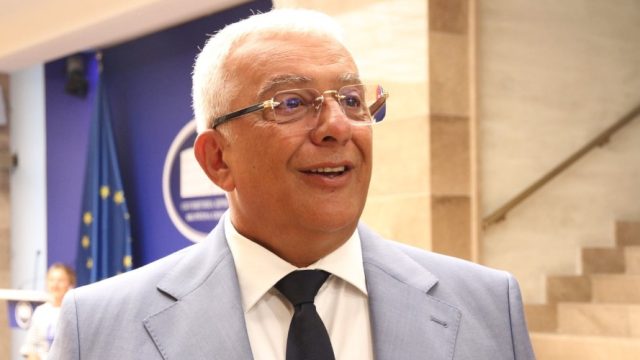
Caption: Serbian President Aleksandar Vučić has sustained a deliberate campaign to reinforce his position, exemplified by an unannounced visit to Novi Sad on 8 February. (The official Facebook page of the Serbian President)
Updated: February 12, 2026 - 12:16