 Edit
Serbia at a crossroads: four scenarios for a nation in turmoil
EU mediation, rising repression or regime collapse - analysts warn that every path carries both risk and opportunity
Serbia’s political and institutional crisis, the most severe since President Aleksandar Vučić came to power, has reached a decisive stage. According to a recent policy paper by the Belgrade Centre for Security Policy, one of the largest think tanks in the Balkans dealing with foreign and security policy and a partner of EUalive, the country faces four possible outcomes between November 2025 and June 2026.
“These are not separate scenarios,” the report cautions, “but rather potential endpoints that could arise from any of the preceding four paths – depending on how the key drivers interact and the choices made by principal domestic and international actors.”
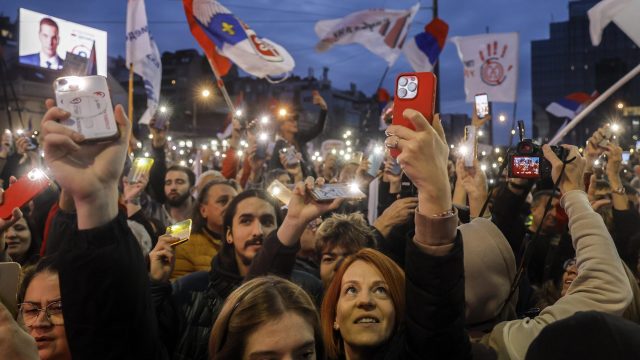
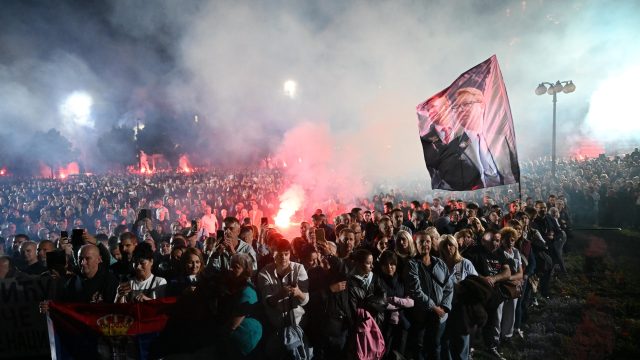
The policy paper outlines how months of protests following the Novi Sad tragedy and waves of repression have eroded public trust and paralyzed institutions, placing Serbia “at a crossroads between democracy and autocracy.”
1. Prolonged impasse: controlled repression and silent consolidation
In the first scenario, described as a “prolonged impasse,” the government refuses to call early elections, while protests gradually lose momentum. The regime relies on “controlled repression – targeted retaliation against universities, educators, students, and members of the judiciary.” Opposition parties remain fragmented and civil society isolated.
Although the situation appears stable, the authors warn that the equilibrium is fragile. Symbolic gestures toward the EU – such as “renewed cooperation on energy issues or limited distancing from Russia”, could temporarily appease external partners, yet any domestic or geopolitical shock may “swiftly propel the country toward renewed repression or a fresh phase of crisis escalation.”
2. EU as broker: a fragile negotiated transition
The second scenario envisions the European Union stepping in as a decisive mediator once the stalemate becomes unsustainable. Following violent clashes or deep institutional paralysis, Brussels could launch “an extraordinary framework for dialogue,” leading either to a transitional technical government or to early elections under improved conditions.
Through such mediation, student leaders and opposition figures would gain indirect recognition, while civil society would help monitor reforms in electoral law and media regulation. The report foresees a North Macedonia–style arrangement, where EU and OSCE oversight ensures minimum democratic standards.
A new balance could emerge, the authors note, if “a peaceful transfer of authority” is achieved through an EU-brokered agreement – a development that might restore the rule of law and reopen Serbia’s path to European integration.
3. Intensifying repression: chaos and potential collapse
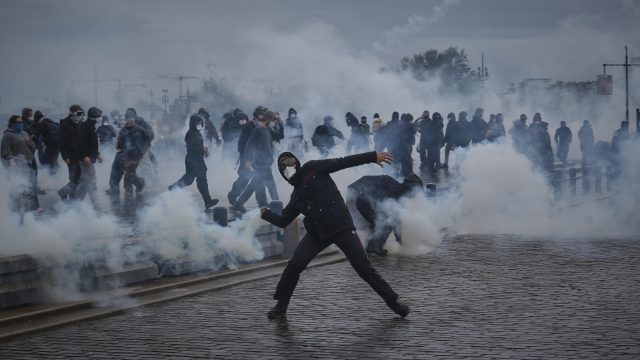
A third, darker path foresees “beatings, mass arrests, and violent dispersal of protests.” Far from restoring order, such measures could fuel nationwide unrest and the eventual breakdown of state control. The regime would enact “anti-terrorism” and “anti-extremism” laws modelled on Russian and Chinese precedents, effectively criminalising civil society and opposition activity.
If police and paramilitary forces fail to contain the unrest, “the regime escalates further – deploying the military and declaring a state of emergency.” The brief warns that this could lead to “the disintegration of the security apparatus and the eventual fall of the regime,” leaving behind a vacuum marked by legal paralysis and competing factions.
4. Early elections: controlled pluralism and uncertain reform
In the fourth scenario, President Vučić could call snap elections once protests subside and his party regains confidence. The elections, framed as “a return to normalcy,” might restore superficial calm while preserving regime dominance.
Although the EU would likely support the vote “as a potential exit from crisis,” the authors caution that absent genuine reform, the process risks “legitimising rather than resolving Serbia’s political impasse.” Media control and electoral manipulation could again undermine trust, while any credible evidence of fraud might reignite protests.
Endgames and European responsibility
All scenarios, the policy brief concludes, could ultimately converge into one of four outcomes: political vacuum, negotiated transition, regime collapse or authoritarian consolidation. The final trajectory, it stresses, will depend on “the endurance of civic mobilisation, the regime’s capacity for repression or compromise, and the resolve of the European Union to act not as a distant observer but as a decisive guarantor of democratic principles.”
In short, Serbia’s crisis “remains a living, mutable process rather than a linear progression toward resolution.” Whether it ends in democratic renewal or deeper autocracy will be decided in the months ahead – not only in Belgrade’s streets, but also in Brussels’ corridors of power.
The policy paper “Political and Institutional Crisis in Serbia: Scenarios and Outcomes” was authored by Igor Bandović, Srđan Cvijić, Marko Drajić, Jelena Pejić Nikić, Predrag Petrović and Vuk Vuksanović. For more context, see our earlier interview with Srđan Cvijić here.
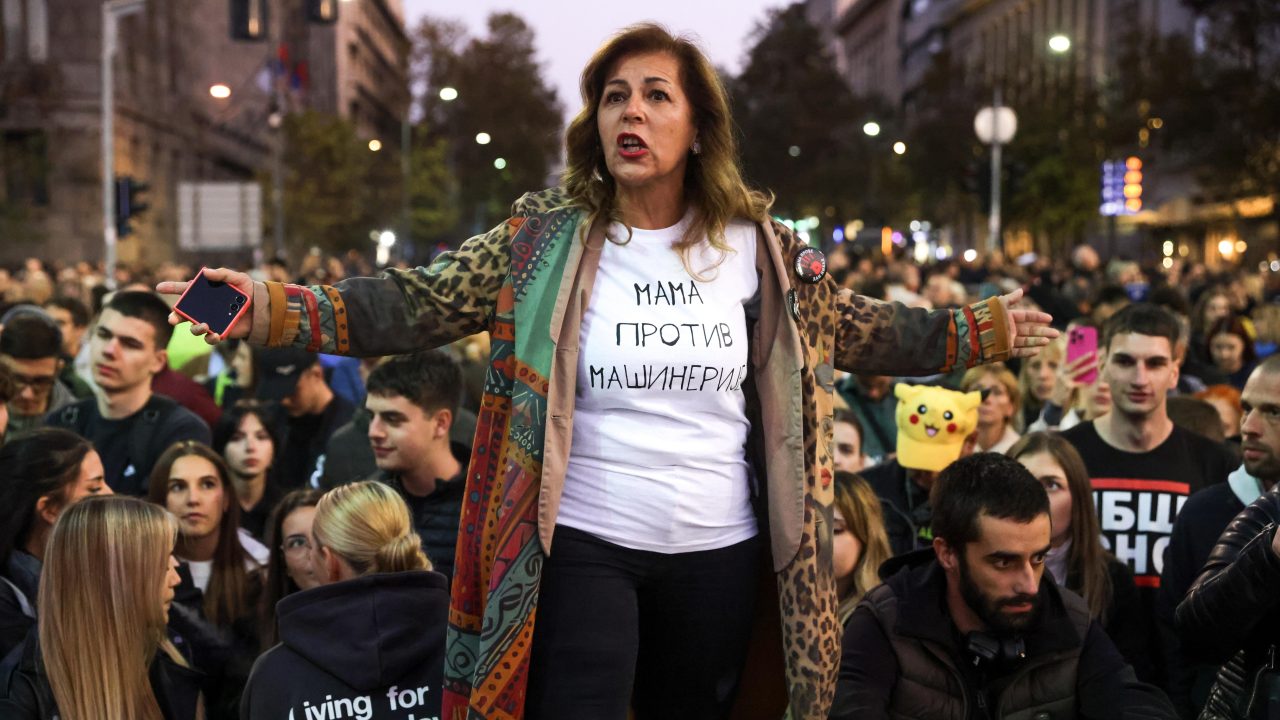
Caption: A woman wearing a T-shirt that says ‘Mom Against Machinery’ People shout slogans during a protest in front of the Serbian’s Parliament building in Belgrade, Serbia, 5 November 2025. Dijana Hrka, mother of one of the victims of the Novi Sad accident, began a hunger strike outside Serbia’s Parliament, demanding accountability for the collapse of a railway station canopy on 01 November 2024 that killed 16 people. EPA/ANDREJ CUKIC
Updated: November 10, 2025 - 14:40