 Edit
Will Serbia enter an oil alliance with Russia while the EU looks the other way?
Instead of returning to the path of dependency, the country must choose the path of open markets and reliable suppliers
Serbia will start construction works on a planned oil pipeline connection with Hungary by the end of the year. According to reports, the preliminary design and the feasibility study for the project have already been developed, while the construction permit as well as the completion of the project and technical documentation for the pipeline are expected by the end of the year. Construction works are planned to be completed in 2027.
In June 2023, Serbia and Hungary signed an agreement to build the 128 km oil pipeline linking Novi Sad in northern Serbia to Algyo in southern Hungary. Serbia will invest 150 million euro ($155.5 million) in the project, which will eventually extend over 300 km to connect Novi Sad with the Druzhba pipeline’s receiving station in Szazhalombatta, Hungary. The pipeline is expected to have an annual capacity of about 5 million tonnes of oil, Djedovic Handanovic said earlier.
The Druzhba pipeline, also referred to as the Friendship Pipeline and the Comecon Pipeline, is one of the world’s longest oil pipelines and one of the largest oil pipeline networks in the world. It began operation in 1964 and remains in operation today. It is clearly a function of Russian energy influence in Central and Eastern Europe, Hungary and Slovakia in particular, now bringing Serbia back into direct dependence on Russian oil flows.
Currently, crude oil is imported via the Croatian terminal Omišalj and the JANAF pipeline, which gives Serbia the possibility to supply energy from different sources and maintain a neutral position in energy supply. The reorientation toward the Hungarian-Russian corridor opens up a serious strategic paradox because, under the pretext of diversification, the country will be tied to a single supplier.
The capacity of the planned pipeline is estimated at 5.5 million tonnes per year, although the NIS has never processed the maximum capacity of the Pančevo refinery (4.8 million tonnes/year) and actually imports about 3 million tonnes of crude oil per year. This clearly shows that Serbia will become 100% reliant on Russian oil.
The financial risks are also pronounced. The project is estimated to cost around 550 million euros, and the entire cost will be borne indirectly by NIS as the sole user of the route by continuously guaranteeing the volumes to be transported over a longer period of time.
This is because Hungary’s MOL requires guarantees for annual volumes according to the principle of “smaller volume – higher tariff” and vice versa. According to the proposals submitted by MOL so far, the transportation price would be 2-3 times higher than via JANAF. In practice, Serbia would be financing non-transparent infrastructure in favor of competitors with hegemonic ambitions.
The ambitions of MOL in the region can indeed be called hegemonic. In recent years, MOL has acquired INA in Croatia and Slovnaft in Slovakia, which has led to cutbacks and disruptions in the refinery operations. In Bulgaria, MOL reportedly wants to buy the country’s only refinery from Lukoil.
On a political level, such development is leading Serbia away from the path of European integration. Joining the EU implies not only economic standards but also harmonization with the common foreign and security policy. Long-term energy dependence on Russia with the tacit consent of Hungary – which is often considered a disruptive factor in the EU – would be a profound strategic mistake.
The historical precedent should also not be forgotten. Serbia has already missed the opportunity to diversify gas flows by refusing to co-operate with Romania and participate in the Blue Stream project. Now the same pattern of indecision and external influences is repeating itself in the oil sector.
On a broader level, this project positions Serbia as an exception in a region that is rapidly freeing itself from energy dependence on Moscow. The war in Ukraine has disrupted global relations and made energy policy a key security issue. By continuing the Druzhba project, Serbia is exposing itself to greater dependence on the Kremlin and is increasingly distancing itself from Brussels and Washington.
It is unclear why Brussels looks the other way. The EU has the leverage to call on Belgrade to reconsider the decision that directs Serbia to the outdated Russian infrastructure while Europe largely abandons this model.
Moreover, by investing in this pipeline means that Serbia is putting agreements with the EU and the US on hold while the entire world turns to clean and diverse sources. The question remains: can a project presented as a diversification measure actually pull Serbia back into dependence at a time when it is clear that the West favours innovative and more resilient models?
It is no rocket science: instead of returning to the path of dependency, Serbia must choose the path of open markets and reliable suppliers. And stay away from small hegemons like MOL, or larger ones such as Russia.
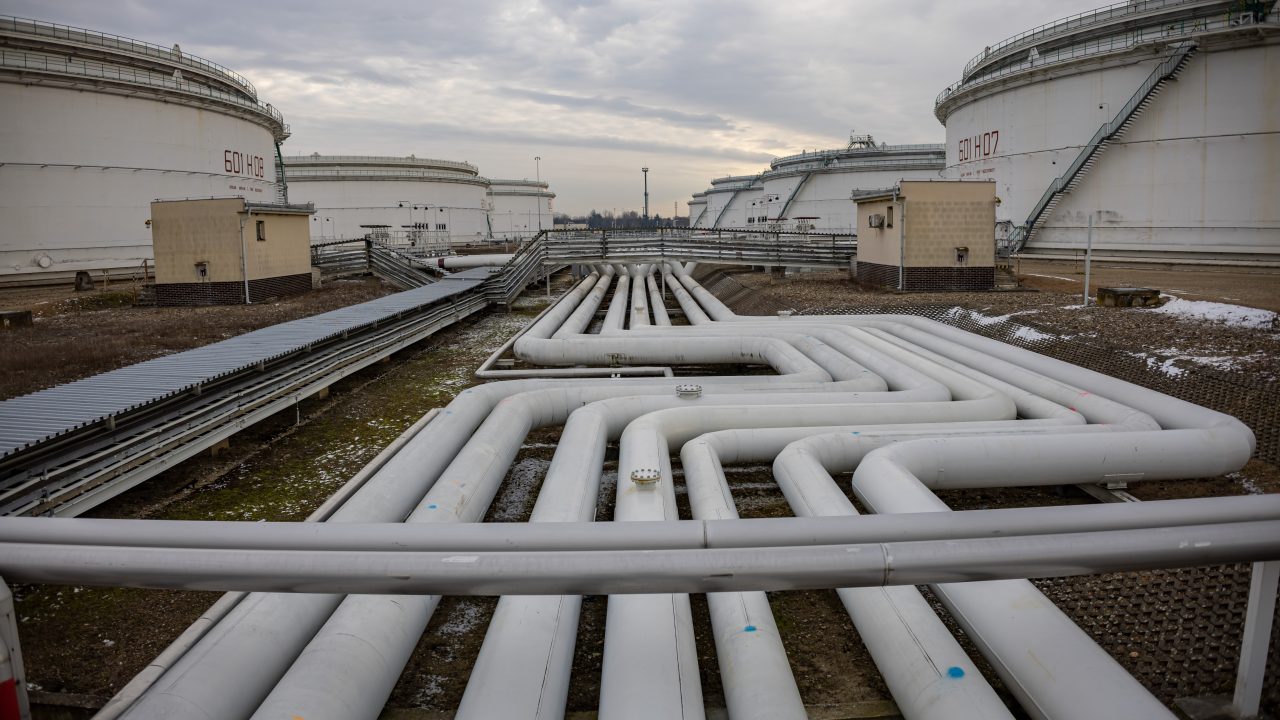
Caption: Storage tanks and pipelines at the Central oil tank farm operated by Mero CR near Nelahozeves, Czech Republic, 14 January 2025. The Czech government confirmed on 14 January 2025, adding that Czechia will no longer be dependent on Russian oil from the Druzhba pipeline by the middle of this year. EPA-EFE/MARTIN DIVISEK
Updated: June 25, 2025 - 05:28