 Edit
EditNATO secures Spain’s agreement on 5% GDP defence spending goal, overcoming resistance
The breakthrough marks a significant victory for Trump, who has relentlessly pressed NATO members to bolster budgets
NATO allies reached a landmark consensus on Sunday (22 June), adopting a statement for the upcoming summit in The Hague that commits to increasing annual defence and security spending to 5% of GDP by 2035, a target championed by U.S. President Donald Trump.
The agreement, confirmed by Reuters and DPA, marks a significant victory for Trump, who has relentlessly pressed NATO members to bolster their budgets. Spain, the last holdout, withdrew its opposition after intense diplomatic negotiations, though details of the persuasion remain undisclosed. The statement awaits formal approval by NATO leaders, including Trump, at Wednesday’s summit, highlighting the alliance’s effort to address escalating global threats amid tensions with Russia and China.
The decision follows months of contentious debates within NATO, with Trump’s insistence on a 5% GDP target – well above the current 2% guideline – meeting resistance from several members, most notably Spain. The new goal allocates 3.5% of GDP to direct defence spending and 1.5% to defence-related areas, such as cybersecurity and infrastructure. Sources indicate that all 32 NATO members endorsed the draft, a critical step to present a united front at the summit, where Trump is expected to scrutinize allies’ commitments.
Spain’s resistance to higher defence spending
Spain’s reluctance to embrace the 5% target stemmed from a combination of economic constraints, domestic political pressures, and a historically low defence budget.
In 2024, Spain’s defence spending was approximately 1.28% of GDP, among the lowest in NATO, reflecting a post-Cold War emphasis on social welfare and economic recovery over military investment.
Prime Minister Pedro Sánchez, leading a progressive coalition government, faced significant pushback from his Socialist Workers’ Party (PSOE) and coalition partner Sumar, which prioritize healthcare, education, and climate initiatives. Public opinion in Spain, shaped by decades of relative geopolitical stability and a strong anti-militaristic sentiment, has consistently favoured domestic spending, with polls showing only 34% support for increased defence budgets in 2024.
Sánchez’s letter to NATO Secretary General Mark Rutte last week, requesting a “more flexible formula” for spending targets, underscored Spain’s concerns about the economic burden of rapid increases. The country’s public debt, at 107% of GDP in 2024, and sluggish growth projections limited fiscal room for military expansion.
Sánchez argued for a phased approach, citing Spain’s contributions to NATO missions in the Baltic states, Turkey, and the Mediterranean as evidence of its commitment despite lower budgets. Spain’s strategic focus on southern threats, such as migration and terrorism from North Africa, also clashed with NATO’s emphasis on countering Russia, further fuelling its scepticism toward the 5% goal.
Overcoming Spain’s objections
While precise details of how Spain was persuaded remain undisclosed, diplomatic sources suggest a combination of pressure from key allies, particularly the U.S., and concessions within NATO facilitated the breakthrough.
Trump’s blunt remark last week that “NATO has to deal with” Spain signalled Washington’s impatience, raising fears of strained U.S.-Spain relations or reduced American commitment to the alliance. The U.S., which accounts for nearly 70% of NATO’s defence spending, leveraged its influence to rally support, with bilateral talks involving U.S. Secretary of State Marco Rubio reportedly playing a pivotal role.
NATO allies, including Germany and the UK, also engaged in intensive backchannel diplomacy to address Spain’s concerns. Sources indicate that NATO offered flexibility in implementation timelines, allowing Spain to scale up spending gradually through 2035, with interim benchmarks to ensure progress. Commitments to enhance NATO’s focus on southern flank security – such as increased resources for counterterrorism and maritime patrols in the Mediterranean – likely assuaged Spain’s strategic priorities. Additionally, assurances of EU-NATO cooperation to offset costs through joint defence projects, like the European Defence Fund, may have eased Spain’s fiscal worries.
Domestic political manoeuvring also contributed. Sánchez, facing a fragmented parliament, secured tacit support from opposition parties like the People’s Party (PP), which favours stronger NATO alignment, by framing the agreement as a necessary step to maintain Spain’s credibility within the alliance. The promise of job creation through defence contracts, particularly for Spain’s shipbuilding and aerospace sectors, further softened resistance.
The consensus on 5% GDP spending reflects NATO’s response to heightened global insecurity, including Russia’s aggression in Ukraine, China’s growing assertiveness, and Iran’s nuclear ambitions following recent U.S. strikes. As leaders prepare for The Hague summit, the focus will shift to implementation and accountability, and. Spain’s compliance will be closely watched.
With European Pravda, Reuters, DPA, edited by g.g.
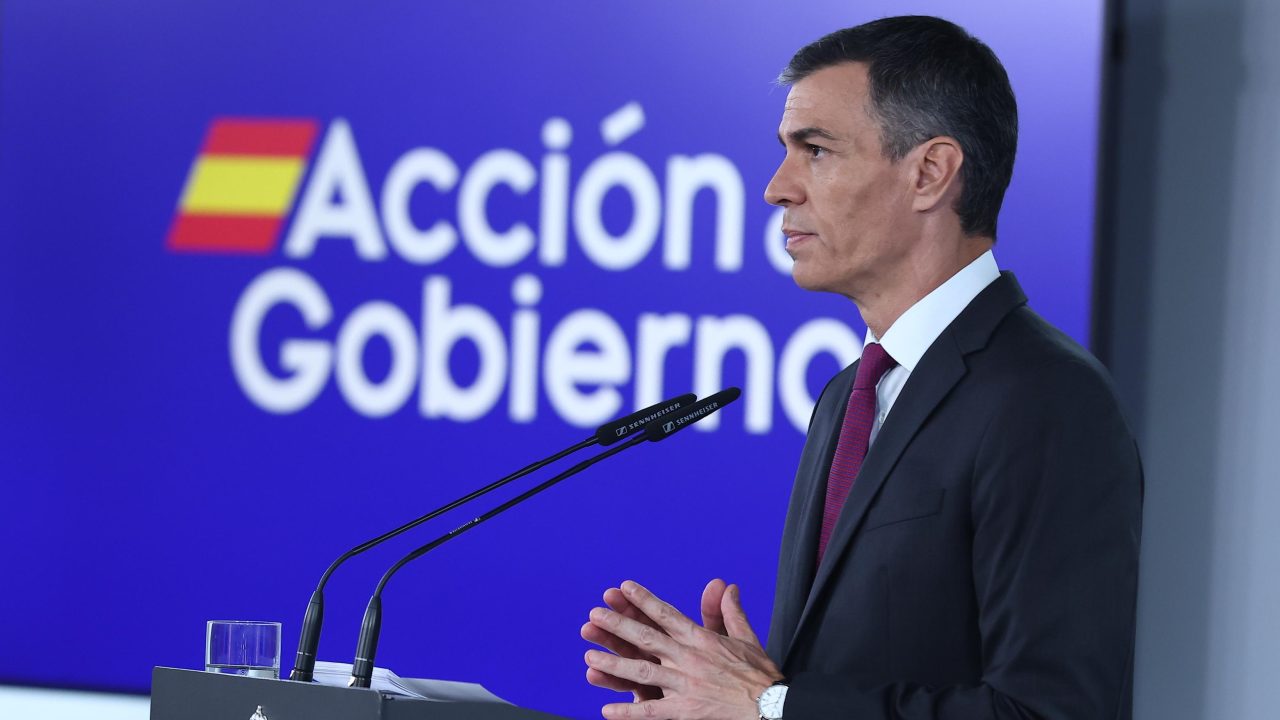
Caption: A handout photo made available by the Moncloa Palace of a video capture of Spanish Prime Minister Pedro Sanchez, delivers an institutional declaration at La Moncloa Palace, in Madrid, Spain, 22 June 2025. Sanchez said that the agreement reached with NATO not to spend 5% of GDP on defence allows Spain to meet its commitments to the Alliance without the need to increase its defence investment. EPA/FERNANDO CALVO / MONCLOA PALACE / HANDOUT
Updated: June 23, 2025 - 07:12