 Edit
Hungary’s Szijjártó: More member states are blocking North Macedonia’s EU accession
The Hungarian FM also strongly criticised the speed at which Ukraine’s accession was being promoted in Brussels
Hungarian Foreign Minister Péter Szijjártó denounced what he called double standards by the EU on the issue of enlargement, during a visit to Skopje, accusing not only Bulgaria but also other EU member states of misleading the public regarding North Macedonia’s path toward the Union.
At a joint press conference with North Macedonia’s Foreign Minister Timčo Mucunski on 14 June, Szijjártó stated: “If they truly wanted you to join the Union, you wouldn’t have been waiting 20 years for full membership.” He argued that despite the rhetoric of support, behind closed doors in meetings of the 27 member states, “supporters of enlargement are in the minority.”
The role of Bulgaria and the wider European landscape
He acknowledged that Bulgaria was “openly obstructing” North Macedonia’s EU accession efforts but stressed that this is not the only reason for the delays.
“Don’t be angry, but the situation is much more difficult. You haven’t been waiting twenty years because of Bulgaria, but because many countries say nice things to your face and something else behind closed doors”, he said.
Bulgaria insists that there is no bilateral issue concerning North Macedonia’s accession talks. Sofia says conditions are embedded in the EU’s negotiation framework, agreed in 2022, Bulgaria and North Macedonia reached a deal brokered by the French EU Presidency. Under the agreement, Bulgaria lifted its veto on Skopje’s EU path in exchange for constitutional amendments, which became a requirement at EU level for starting accession talks. However, the implementation has stalled due to opposition from VMRO-DPMNE, now leading the government in Skopje.
The Hungarian Foreign Minister criticised countries that “build walls” against enlargement while publicly appearing as its supporters. As he noted, the Hungarian presidency aims to accelerate the accession of the Western Balkan countries, but resistance within the EU remains strong.
Harsh criticism of Ukraine’s EU candidacy
But if there is a country “building walls” against EU elargement including Ukraine, this is certainly Hungary. At the presser Szijjártó strongly criticised the speed at which Ukraine’s accession was being promoted in Brussels, stressing that “many Western Balkan countries are more prepared and more developed than Ukraine.” He described as “unacceptable” the fact that Ukraine is being favored while the Western Balkans remain stagnant.
“We don’t want to import war into EU territory, nor to flood the market with low-quality grain from Ukraine,” he noted. He also stated, “We don’t want Hungary to become a transit zone for the Ukrainian mafia, nor do we want Hungarian taxpayers’ money to be sent to Kyiv.”
Hungarian Prime Minister Viktor Orban opposes Ukraine opening accession talks. The veto stems from domestic politics: with Hungary’s parliamentary elections set for April 2026, Orban is leveraging anti-Ukraine sentiment to rally voters. He portrays Ukraine’s EU membership as a “mortal threat” to Hungary, a narrative central to his campaign amid growing risks of electoral defeat.
Hungary’s veto propels Moldova toward EU membership, leaving Ukraine in limbo
Human rights violations and the Hungarian minority in Ukraine
Szijjártó raised the issue of minority protection in Ukraine, highlighting the “unacceptable situation” faced by the Hungarian community in the region beneath the Carpathians. He claimed that over the past ten years, the Ukrainian authorities have systematically restricted their rights.
“I cannot imagine an EU member state openly violating fundamental European values so brutally,” he stressed, adding that the Hungarian minority faces increasing restrictions in language use, education, public administration, and the media.
Strategic agreement between Skopje and Budapest
The visit concluded with the signing of a strategic cooperation agreement between North Macedonia and Hungary, with Szijjártó emphasizing that “support for EU enlargement toward the Western Balkans is a consistent position of Budapest, in contrast to the stance of many in Western Europe.”
Hungary’s support for the VMRO-DPMNE-led government in Skopje, under Prime Minister Hristijan Mickoski, reflects a strategic alignment rooted in shared nationalist and anti-Western sentiments, as well as Budapest’s broader agenda in the Western Balkans.
Since VMRO-DPMNE’s return to power in North Macedonia’s May 2024 elections, Hungarian Prime Minister Viktor Orbán has openly backed the party, praising its conservative policies and resistance to EU pressure over constitutional reforms demanded by Bulgaria for North Macedonia’s EU accession.
This support mirrors Hungary’s controversial role in 2018, when it facilitated the escape of VMRO-DPMNE’s former leader and prime minister Nikola Gruevski, who fled North Macedonia to avoid a nine-year prison sentence for corruption, including illicit property purchases and illegal demolition of a rival’s building. Granted asylum in Budapest, Gruevski’s case highlights Hungary’s willingness to shield fugitive politicians.
North Macedonia and Hungary are linchpins in China’s Piraeus-Skopje- Budapest railway, with Skopje as a transit hub and Budapest as the EU gateway. Initiated in 2014, the project has faced delays, cost overruns, and EU scrutiny, but remains a cornerstone of China’s strategy to enhance its economic influence in the Balkans and Central Europe.
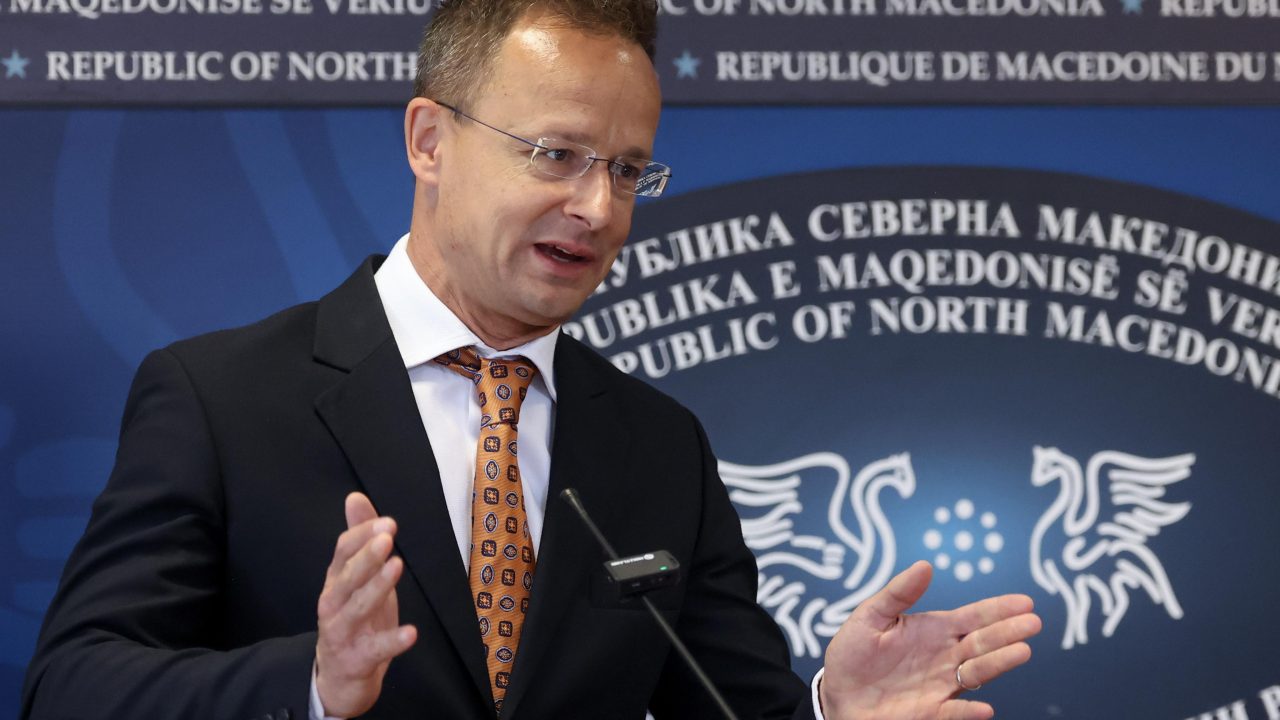
Caption: Hungarian Foreign Minister Peter Szijjarto speaks at a joint press conference with North Macedonia’s Foreign Minister Timco Mucunski (not seen) in Skopje, Republic of North Macedonia, 13 June 2025. Hungarian Foreign Minister Peter Szijjarto arrived for a one day visit to North Macedonia. [EPA/GEORGI LICOVSKI]
Updated: July 6, 2025 - 07:28