 Edit
EditSixteen EU countries sign up to cut red tape
Austria-led alliance targets gold-plating at home as capitals also press Brussels to pause and clean up existing law
Sixteen EU governments have signed a joint declaration in Brussels backing an Austrian-led “Alliance for the Reduction of Bureaucratic Burden.” The list includes Germany, Italy, the Netherlands, Sweden, Denmark and several central and southern European states. The launch was opened by Commission vice-president Valdis Dombrovskis. That detail alone should settle the first question: this is not a rebellion against the Commission.
16 EU Member States joined the launch of the Austrian State Secretary‘s efforts to reduce bureaucratic burden:
🇦🇹🇧🇪🇭🇷🇨🇿 🇩🇰🇩🇪🇬🇷🇭🇺🇮🇹🇱🇹🇳🇱🇵🇹🇷🇴🇸🇰🇸🇮🇸🇪
Read the Joint Declaration of the Alliance for the Reduction of Bureaucratic Burden👇https://t.co/BWAZ6PDkwL— Austria at EU (@AustriaatEU) September 22, 2026
It is something more useful and more typical of how the EU actually works. Member states cannot table legislation. The Commission still holds the exclusive right of initiative. What the capitals can do is coordinate, set political expectations, and police their own implementation. That is what happened this week, in two overlapping tracks.
The alliance itself is mainly about national homework. State Secretary Sepp Schellhorn’s argument is simple: governments spend years complaining about “Brussels bureaucracy” while adding extra layers when they transpose EU rules – the practice known as gold-plating – and rarely compare notes with one another. The declaration commits signatories to simpler national legislation, faster and cleaner implementation of EU directives, a “once-only” approach to data requests from businesses, and a standing network to swap what actually works. Schellhorn’s line captured the point: steal the good ideas, leave the bad ones at home, and stop putting the tape back on in 27 different ways.
A second, more ambitious document is circulating in parallel. An Austrian-led non-paper signed by 13 countries – including Germany, Italy, Poland and several Nordic and Baltic states – calls for a “European Implementation and Consolidation Year.” The idea is a sector-by-sector “deep cleaning” of existing EU law: keep what is needed, update what is outdated, and drop rules that impose cost without clear value. Some reporting has framed this as a request to pause new legislation for a year. That remains a political ask, not a decision. The Commission can ignore it, water it down, or use it as cover to do what it already claims it wants to do.
Important initiative by 🇦🇹 🇪🇺Minister @claudiabauer_at together with 13 MS 🇮🇹🇩🇪🇸🇰🇸🇮🇨🇿🇭🇺🇬🇷🇵🇱🇪🇪🇫🇮🇱🇻🇩🇰🇱🇹 to make simplification really work: 👉a year of consolidation and implementation. https://t.co/B82WsiUN9R pic.twitter.com/FCIIZv6GLT
— Austria at EU (@AustriaatEU) September 22, 2026
The timing is not accidental. Last week Ursula von der Leyen used her State of the Union speech to demand a “pact against gold-plating” and told member states to “step up.” The Commission has already put omnibus simplification packages on the table and set targets of a 25 percent cut in administrative burden, 35 percent for SMEs. The alliance declaration welcomes those efforts. In other words, the capitals are pushing the Commission further while accepting the Commission’s own diagnosis that a large part of the problem sits in national capitals.
That diagnosis has numbers behind it. The ECB has estimated that internal regulatory barriers inside the single market can act like a 45–60 percent tariff on goods. Austrian business groups put the domestic cost of bureaucracy at more than €21 billion a year. Those figures explain why competitiveness, not ideology, is the language everyone is using.
The article-worthy tension is not “member states versus Brussels.” It is whether a political coalition this broad can turn declarations into measurable cuts. France and Spain are not on the published 16-country list. Several signatories have mixed records at home. Austria itself has been accused of being a gold-plating champion, a point Schellhorn now openly concedes. A network that only meets once a year and produces another communiqué will change nothing. A network that forces ministries to justify extra national requirements, copies successful simplifications across borders, and keeps pressure on the Commission’s work programme could.
The substance is therefore real: a majority-sized coalition, a Commission-aligned political window, a concrete economic case, and a split between EU-level cuts and national add-ons that every government has promised to fix and few have. Whether it becomes more than a well-timed press event will be visible in two places. First, in how the Commission treats the “consolidation year” request in its next work programme. Second, in whether the 16 governments actually stop adding national rules after they sign the paper that says they will.
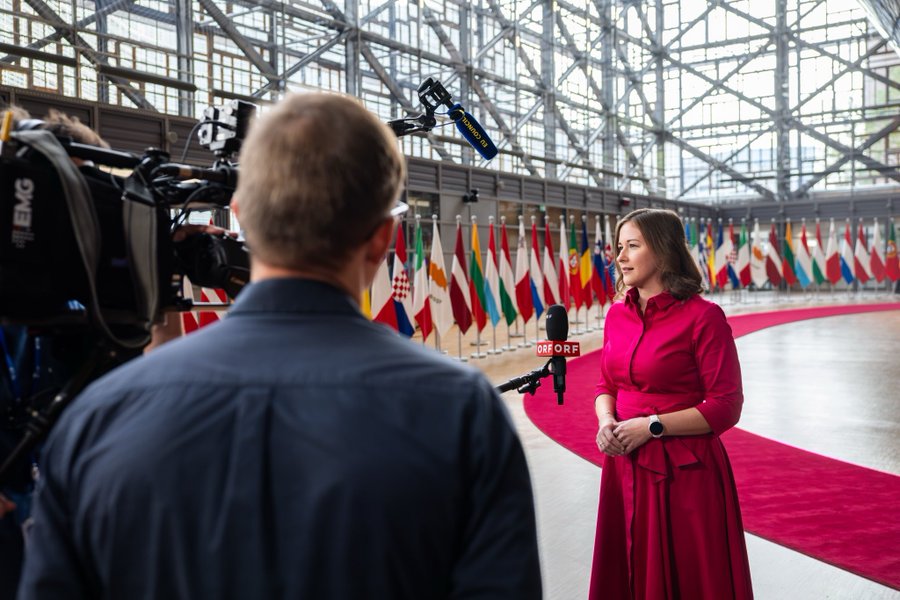
Caption: Austrian minister for Europe Claudia Bauer [@AustriaatEU on X]
Updated: September 22, 2026 - 16:26