 Edit
A journalist’s blunder that served Moscow well
Journalists who insert themselves so aggressively into the story they cover, as Michael Martens from FAZ did, do not serve their readers
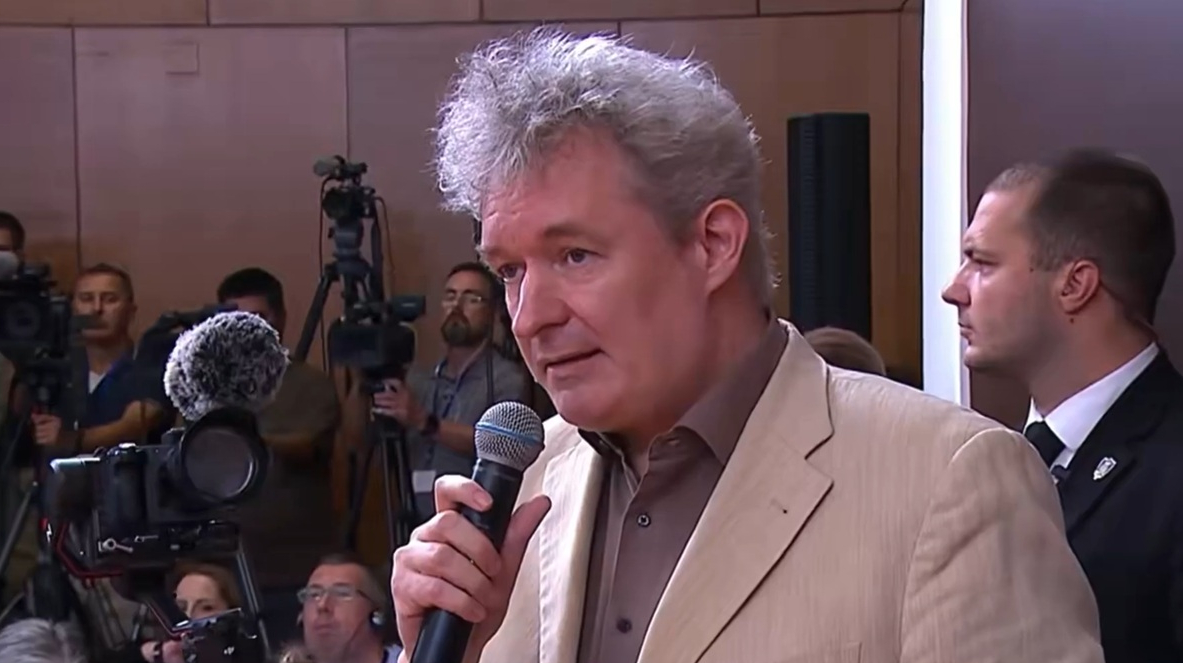
There is something deeply unsettling about watching a reporter seize the stage from the very leaders he is meant to scrutinize. At the joint press conference of Ukrainian President Volodymyr Zelenskyy and Serbian President Aleksandar Vučić in Belgrade on 8 August 2026, Frankfurter Allgemeine Zeitung correspondent Michael Martens did precisely that. His question – “What can we Europeans do to help you kill more Russians… more Russian soldiers, of course?” – was not merely clumsy. It was grotesque. And in one stroke it transformed a carefully choreographed diplomatic encounter into a propaganda gift for the Kremlin.
A journalist’s role is to extract information, test claims, and illuminate power. It is not to become the protagonist. Yet that is exactly what happened. The video of Martens posing the question rapidly eclipsed the substantive exchanges between Zelenskyy and Vučić. The politicians faded into the background; the reporter filled the frame. That inversion of roles is a professional failure of the first order.
Worse, the phrasing handed Russian propagandists a ready-made exhibit. Moscow has long peddled the claim that the West seeks not merely Ukraine’s survival but the destruction of Russia itself. Martens’ words – spoken by a German correspondent of a leading European newspaper – supplied the soundbite they needed. The subsequent amplification by Russian state media and officials was predictable. The incident continues to reverberate precisely because it appears to confirm a narrative that is otherwise false. One poorly chosen sentence can do more damage than a carefully drafted communiqué can repair.
To add insult to injury, Michael Martens’ grandfather, Hans-Hermann Martens, was a Nazi Party (NSDAP) and SA member who was appointed a state prosecutor by Hitler in 1936 and, from 1941, served as an officer in the operations department of the Wehrmacht High Command staff (Wehrmachtführungsstab) under Alfred Jodl; he occasionally attended Hitler’s table talks and later acted as a military judge who imposed death sentences on deserters. Russian officials, led by Foreign Ministry spokeswoman Maria Zakharova, seized on this family history after the Belgrade press conference, branding Martens a “descendant of a Nazi,” an “hereditary Nazi,” and a “brown propagandist” whose question about killing Russian soldiers supposedly revealed an unbroken Nazi lineage and the true intentions of the West.
Context matters. In Aleksandar Vučić’s Serbia, major press conferences are rarely exercises in spontaneous inquiry. Questions are frequently pre-arranged, journalists selected, and themes coordinated. This is not free journalism; it is managed political theatre. That Martens was given the floor suggests either an intentional choice or a failure of control. In either case, Vučić’s government bears indirect responsibility for the optics that followed. When staged propaganda malfunctions, the resulting embarrassment is shared.
The Frankfurter Allgemeine Zeitung has since expressed regret, stating that the question was badly formulated and clarifying that it is not the paper’s editorial position that as many Russian soldiers as possible should be killed. The paper reaffirmed support for Ukraine’s right of self-defence under international law and for an end to Russia’s war of aggression. That clarification was necessary and welcome. Yet the damage was already done. A newspaper of FAZ’s standing should not have to issue such a statement after one of its correspondents has spoken on its behalf in such terms.
Wars are brutal. Ukraine has every legal and moral right to defend itself, and Western support for that defence remains justified. But the language of total annihilation, even when later qualified, is not the language of responsible journalism. It coarsens public debate, hands ammunition to adversaries, and distracts from the real strategic questions: how to sustain Ukrainian resilience, how to impose costs on the aggressor, and how to create conditions for a durable peace.
Martens’ question was a blunder. It was hideous, professionally damaging, and geopolitically counterproductive. Journalists who insert themselves so aggressively into the story they cover do not serve their readers, their craft, or the cause of clarity in a time of war. They merely hand the other side a convenient script.
Caption: Videograb of recording showing journalist Michael Martens ask his grotesque question. [EUalive]
Updated: August 11, 2026 - 11:11