Edit
In the service of the Kremlin: who is imposing the “Alternative” on Germany and promoting Russian narratives
Hybrid media in Germany are named in a publication by EUalive’s partner media European Pravda
Recent media attention has focused on dubious bot-farm activity graphs that emerged after disruptions at Russia’s Yandex. Following Ukrainian Defence Forces strikes on data centres in the Russian Federation, Cloudflare – the global cloud platform that acts as an intermediary between website visitors and servers – recorded a drop in automated traffic originating from Yandex.
This sparked discussion of unverified screenshots showing bot activity in support of the Alternative for Germany (AfD) party. Those screenshots were later debunked. However, there is verified data on another component of Russia’s disinformation network in Europe – specifically the German-language segment operating in Germany and Austria. These are pro-Russian websites that, alongside promoting Kremlin disinformation and misinformation narratives, actively support the AfD.
The destructive influence of the resources we analysed is not limited to routine backing of this far-right party. Their tasks are clearly broader. Alongside open promotion of the AfD, these platforms relay Kremlin conspiracy theories – from myths about the “dominance of globalists” to fairy tales about the “decay of Old Europe.” This aligns with statements by Putin himself, who has claimed that the AfD’s success results from the systemic mistakes of “Western globalists” and Europeans’ growing awareness of the risks of being drawn into a war with Russia – risks he attributes, of course, to the policies of current European leaders.
The scale of this information network is clear from traffic analysis of a range of websites and their content. The sites include both large platforms with audiences in the millions and niche satirical outlets. The danger of the latter lies not in mass reach but in their role in targeted GRU/FSB special operations or other hybrid activities, where the media outlet serves merely as a façade for legitimising Russian political influence and financial flows.
Unser Mitteleuropa
This outlet (whose name translates as “Our Central Europe”) carefully cultivates the image of a free volunteer project. In its regular reviews, however, it unreservedly portrays the AfD as a saving “breath of fresh air.” The editorial team tirelessly whitewashes the far right against criticism from traditional German media, arguing that any pressure on the party only works in its favour. The democratic camp is shamelessly branded a “dictatorship,” while AfD figures are presented as innocent victims of political repression.
In one piece, an author stated outright that all pressure on the party stems solely from the fact that the AfD, unlike its opponents, seeks to avoid war with Russia. Pure PR is not the limit. Unser Mitteleuropa generously feeds its audience premium obscurantism: conspiracy theories about the harm of 5G towers, anti-vaxxer nonsense about COVID-19, and other disinformation viruses.
In one recent publication the site alleged American intelligence influence on Europe through the cultural sphere. The site records 82,000 monthly visits according to the Similar Sites platform (subsequent traffic figures in this article are also from this platform).
Notably, long before the full-scale invasion the resource coordinated the creation of a pool of right-wing media, uniting more than 25 outlets of varying degrees of radicalism under the banner of “European Media Cooperation.” The founder of the site is the Hungarian János Bencsik. At the time of the portal’s launch he was a member of the openly pro-Russian Hungarian party Jobbik. Bencsik was also the publisher of the provocative resource Kárpát Hír, aimed at the Hungarian minority in Ukraine’s Zakarpattia region, through which Kremlin disinformation was systematically injected to fuel separatism.
The formal leader of the aforementioned “European Media Cooperation” was the Austrian Peter Gauer (who died in November 2021). In 2020 he stood trial in Austria on charges of violating the law banning Nazi organisations. He was acquitted, but during the hearings Gauer openly admitted that he had created Unser Mitteleuropa together with “Hungarian friends” and that he also worked for Stefan Magnet – a figure discussed separately below.
Report24
This Austrian platform systematically and cynically exploits the topic of the war in Ukraine, shifting responsibility from the aggressor to the victim. Readers are persistently fed the myth of the AfD as the “only pacifist force” capable of bringing peace. Speakers from the far right are given an open platform for any provocations. The site’s traffic is substantial – more than 432,000 monthly visits.
On 22 October, Report24 published an article accusing the SPD, CDU and the Greens of an alleged attack on the Alternative for Germany. The connection between Report24 and Russia is obvious. The outlet is registered in Linz, Austria, at the same legal address (Steingasse 6A) as the odious pro-Russian projects AUF1 and Info-Direkt.
In July 2022, AUF1 promoted the claim that Russia had merely pre-empted a planned invasion of Ukraine by the United States and its allies. Representatives of Info-Direkt travelled to Russia and occupied Crimea, after which corresponding materials appeared in the magazine.
The founder of AUF1 is the aforementioned Stefan Magnet — a long-standing and sincere Kremlin supporter who regularly travels to Moscow and publicly praises Putin’s policies. A 2019 column by Stefan Magnet appeared in the bilingual magazine Art & Business. That magazine was published in Austria under the leadership of Natalia Holzmüller, organiser of the annual Russian Ball in Vienna (Russischer Ball in Wien), which attracted representatives of Austrian and Russian political, cultural and business circles.
Just before such a ball in 2015, Stefan Magnet personally presented the fifth issue of the Info-Direkt magazine. Publicly he denied any formal links to the publication, but facts are stubborn. The cherry on top: since 2016 the Info-Direkt servers have been physically located on Russian territory. The question of who actually administers these processes answers itself.
Journalistenwatch
This is a classic example of manipulative framing. The site focuses all audience attention on migration issues, artificially attributing any internal problems of modern Germany exclusively to refugees. Naturally, the AfD is presented as the sole saviour for Germans. Journalistenwatch has an audience of more than 574,000 monthly visits.
The main leitmotif of its publications is that the current German government is “anti-people and undemocratic,” while a powerful state repressive machine is allegedly working against the AfD. The editor of this mouthpiece is Max Erdinger, a long-time author for the German branch of the Russian state propaganda network RT (Russia Today). Even after the full-scale invasion, Erdinger shamelessly argued that sanctions against Russia were imposed by the United States with the sole aim of destroying German industry.
In one recent publication illustrated with Chancellor Merz against a Ukrainian flag, the main thesis was that to end the war Ukraine must hand over the territories occupied by Russia. The domain belongs to Daniel Matissek — a staff member of the aforementioned Report24. Russian involvement is not even concealed; it sticks out demonstratively from every piece of material.
PI-News
In practice this is an aggressive blog (the name stands for Politically Incorrect News), which the German Federal Office for the Protection of the Constitution officially classified as right-wing extremist in 2021. Its main profile is incitement of hatred, Islamophobia and anti-migrant propaganda. The site records more than 850,000 monthly visits.
Under the sauce of “fighting political correctness,” it continuously attacks Ukraine, smears the German government and demands the restoration of business with Moscow. The only role models held up are AfD leaders — and previously the then pro-Russian Hungarian prime minister Viktor Orbán. AfD party functionaries themselves often publish their own pieces here, praising like-minded people.
PI-News was founded by Stefan Herre, who long worked in the office of AfD MEP Petr Bystron – the same individual whose parliamentary immunity was lifted in stages in 2024–2025 by the Bundestag and the European Parliament amid investigations into the laundering of Kremlin money in exchange for “useful” votes. The financing scheme closed on the well-known Putin crony Viktor Medvedchuk and his network of agents of influence centred on the Voice of Europe project.
COMPACT
This is the flagship of far-right propaganda, created by Jürgen Elsässer. The set of manipulations is standard: hunting migrants, fighting “globalism,” praising the AfD and demonising NATO, which is portrayed as the aggressor in contrast to “peace-loving” Russia. The site has an audience of more than 281,000 monthly visits.
In March 2022, immediately after Russia’s invasion of Ukraine, COMPACT launched a large-scale campaign “Frieden mit Russland” (“Peace with Russia”). Elsässer openly calls for Germany’s withdrawal from NATO, an end to support for Ukraine and the complete lifting of sanctions against the aggressor.
Naturally, Jürgen Elsässer is a regular at receptions in the Russian embassy in Berlin. On 7 October 2025 the outlet presented there a silver medal “Patriot Wladimir Putin,” minted for the “patriot’s” 73rd birthday.
QPress
Despite its small audience, this resource also deserves attention. QPress appears in reports by the NATO Strategic Communications Centre of Excellence (StratCom) as a participant in coordinated Russian information special operations. In particular, it was actively used to sow doubt and provide cover for Moscow after the Novichok poisoning of Alexei Navalny.
Similar Sites does not index the site at all because of low traffic volumes. Another service, Ahrefs, records about 1,300 visits and 1,900 page views per month. The resource disguises itself as satire, supposedly fighting the “absurdity of everyday life.” In reality it pushes the typical agenda: support for the AfD, distortion of reality and attacks on the German political class.
In one recent publication the site criticised investments by German defence companies and spread antisemitic narratives. (Rausmetall, incidentally, is the name of an anti-militarist protest initiative and political slogan in Germany directed against the expansion of the defence industry, the rearmament of the Federal Republic and, specifically, the activities of the German defence concern Rheinmetall. The name is a pun: Rheinmetall + raus (“out,” “away”). In political context it can be translated as “Rheinmetall — out!”)
Overton-magazin.de
The paradox of this resource is that it declares left-wing views. One might wonder what the left has to do with the far-right AfD, but the horseshoe theory of politics works flawlessly: the site regularly publishes columns defending the AfD, seasoned with scaremongering that any attempt to ban the party will inevitably lead to civil war in Germany. The site has quite decent traffic — more than 211,000 monthly visits.
The authors of the resource are closely linked to Russian state structures. In particular, Ulrich Heyden permanently resides in Moscow and writes for RT, regularly producing reports from occupied Ukrainian territories in which he cynically justifies Russian war crimes.
One of the latest publications on the site is devoted to NATO “expansionism” and its alleged fuelling of conflicts. An illustration of Russia surrounded by the Alliance eloquently indicates the content and messages of the article “NATO Expansion Is in Full Swing.” The author writes: “Even without Ukraine, NATO continues its course of expansion. It seems as if all the efforts of the United States aimed at reaching an agreement with Russia are intended only to mask this reality.”
Time to take off the white gloves
All the key information pillars on which the AfD’s electoral success is built have a clear, undisguised and documentarily proven connection with the Kremlin. The chain is unbroken: from shared talking points and servers on Russian territory to visits to the Russian embassy, awards from Putin and cash received through Medvedchuk-style schemes.
These media outlets are not merely engaged in disinformation under the flag of a so-called “alternative point of view.” They legitimise agents of influence and create a convenient socio-political elevator for pro-Russian forces straight into the German parliament. By blurring facts, pumping the electorate with conspiracy theories and fear of invented dangers, Moscow generates demand for controllable marginal forces whose vocation is to destroy the unity of the Federal Republic of Germany and subordinate it to the interests of the aggressor.
For official Berlin the time has come to take off the white gloves. Monitoring content from StratCom or public lectures on media literacy is no longer enough. Instruments of financial control, “sanctions lists” for media – up to the opening of criminal proceedings for financing anti-state activity and the seizure of assets – must be brought into play. The impunity of Kremlin mouthpieces in Europe is fed exclusively by the slowness of Western bureaucracy.
About the authors:
Oleksandr Liemienov is a serviceman, Chairman of the Board of StateWatch
Volodymyr Cherchyk is an analyst of disinformation and hybrid influences
The article in Ukrainian by EUalive’s partner European Pravda can be found here.
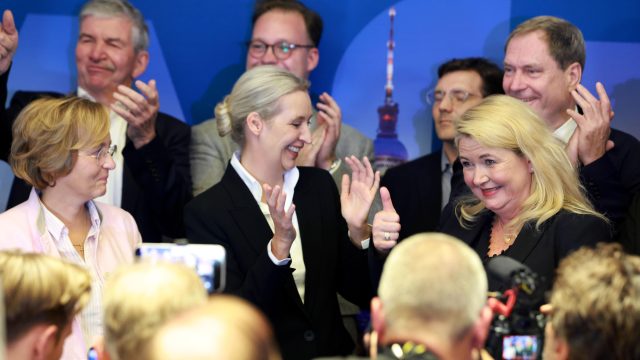
Caption: Alternative for Germany (AfD) party and parliamentary group co-chairwoman Alice Weidel speaks during a media statement on the occasion of a meeting of the AfD parliamentary group in Berlin, Germany, 06 October 2026. EPA/CLEMENS BILAN
Updated: October 23, 2026 - 06:45