 Edit
EditDefiance and division: Spain’s opposition to U.S.-Israel action on Iran deepens Europe’s internal rift
The European Commission and France have firmly backed Madrid amid its escalating dispute with the United States over trade threats from President Donald Trump
The U.S. and Israeli military operation against Iran, which began over the weekend of 28 February has drawn varied responses from European capitals, ranging from cautious support to outright condemnation. At the center of this rift stands Spanish Prime Minister Pedro Sánchez, whose firm opposition has provoked sharp rebukes from U.S. President Donald Trump and highlighted broader tensions over sovereignty, international law, and economic coercion.
Sánchez emerged as the most vocal critic among EU leaders from the outset. On 28 February he posted on X that Spain rejected “the unilateral military actions of the United States and Israel, which constitute an escalation and contribute to the emergence of a more uncertain and hostile international order.” This stance extended beyond rhetoric: Madrid explicitly denied U.S. requests to use jointly operated military bases in Rota and Morón for operations related to the strikes on Iran. As a result, the U.S. relocated 15 aircraft, including vital air tankers, from these southern Spanish facilities to other locations, such as Ramstein in Germany.
The Spanish refusal triggered an immediate and furious response from Trump. During a joint press conference with German Chancellor Friedrich Merz on Tuesday, Trump lambasted Spain, declaring that it “has behaved terribly” and announcing that he had instructed Treasury Secretary Scott Bessent to “sever all ties” and “cut off all trade with Spain.”
He added, “We want nothing to do with Spain,” and floated the possibility of a full embargo, though without specifying details. Trump also tied the dispute to longstanding grievances, noting Spain’s resistance to increasing NATO defence spending to 5% of GDP, a target he had pushed aggressively, and contrasting it with what he claimed was enthusiastic compliance from other European nations, including Germany.
Trump threatens to cut all trade with Spain during meeting with Germany’s Merz
On Wednesday, French President Emmanuel Macron spoke by phone with Sánchez to express France’s “European solidarity” in response to Washington’s recent threats of economic coercion against Madrid. Macron emphasized the need for EU member states to close ranks and unite in defending any targeted member – potentially responding collectively if the U.S. follows through on its warnings.
The European Commission echoed this support, declaring the EU in “full solidarity with all member states” and standing “ready to act if necessary” through its common trade policy to safeguard the bloc’s interests against any external pressure.
The U.S. attacks on Iran have deeply divided Europe, exposing fractures within the transatlantic alliance and among EU member states as the conflict escalates in the Middle East.
European solidarity amid transatlantic strain
Merz, while acknowledging Spain’s shortfall on defence commitments, pushed back diplomatically. He informed Trump that excluding a single EU member from trade agreements was impossible, given the bloc’s common commercial policy. This intervention underscored the limits of unilateral U.S. action against individual European countries.
France’s President Emmanuel Macron quickly rallied to Sánchez’s side. In a telephone call, Macron expressed solidarity, with the Élysée Palace stating that “EU countries should unite against Washington if Trump attempts to implement his threats.”
He emphasized European unity in the face of economic coercion. Although the E3 group (France, Germany, and the United Kingdom) had initially issued a measured statement on the day after the strikes – pledging cooperation with the U.S. and allies while not ruling out proportionate defensive actions – Macron later shifted tone. He condemned the U.S. and Israeli attacks as a violation of international law that “cannot be supported,” reflecting a view that Europe must speak with one voice when one member faces pressure.
The Atlanticist-pragmatic camp
At the other end stands the United Kingdom, which has moved from initial hesitation to active defensive cooperation. Prime Minister Keir Starmer has authorised the use of British bases (including Akrotiri in Cyprus) for US defensive operations against Iranian missiles and drones, while condemning Tehran’s “indiscriminate and disproportionate” attacks on Gulf states.
The UK frames its role as protecting allies and British interests without crossing into offensive regime change – a position that has drawn Trump’s public frustration but maintains operational closeness.
Germany has tilted noticeably toward this camp. Merz has explicitly stated it is “not the time to lecture our partners and allies,” voiced support for the ultimate goal of removing the Iranian regime, and avoided criticising the initial strikes. Berlin is ready for “proportionate defensive measures” and sees the conflict through the lens of broader transatlantic and Ukraine-related strategy.T
his pragmatic axis includes several Central and Eastern European states that view firmness toward Iran as linked to containing Russia: Poland, the Czech Republic, the Baltic states (Estonia, Latvia, Lithuania), and Romania have strongly condemned Iranian retaliation and expressed support for allied defensive action.
Italy under Giorgia Meloni has offered naval reinforcements (including consideration of the destroyer Caio Duilio) to protect Cyprus and Gulf partners, while Greece has dispatched frigates and F-16s to defend Cypriot airspace and territory. The Netherlands and Denmark have similarly aligned with defensive solidarity.
The EU institutions caught in the middle
The broader European Union institutions have tried to thread the needle with calls for “maximum restraint,” respect for international law, and renewed diplomacy (led by Ursula von der Leyen, Antonio Costa, and Kaja Kallas). Yet the bloc has failed to produce a unified position: the E3 joint statements have been tougher on Iran’s retaliation than the full EU-27 consensus, revealing the limits of common foreign policy.
The divide is not merely rhetorical. At its core, the Iran war has reopened old European fault lines: differing historical lessons (Iraq 2003 vs. the need to confront authoritarian threats), varying threat perceptions (Iranian missiles and drones vs. risks of uncontrolled escalation), and attitudes toward U.S. leadership in the Trump era. The result is a fragmented European voice at a moment when the conflict threatens energy security, NATO cohesion, and regional stability.
Sources: Focus Europe.it, EFE
Trump threatens to cut all trade with Spain during meeting with Germany’s Merz
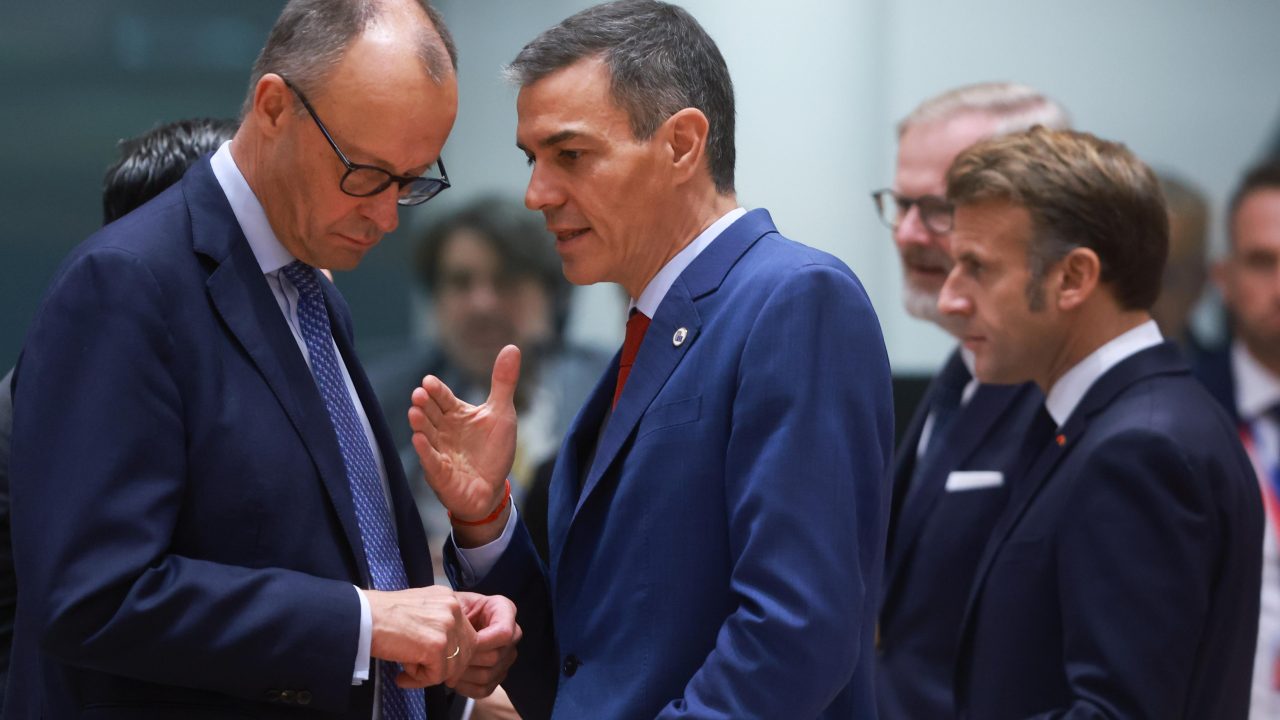
Caption: (L-R) German Federal Chancellor Friedrich Merz, Spain’s Prime Minister Pedro Sanchez, and French President Emmanuel Macron attend the European Council Summit in Brussels, Belgium, 23 October 2025. European leaders will discuss financial support for Ukraine in the coming years, European defence, recent developments in the Middle East, and how the EU can support ongoing efforts toward a just and lasting peace. EPA/OLIVIER HOSLET
Updated: March 5, 2026 - 12:57