 Edit
“Serbian World” in Podgorica? The push for Serbian as official language tests Montenegro’s sovereignty
The two languages are closely related, but they risk becoming a geopolitical battleground affecting Montenegro's EU path
What is the official language of Montenegro? Or are there more languages than one? Is it Montenegrin, but also Serbian? These are not irrelevant questions.
The next parliamentary elections in Montenegro are scheduled to take place before 30 June 2027, yet the political atmosphere already feels like an active campaign season.
A major point of contention revolves around the status of the Serbian language, reignited by the results of the 2023 census (published in October 2024). Pro-Serbian parties in the ruling coalition, leveraging these figures, are pushing for constitutional amendments to elevate Serbian to official language status alongside Montenegrin, which has been the sole official language since the 2007 Constitution. Serbian, along with Bosnian, Croatian, and Albanian, currently holds the lesser status of a language in official use. Such a change would require a two-thirds majority in parliament, making it a highly contentious issue that tests the stability of the governing coalition.
According to official data from MONSTAT, Montenegro’s population stands at 623,633, marking a modest 0.6% increase since 2011. Ethnically, 41.12% of citizens identify as Montenegrin, while 32.93% identify as Serb – an increase of about four percentage points for Serbs compared to the previous census. In terms of language, 43.18% declared Serbian as their mother tongue (up slightly from 42.8% in 2011), while 34.52% named Montenegrin (down from around 37%).
The linguistic differences between standard Montenegrin and standard Serbian are very small. They are both based on the Serbo-Croatian language system – the same umbrella that also includes standard Croatian and Bosnian. The two varieties share virtually identical core grammar and syntax, the vast majority of vocabulary, and full mutual intelligibility – speakers understand each other effortlessly, much like British and American English speakers do.
Because the two languages are so closely related, they often become the subject of a geopolitical battleground – this time possibly affecting Montenegro’s EU path. Certain pro-Serbian circles promote the idea that Montenegrin and Serbian are essentially the same language to support the “Serbian World” (Srpski svet) concept – a geopolitical vision advocating cultural and political unity among Serbs across borders, with Belgrade as the center of gravity. Critics view this as an attempt to question Montenegro’s full sovereignty and cultural distinctiveness.
EP rapporteur: “Serbian World” is dangerous for the European Union and the Balkans
Prime Minister Milojko Spajić, leader of the centrist Europe Now! movement, has headed the government since autumn 2023. His coalition includes pro-Serbian and pro-Russian figures such as Andrija Mandić of the New Serbian Democracy (who serves as parliamentary speaker since October 2023) and Milan Knežević of the Democratic People’s Party (DNP). Mandić and Knežević have long been vocal supporters of close ties with Serbia and Russia, while expressing skepticism toward Montenegro’s 2006 independence from Serbia, its 2017 NATO membership, EU integration, Kosovo’s independence, and recognition of the Srebrenica genocide. Their positions often challenge core elements of Montenegrin statehood and civic identity as promoted since independence. Diplomats in Podgorica say Mandić is the most powerful politician in the country.
Serbian President Aleksandar Vučić recently weighed in on the debate during a 13 January visit to Abu Dhabi. He described the push for Serbian language rights as a “legitimate struggle” for the Serbian people in Montenegro, where the language is dominant according to census data. Vučić pledged Serbia’s ongoing support for linguistic protections while emphasizing that the final decision rests with Montenegrin authorities. He suggested that the current government’s response might mirror the resistance seen under former leader Milo Đukanović – perhaps publicly hedging with claims of lacking a majority, while avoiding direct interference in other matters.
Within the coalition, tensions have escalated. Knežević has issued strong ultimatums, stating that the DNP will withdraw from the government if Prime Minister Spajić’s administration fails to advance initiatives for constitutional recognition of Serbian as official, adoption of the tricolor (similar to the Serbian flag, the current flag being mostly red) as a national symbol, changes to citizenship laws, and dialogue on local issues such as events in Botun and wastewater infrastructure. The DNP leadership has already approved such a decision in principle, though it led to one party functionary leaving in protest. Deputy leader and Transport Minister Maja Vukićević echoed this stance, stressing that the party will not wait indefinitely and expects progress within a reasonable timeframe rather than postponement until after future elections.
Mandić has defended the coalition’s durability, insisting that the current majority could endure beyond 2027 if it governs effectively. He argued that promoting Serbian as official language would not derail Montenegro’s EU path and could even benefit the Union by introducing the language upon accession. Mandić highlighted broader progress since 2020, including lower unemployment, reduced public debt relative to 2019 levels, higher personal incomes and pensions, and greater freedom of expression compared to the more disciplined, one-party-dominated era before.
Critics, however, view these demands as discriminatory and ideologically driven. Linguist Professor Jelena Šušanj, a former member of the Expert Commission for the Standardization of the Montenegrin Language, has condemned the push to prioritize Serbian over other languages in official use. She argues that elevating Serbian would marginalize Montenegrin, Bosnian, Croatian, and Albanian, reflecting not statistical realities but a nationalist agenda to assert Serbian primacy and portray Montenegro as inherently a Serbian state – an approach she describes as chauvinistic and contrary to the country’s civic foundations. Šušanj emphasizes that official language status is not strictly tied to speaker numbers in many countries. Montenegro’s Constitution deliberately grants primacy to Montenegrin as the language named after the state itself, while recognizing others in official use.
This ongoing debate underscores Montenegro’s persistent identity divisions, which put at risk the country’s perceived front-runner position on its way to EU accession.
Analyst warns: Serbia may try to derail Montenegro’s EU advancement
Source: EUalive’s partner Antenna-M.
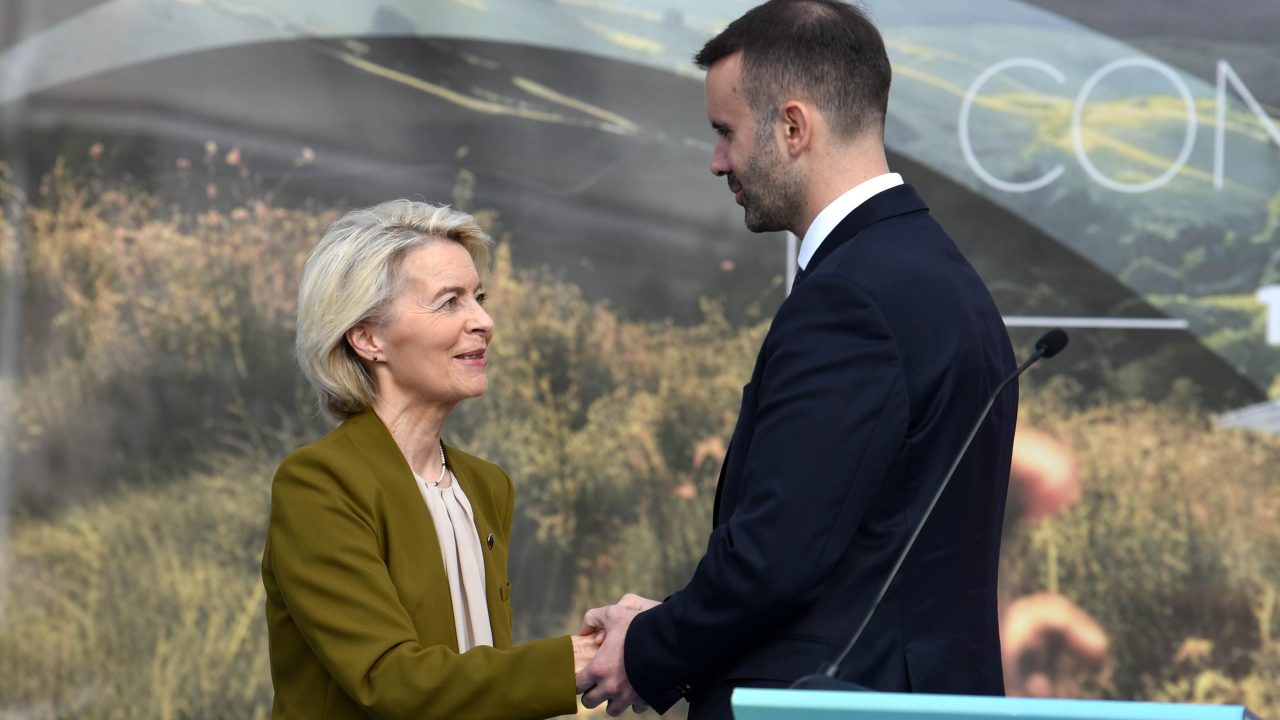
Caption: Montenegro’s Prime Minister Milojko Spajic (R) and EU Commission President Ursula von der Leyen (L) shake hands at the ‘Smart Growth, Green Future: Acceleration of Investments in Montenegro’ conference in Lustica, Montenegro, 14 October 2025. Von der Leyen is in Montenegro to attend the conference as part of her tour of Western Balkan countries. EPA/BORIS PEJOVIC
Updated: January 18, 2026 - 11:27