 Edit
Von der Leyen’s defiance: a lost chance for transparency and reform
The Commission President’s effrontery squandered a chance to restore trust, leaving her perched atop a shaky pedestal
From the outset it was always highly improbable that the motion of censure against the von der Leyen Commission on which the EU Parliament voted on 10 July would succeed. The two third majority required to unseat the Commission did not exist. Victory for the Commission President was baked in.
The vote, however, highlighted the growing cracks in the Coalition in the European Parliament that produced the second von der Leyen Commission. While the Commission survived the day it would be foolhardy for it to assume that the vote on 10 July gave it a mandate to ‘carry on regardless’. Whether that message ‘lands’ with the Commission is questionable.
Numbers and body language
The voting from the Strasbourg debate tells an interesting story. On 18 July 2024 just under twelve months earlier, 401 MEPs, 56% of the Parliament’s membership supported von der Leyen’s return to the Commission Presidency. This was by no means a ringing endorsement, just under 40% opposed the Commission.
In Thursday’s vote half the members of the Parliament, 360 of them, voted against the motion, effectively supporting – albeit grudgingly in many cases – the von der Leyen II Commission. Just under a quarter of the Parliament’s members voted for censure and the remaining Parliament’s Members either abstained or chose not to vote. These are not good numbers for a Commission just over seven months into its term.
Comparisons with previous votes to oust Commission leaders demonstrate just who dismal the figures are. In the November 2014 the vote to censure the Juncker Commission arising from the “Lux Leaks” revelations was rejected by 61% of MEPs. It was supported by 13.4 % of the Parliament with the remaining MEPs either not participating or abstaining. The 2005 attempt to unseat José Manuel Barroso was rejected by 80% of the Parliament with less than 5% supporting censure.
During the censure debate the body language in the Parliament also spoke volumes. While President von der Leyen’s response to the motion won applause, the clapping was weak, often pro forma. MEPs from outside the EPP group who had committed to rejecting the censure motion looked decidedly uncomfortable. Some discomfort was also evident within the EPP ranks.
Speaking in the debate, the S&D leader while attacking the censure motion as “not an act of scrutiny (but) a reactionary assault on the heart of the European project” made her the group’s discontent with the Commission President clear. After the debate a Vice Chair of the Parliament from the S&D Group commented that many colleagues are determined that this will be the “absolute last chance” for von der Leyen. In her contribution the leader of the Renew group suggested the Commission had become “centralised” “stiff” and ‘not agile,’ warned President von der Leyen “don’t take anything for granted”, to “put your own political house in order” and “get a grip” and made clear that continued support for the President was not unconditional.
Leadership style
When von der Leyen succeeded Jean-Claude Juncker in December 2019 a Presidency with transparency at its core was promised.
From the outset the von der Leyen leadership style has been questioned. There has been unease that the collegial approach of previous Commissions has been systematically eroded. The President has been accused of being controlling, sidelining Commissioners who did not align with her views and of the centralisation of decision making. When the present Commission was being assembled after the 2024 elections von der Leyen was accused of plotting to ensure that dissenting voices from her first term were not renominated.
In the run up to the 10 July debate Michel Barnier provided additional commentary on the President’s leadership style, accusing her of “overseeing an authoritarian drift”, as trying to personally control all political decisions and of reducing the Commissioners to “super technocrats” rather than harnessing their range of experience.
The Pfizer texts
The Commission’s response when the Pfizer CEO Albert Bourla revealed that exchanges relating the supply of Covid-19 vaccine had been conducted by text message was extraordinary – it ducked for cover. Rather than providing an explanation for what had happened, why text messages were the chosen route for communication or why access to the messages should be denied, it did all in its power to draw a veil of secrecy around the affair. Access to the texts was refused. When the EU Ombudsman intervened she was told that the Commission “did not hold the text messages”. The Ombudsman’s recommendation that the President’s office should make a search for the missing texts was not followed: her finding of maladministration had no impact.
In May the EU General Court took the drama a step further. Responding to an appeal taken by the New York Times, the Court annulled the EU Commission decision to deny access to the text messages exchanged between the Commission President and the Pfizer CEO.
EU court rules against von der Leyen in Pfizer case, exposing her fragility amid mounting challenges
The Court took the view that the denial of access had been “based either on assumptions or on changing or imprecise information.” It concluded that the New York Times had successfully rebutted the Commission’s presumptions of “non-existence and of non-possession of the requested documents.” It also questioned if the Commission had clarified whether the messages had been deleted and questioned why the Commission had taken the view that the message exchanges did not contain important information. It basically questioned the Commission’s truthfulness.
The Commission’s response was intriguing. Rather than accept the Court’s findings it gave an undertaking to “closely study the General Court’s decision […] decide on next steps” (and) “adopt a new decision providing a more detailed explanation”. That is expected shortly. It will make for interesting reading.
Pfizergate not a ‘one off”
The Pfizergate affair is by no means a ‘one off’ example of the Commission failing to live up to its Treaty responsibilities and to the promises on transparency. There are plenty of other examples. Two demonstrate how ubiquitous the problem has been allowed to become.
In the run up to the Pfizergate drama an own initiative enquiry by the Ombudsman on the issue of the Commission’s handling of public access to documents found that while only 10% of access requests were refused outright, the Commission’s overall response to requests to such requests fell “far short” of public expectations.
The Commission was particularly tardy where it was asked to review decisions where access had been refused or where only partial access was granted. In a staggering 85% of all cases the Commission failed to meet the deadlines set in the EU’s ‘Transparency Regulation’ a level of delay that constituted “maladministration”.
In her report the Ombudsman requested the EU Parliament to support her efforts to “reduce systemic delays in dealing with requests for public access to documents”. Responding the Parliament “urged” the Commission to correct the problems highlighted by the Ombudsman, called on it to implement Ombudsman’s recommendations, “to reform its management of public access to documents,” instructed it to respond to outstanding cases relating to Covid-19 vaccines and threatened that if the Commission failed address the issues highlighted by the Ombudsman “by the time the new College of Commissioners is established, Parliament would consider using all available parliamentary instruments to address the matter”. The Parliament has still to follow that up.
The EU Commission’s determination to shield itself from scrutiny is perhaps nowhere more strikingly demonstrated than in the manner in which it deals with the European Parliament itself. The parliamentary question mechanism, widely regarded as a key ‘tool’ for the enforcement of parliamentary accountability in most parliaments, is treated with a disregard bordering on contempt by the European Commission.
The Commission is notoriously slow in answering questions. In the last European Parliament, an analysis conducted by an MEP concluded that over 90% of replies were answered late. Replies when delivered are frequently incomplete, misleading, dismissive, disrespectful, inaccurate and occasionally false. While the PQ system has never been as well developed or respected in the EU Parliament as in national parliaments its decline has been spectacular during the lifetime of the von der Leyen Commissions.
Missed opportunity
While President von der Leyen’s speech on 10 July was well crafted – particularly where it recalled the challenges posed by the Covid epidemic and the success of the steps taken within the EU to meet those challenges and to set the stage for recovery – the overall tone was combative, deflective and evasive.
The Commission President portrayed the motion as part of the struggle between democracy and illiberalism, the product of extremist political parties fueled by “anti-vaxxer” and “Putin apologists”.
There was a brief acknowledgement that some Members of the Parliament “had legitimate concerns about some of the issues raised” overall, however, there was no sign of introspection, no admission of any errors and no explanation of what happened to the text messages.
There was no indication in the speech that the Commission President or those around her either recognise or are willing to address the transparency and accountability problems that exist in the EU institutional structure. Rather than seizing the moment to confront the Commission’s transparency failures with candor and reform, von der Leyen’s defiant stance squandered a chance to restore trust, leaving her perched atop a shaky pedestal, preaching unity while dodging accountability with a swagger that borders on farce.
EUalive’s columnist Dick Roche is a former Irish Minister of State for European Affairs. His columns can be found here.
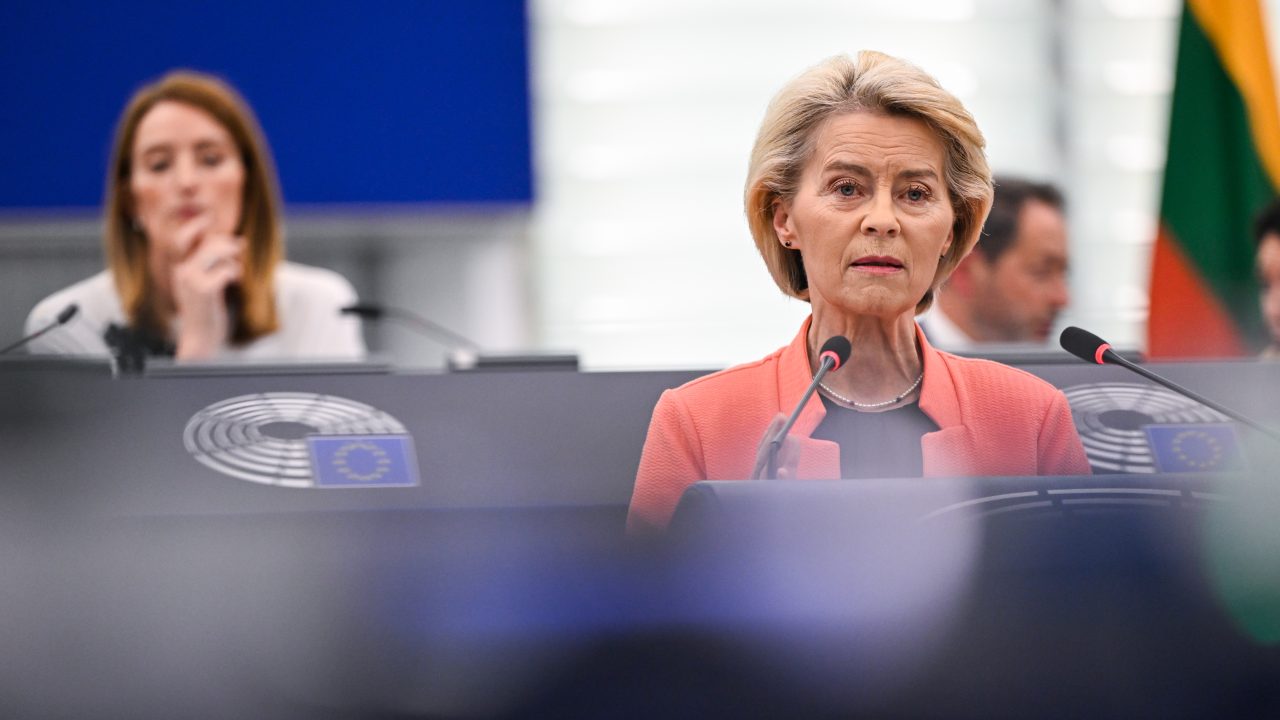
Caption: EP Plenary session – Motion of censure on the Commission [European Parliament Multimedia Library]
Updated: July 21, 2025 - 05:49