Edit
Alberta’s referendum: the campaign to break away from Canada
Alberta is one of Canada's wealthiest provinces, with an economy built on its oil and natural gas reserves and highly developed energy sector
Alberta’s referendum puts pressure on Canadian Prime Minister Mark Carney at a time when hr is trying to deal with problems from Canada’s ‘troublesome southern neighbour’, writes Dick Roche.
Dick Roche is a former Irish Minister for European Affairs and a former Minister for the Environment. As Minister for European Affairs he played a key role in the Irish referendums on the Nice and Lisbon Treaties.
Voters in the Canadian province of Alberta go to the polls today to decide whether their province which joined the Canadian Federation in 1905 should remain part of Canada or whether the provincial government should trigger a constitutional process that will lead eventually to a binding referendum on separation from Canada.
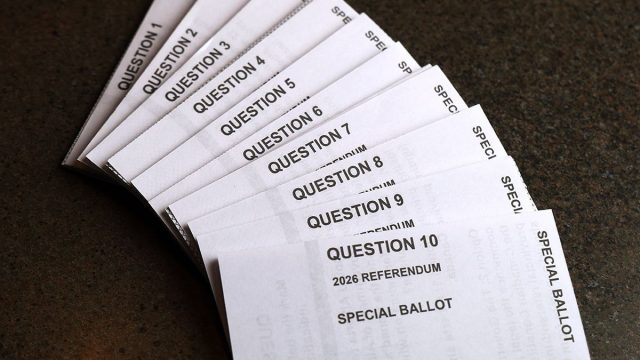
The referendum is unusually complex. Voters are not being asked whether Alberta should separate from Canada. There are ten separate questions on the ballot paper touching on immigration, access to public services, voting rules and provincial powers The key question is whether to begin the legal process towards a future binding vote on separation.
While the referendum vote is very unlikely to produce a result that leads to Alberta exiting Canada the fact that the vote is taking place and that a separatist movement exists in the Canadian province with the highest GDP per capita is significant.
Monday’s referendum in Alberta is a first for that province but it is not a first for Canada. Referendums were held in Quebec on independence in 1980 and again in 1995. The referendum in May 1980 authorising the provincial government to negotiate a sovereignty-association agreement with Canada was beaten 59.6% No to 40.4% Yes. The second referendum in October 1995 was much closer run. It was beaten 50.6% No to 49.2% Yes – a very close call.
That referendum triggered some significant changes. It changed how the federal government approached Quebec separatism, the province’s place in Canada, protection of its French speaking identity and its constitutional concerns. It also saw an important ruling from Canada’s Supreme Court that clarified constitutional requirements on separation. It also resulted in the passage of the Clarity Act 2000 which codifies the earlier Supreme Court ruling establishing a rigid legal framework governing the circumstances in which the Canadian federal government could negotiate a province’s secession from Canada. The Act requires that the House of Commons determine that the wording of any referendum on secession is clear and determine whether a “clear majority” of a province has voted for separation and it prohibits unilateral secession. The draft legislation which in effect enshrines the principle of the indivisibility of Canada in law faced very strong opposition in both the Canadian Commons and Senate at the time.
Alberta is one of Canada’s wealthiest provinces, with an economy built on its oil and natural gas reserves and highly developed energy sector. The province also has significant manufacturing and engineering industries, alongside a substantial agricultural sector.
Tensions between the provincial government in Edmonton and the federal government in Ottawa go back decades. There was a particularly strong dispute between the provincial government and Pierre Trudeau’s administration over the National Energy Program in 1980. The programme which aimed to increase Canadian control over energy supplies and revenues. It was widely seen in Alberta as federal interference which undermined and damaged the province’s petroleum industry. While the measures introduced by the Trudeau era were subsequently modified, the dispute left a lasting legacy. More recently differences over environmental regulations, regulatory restrictions, delays in sanctioning pipelines and carbon pricing have contributed to federal-provincial tensions. In addition many in Alberta feel that their province contributes disproportionately to federal ‘coffers’ while having insufficient influence over major decisions that impact on the province’s economy and the development of its own resources.
While the political forces that drove Quebec’s sovereignty referenda in 1980 and 1995 differ from those underpinning Alberta’s separatist movement, both share a common thread: dissatisfaction with, and a distrust of, the federal government in Ottawa. Quebec’s sovereignty movement arose from linguistic and cultural nationalism. Alberta’s separatist movement is rooted in what Canadians describe as Western alienation – the perception that the province’s economic interests and priorities are inadequately recognised at the federal level.
Alberta’s referendum coming immediately coming after a remarkable electoral resurgence by the Parti Québécois puts pressure on Canadian Prime Minister Mark Carney at a time when hr is trying to deal with problems from Canada’s ‘troublesome southern neighbour’. Carney, who grew up in Alberta, has called on voters to reject the proposal to trigger the legal process towards separation and a future independence referendum and to vote for Alberta to remain in Canada. He has also asked that they reject the other proposals.
In a rally on 15 October Carney reminded voters: “The world has become more dangerous and divided. Some outside our borders are working to break us so they can own us” – taken as a thinly veiled reference to President Trump – “and we know that when we are united, we become even stronger, fairer, and freer as a country.”
Polling suggests that that the proposal to process towards will be substantially defeated with up to 72% voting No to the proposition. The complex multi-coloured ballot paper being distributed to Albertans in the referendum gives voters plenty of room to ‘send Ottawa a message’ short of triggering separation option. The results of the referendum will be interesting.
Following the publication of this opinion, Reuters reported:
Alberta votes to remain part of Canada
Alberta residents voted to remain part of Canada in the province’s first-ever referendum on separation, CBC News said late Monday, in a much-needed win for Prime Minister Mark Carney as he attempts to unify the country amid an ongoing trade war with the U.S.
The referendum was nonbinding and asked residents if they wanted to stay part of Canada or start the legal process required to have a binding vote on separation.
Pollsters and analysts had repeatedly dismissed the possibility of a separatist victory, citing data that showed about one-third of residents in the Western province supported having a future referendum over leaving the province.
Caption: Canada’s Prime Minister Mark Carney attends a meeting with Britain’s Prime Minister Andy Burnham (not pictured) ahead of the Everton v Wolverhampton Wanderers English League Cup football match at Hill Dickson Stadium in Liverpool, Britain, 16 September 2026. EPA/ANTHONY DEVLIN / POOL
Updated: October 20, 2026 - 08:43