 Edit
U.S. distances itself from Kosovo’s Kurti, suspends strategic dialogue
The local elections and potential snap legislative polls will test the hold on power of the battered prime minister
The Trump administration’s decision to suspend planning for a strategic dialogue with Kosovo reflects growing frustration with caretaker Prime Minister Albin Kurti’s uncooperative stance, which Washington perceives as destabilizing.
Announced on 12 September, just before Kosovo’s local election campaign, the move signals an attempt to sway voters against Kurti’s Self-Determination Movement, potentially weakening his grip on power.
This suspension, a significant blow to Kosovo given the U.S.’s role as its key ally for three decades, highlights tensions over Kurti’s unilateral actions, particularly against the Serb community, and raises concerns about Kosovo’s international support and regional stability.
Reasons for U.S. frustration
The U.S. decision stems from Kurti’s repeated disregard for Washington’s calls for cooperative, stabilizing measures. Over the past year, Kurti’s government has taken unilateral steps, including banning the Serbian dinar and forcibly closing Serbian institutions like health and pension funds in northern Kosovo, without consulting the U.S. or European partners.
These actions, notably the 12 September shutdown of Serbian-run offices in Northern Mitrovica, have heightened tensions. Kurti’s recent attacks on Kosovo’s Constitutional Court, which he called a “political shadow of the opposition” after it halted parliamentary actions until 30 September, further strained relations. The court’s ruling, prompted by the Serb List’s objections to the election of Assembly deputy speakers, was exacerbated by Kurti’s refusal to support Serb List candidates, whom he labels terrorists.
His attempts to block the Serb List from 12 October local elections crossed a “red line” for Washington, according to a senior State Department official.
Impact of the suspension
Strategic dialogues are a U.S. diplomatic tool to deepen ties on issues like defence, security, energy, and economic cooperation, used with countries like Croatia and Bulgaria. Kosovo was set to finalize such an agreement in 2025, following President Vjosa Osmani’s January announcement. The suspension, though not a complete halt to U.S.-Kosovo cooperation, is a setback for Pristina, which has relied on Washington’s $2 billion in aid and support for its independence and Euro-Atlantic integration.
The U.S. remains Kosovo’s most vital ally, with 77% of Kosovars in a 2025 International Republican Institute survey naming it as such, yet only 38% supported a government change, indicating Kurti’s domestic resilience despite international criticism.
The timing of the suspension, coinciding with Kosovo’s local election campaign, suggests a U.S. intent to pressure voters to reject Kurti’s party. A poor electoral performance could jeopardize his caretaker government, in place since February 2025 elections failed to produce a majority. T
he U.S. appears to favour an opposition-led government, viewing Kurti as unreliable. Former U.S. Ambassador Jeffrey Hovenier emphasized that Kosovo’s citizens must decide their leadership to strengthen U.S. ties, signalling that continued support hinges on a more cooperative partner.
Regional implications
Kurti’s actions have also drawn European criticism, isolating Kosovo diplomatically. His refusal to integrate Serbian institutions into Kosovo’s system in coordination with Belgrade, as urged by the U.S., has fuelled instability, particularly in Serb-majority areas.
Meanwhile, Serbia is poised to capitalize on Kosovo’s weakened position. With a U.S.-Serbia strategic dialogue planned for this fall, Belgrade aims to shift international perceptions in its favour, as Serbian Foreign Minister Marko Djuric indicated.
A Serb List victory in ten Serb-majority municipalities on 12 October could further bolster Serbia’s influence.
Kosovo’s precarious position
The suspension underscores waning international support for Kurti amid Kosovo’s ongoing political crisis. While the U.S. is unlikely to withdraw troops, given the Pentagon’s planned reduction in Europe, Kosovo risks losing the robust backing it has enjoyed. Kurti’s government insists its actions are “legal and constitutional,” but his dismissal of U.S. concerns as mere “differences” downplays the rift. The U.S. seeks a partner who avoids destabilizing moves, and Kurti’s intransigence has led to this diplomatic rebuke. The local elections and potential snap legislative polls will test Kurti’s hold on power and Kosovo’s alignment with its Western allies, with Serbia watching closely for opportunities to advance its regional agenda.
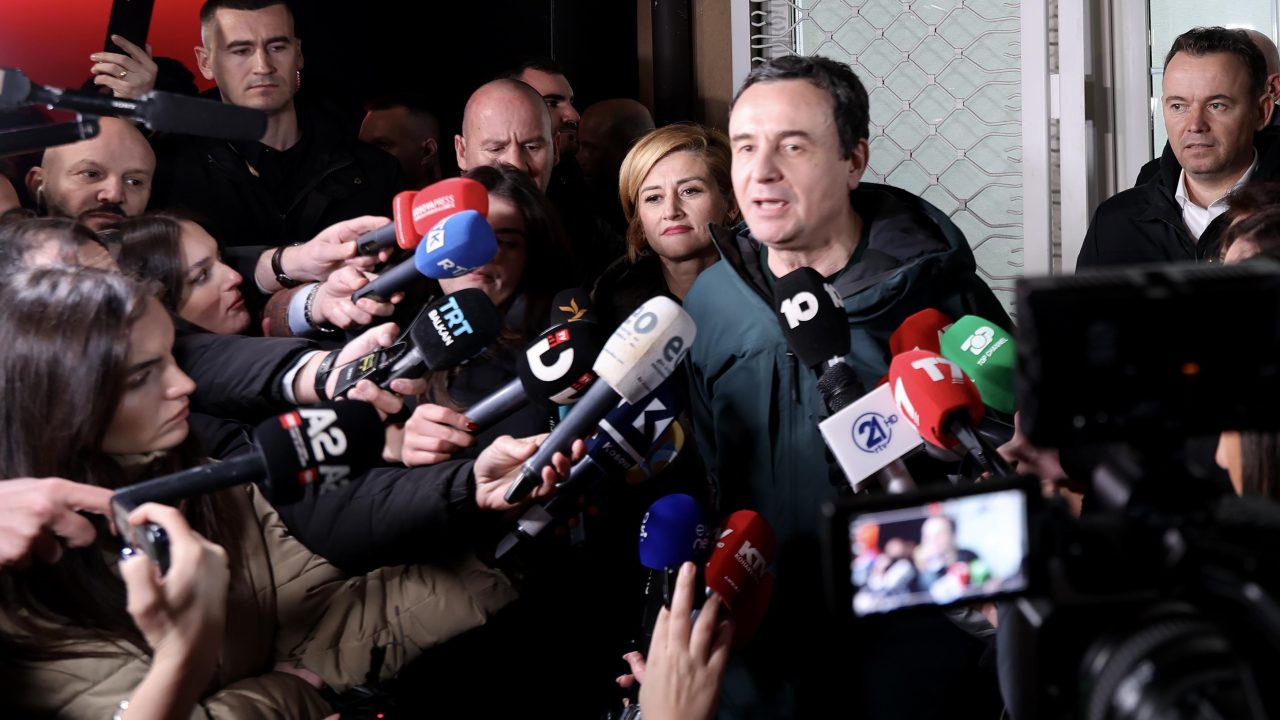
Caption: Incumbent Prime Minister and leader of ‘Vetevendosje’ party, Albin Kurti (C) addresses the media after winning the parliamentary elections in Pristina, Kosovo, 9 February 2025. The Republic of Kosovo held the parliamentary elections with Kurti’s party leading with 42 percent of the vote, a drop from the 50 percent Kurti received in 2021. EPA/GEORGI LICOVSKI
Updated: September 25, 2025 - 06:12