 Edit
U.S. diplomat: For Putin, Vučić is no longer a friend, but rather an enemy
According to former US ambassador John B, Craig, Putin wages a long-haul battle for influence in the Western Balkans
Russian President Vladimir Putin’s growing frustration with Serbia’s deepening ties to the West has heightened tensions in the Western Balkans, potentially testing the patience of U.S. President Donald Trump’s administration. Moscow’s accusations of betrayal and its efforts to destabilize Belgrade underscore a broader struggle for influence in the region, U.S. Ambassador John B. Craig writes in an article published on the Brussels-based Euronews portal.
Ambassador John B. Craig was a former US Ambassador to Oman and Special Assistant to President George W. Bush for Combating Terrorism. He is a Senior Fellow at the Transatlantic Leadership Network in Washington and a member of the advisory board of the Institute for Politics and the Economy of Southeast Europe.
Craig writes that Putin is preparing for a long political struggle for influence in the Western Balkans and that Serbia, a country friendly to Russia, seems to be a new target after it was discovered that it has been supplying that country with weapons since the beginning of Russia’s aggression against Ukraine.
Serbia’s arms supplies to Ukraine spark Moscow’s ire
The American diplomat explains that since Russia’s invasion of Ukraine, Serbia, a country historically aligned with Moscow, has been supplying Ukraine with military equipment, including rockets for multiple rocket launchers and mortar shells, often through intermediaries in Bulgaria and the Czech Republic. Moscow has condemned this as a “stab in the back,” issuing two official rebukes to Belgrade within a month. In response, Serbian President Aleksandar Vučić had announced a halt to all military equipment exports.
Serbia halts arms exports to Israel amid domestic unrest and international scandals
Craig notes that Russian far-right philosopher Aleksandr Dugin, often referred to as “Putin’s brain” and sanctioned by the U.S. Treasury in 2015 for his role in Russia’s aggression against Ukraine, has publicly questioned Vučić’s legitimacy. Dugin has also voiced support for ongoing anti-corruption protests in Serbia, which erupted following the tragic collapse of a canopy in Novi Sad on 1 November, 2024.
Serbia’s pivot toward the West
According to the diplomat, beyond its military support for Ukraine, Serbia’s recent agreements with Western partners have further strained its relationship with Russia.
In July 2024, Serbia, the EU and Germany signed a landmark battery supply chain agreement, granting the EU access to Serbia’s vast lithium deposits in the Jadar Valley. This deal positions Serbia as a potential major supplier of lithium, a critical component for battery production, reducing Europe’s reliance on China. Former German Chancellor Olaf Scholz hailed the $2.4 billion (€2 billion) Jadar project as a “mega project” capable of meeting 90% of Europe’s current lithium needs.
Rio Tinto’s lobbying blitz in Berlin paves way for Serbia’s lithium deal
However, the agreement sparked significant protests in Belgrade, with tens of thousands rallying against potential environmental damage to the Jadar Valley. Some protesters waved flags combining Russian and Serbian colors, signaling Moscow’s potential influence in stoking dissent. Notably, Russian forces recently seized one of Ukraine’s most valuable lithium deposits near Shevchenko in Donetsk, leaving Kyiv with control over only two of its four deposits, Craig recalls.
Serbia’s security alignment is also shifting. A €2.7 billion deal to purchase 12 Rafale fighter jets from France’s Dassault Aviation marks a significant departure from Serbia’s reliance on Russia as its traditional arms supplier. Additionally, the U.S. Export-Import Bank (EXIM) approved a $50 million (€42.8 million) preliminary commitment to Serbia’s Telekom Group to support the rollout of a secure 5G network, aligning with EXIM’s China and Transformational Exports Program.
Moscow’s response and implications for U.S. Policy
Craig believes that these developments have prompted Moscow to attempt to destabilize Vučić’s government, perceiving Serbia’s Western pivot as a direct challenge to its regional influence.
According to the former U.S. diplomat, Putin’s ambitions may also extend to Serbia’s lithium reserves, a strategic asset in the global energy transition.
The Trump administration, he writes, initially hopeful for a swift resolution to Russia’s war in Ukraine, has expressed disappointment with Putin’s intransigence.
Following a recent phone call between Trump and Putin, the U.S. appears increasingly alert to Moscow’s destabilising activities in its neighborhood. Whether Putin has crossed Trump’s “red line” remains unclear, but the administration is now weighing the possibility of imposing stricter sanctions on Russia, is the ambassador’s position.
According to Craig the coming months will reveal whether the U.S. will respond with decisive action or continue only to monitor Russia’s provocations.
With Euronews, edited by a.k.
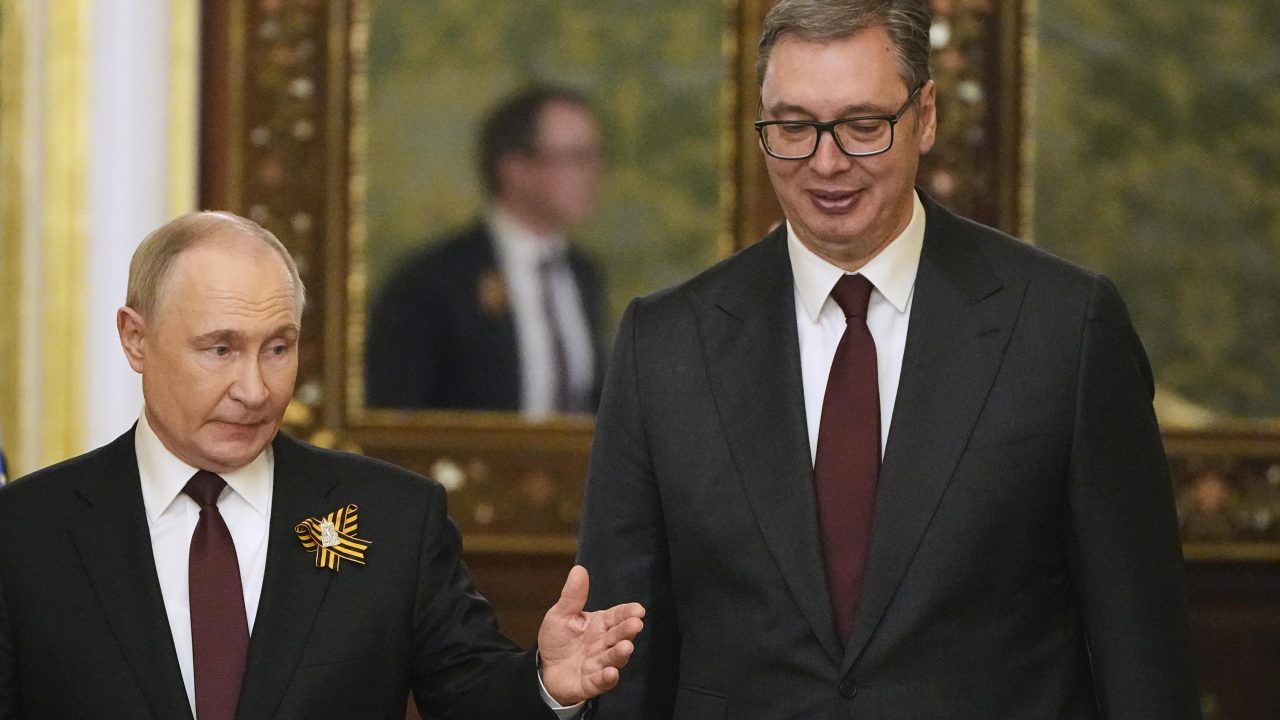
Caption: Russian President Vladimir Putin (L) and Serbian President Aleksandar Vucic (R) enter the hall during their meeting in Kremlin, Moscow, Russia, 9 May 2025. Russia marks the 80th anniversary of the victory in World War II over Nazi Germany and its allies. EPA/ALEXANDER ZEMLIANICHENKO/AP POOL
Updated: July 15, 2025 - 12:02


