 Edit
Serbia strikes provisional deal to oust Russian control from key oil giant NIS
Gazprom Neft agrees to sell majority stake to Hungary's MOL under U.S. sanctions pressure
Russia’s Gazprom Neft has reached a provisional agreement with Hungary’s MOL to sell its majority stake in Serbia’s oil company Naftna Industrija Srbije (NIS), marking a decisive step by Belgrade to remove Russian capital from one of its most strategic assets under U.S. sanctions pressure.
Serbia’s energy minister, Dubravka Đedović Handanović, confirmed that Gazprom Neft and MOL had agreed on the key elements of a future sales contract covering the Russian-owned 56.15% stake in NIS. The agreement, however, is not yet final and must be submitted to the U.S. Treasury’s Office of Foreign Assets Control (OFAC) for approval, as NIS remains under American sanctions due to its Russian ownership.
“Serbia has managed in these negotiations to improve its position compared with 2008, when we remained below 30% ownership,” Đedović Handanović said. She added that Serbia would increase its stake in NIS by five percentage points, giving the state greater decision-making rights in the shareholders’ assembly and, as she put it, better tools to protect the interests of citizens.
According to the minister, partners from the United Arab Emirates are also expected to be part of the future ownership structure, although no details have been disclosed regarding the size or form of their participation.
The announcement follows months of negotiations prompted by U.S. sanctions imposed on NIS on 9 October, targeting the participation of Russia’s state-owned Gazprom and its subsidiary Gazprom Neft. Washington has made clear that the only path to lifting the measures is the complete exit of Russian capital from the company.
In early January, MOL began on-site inspections of the Pančevo oil refinery and other key NIS assets, marking the first concrete step towards a potential takeover since Serbia announced plans to divest Russian ownership. Representatives of the Hungarian company toured fuel stations across Serbia, while technical teams met with refinery and company management in Pančevo to assess production processes, technical parameters and operational organisation, as part of a broader due diligence exercise.
Hungary’s MOL begins due diligence on NIS assets as Serbia races to divest Russian stake
Serbian President Aleksandar Vučić said on 2 January that he expected the main elements of a potential agreement between NIS and MOL to be finalised by 23 January, while cautioning that no deal was guaranteed. He confirmed that MOL, NIS and the Serbian government were jointly preparing a submission to OFAC seeking approval for continued operations and additional crude supplies.
The sanctions have had an immediate and severe impact on Serbia’s energy sector. On 2 December, NIS was forced to shut down the Pančevo refinery, Serbia’s only oil refinery and its most important energy asset, after sanctions disrupted crude imports. The facility supplies around 80% of the country’s domestic market for petroleum products.
A temporary reprieve came in late December, when OFAC issued a special licence, publicly confirmed by NIS on 1 January, allowing limited operations until 23 January. The licence permits refinery processing, crude imports and transactions deemed necessary for supply security and technical maintenance. Vučić said this allowed NIS to pay for 85,000 tonnes of oil stored in Omišalj, Croatia, and order an additional tanker carrying 140,000 tonnes, with full refinery capacity potentially restored by 20 January.
The licence also enabled Croatia’s JANAF pipeline to resume transporting non-Russian oil to NIS until 23 January, after flows were halted following the sanctions. However, the temporary nature of the authorisation has underscored the urgency for Belgrade to secure a lasting solution.
OFAC has extended the deadline for negotiations on the sale of the Russian stake until 24 March 2026, but without granting NIS the right to conduct full commercial activity during the talks. Vučić has warned that Serbia is currently forced to import large quantities of fuel on a daily basis, making a swift resolution essential for energy security.
The potential sale carries significant political and strategic weight. NIS was sold to Gazprom in January 2008 for €400 million under an intergovernmental energy agreement between Serbia and Russia. Russian President Vladimir Putin said in December that Gazprom Neft had invested more than $3 billion in the company and that discussions with Serbia were ongoing.
Beyond oil, Serbia remains heavily dependent on Russian energy, importing around 80% of its natural gas from Russia. Despite being an EU membership candidate since 2012, Belgrade has refused to join EU sanctions against Moscow, maintaining close political, economic and military ties.
Sources: Reuters, politika.rs, BGNES
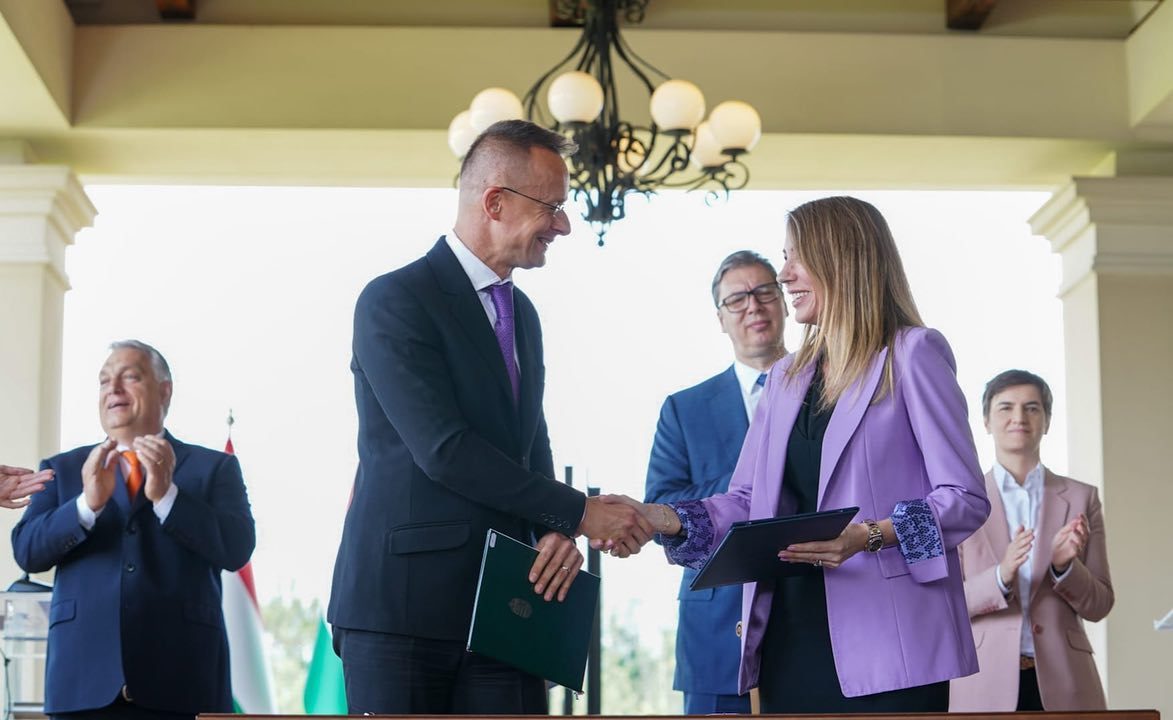
Caption: On 20 June 2023, Serbia’s energy minister Dubravka Đedović Handanović and Hungary’s foreign minister Péter Szijjártó shake hands after signing a Memorandum of Understanding on the construction of a new oil pipeline to Hungary. Serbian President Aleksandar Vučić, Hungarian Prime Minister Viktor Orbán and Serbian parliamentary speaker Ana Brnabić are also pictured./Facebook, Dubravka Đedović Handanović
Updated: January 19, 2026 - 17:47


