 Edit
Putin’s hollow mediation offer: preaching Peace in Iran while waging war on Ukrainian civilians
If Moscow truly seeks a “just and lasting peace” anywhere, the most direct path starts with halting its own aggression and withdrawing from Ukraine
On Sunday, Russian President Vladimir Putin told Iranian President Masoud Pezeshkian that Moscow is ready to mediate efforts for a “just and lasting peace” in the Middle East. The Kremlin readout framed the offer as support for a political and diplomatic settlement to the ongoing conflict involving Iran, the United States, and Israel – coming just after U.S.-Iran talks in Islamabad collapsed without agreement.
This is classic Putin diplomacy: positioning Russia as a responsible global actor eager to broker ceasefires abroad, even as his own military continues to inflict heavy civilian suffering in Ukraine.
The irony is glaring. While Putin extends an olive branch toward Tehran amid tensions over the Strait of Hormuz and regional strikes, Russian forces in Ukraine persist with attacks that kill and injure civilians far from any frontline. According to the United Nations Human Rights Monitoring Mission in Ukraine, the full-scale invasion launched in February 2022 has so far killed at least 15,000–16,000 civilians and injured more than 41,000, with the toll rising sharply in 2025 and 2026. In February and March 2026 alone, hundreds more civilians died or were wounded, many from long-range missiles, drones, and strikes on cities and energy infrastructure.
These are not abstract statistics. Verified reports document repeated strikes on residential areas, hospitals, schools, and power grids that leave ordinary Ukrainians without heat, water, or safety. Independent monitors and the UN have consistently attributed the overwhelming majority of civilian casualties to Russian forces. Yet Moscow routinely denies targeting civilians, calling such incidents “regrettable” or blaming Ukrainian defences – a pattern of deflection familiar to anyone following the war.
Putin’s sudden interest in Middle East mediation serves clear Russian interests. Moscow maintains close ties with Iran, including military cooperation, while trying to keep channels open with other players. Offering to mediate allows Russia to project influence, distract from its quagmire in Ukraine, and potentially ease Western pressure. It also fits a broader pattern: Russia has repeatedly offered itself as a peacemaker in various conflicts while showing little willingness to end the one it started and sustains on European soil.
Credible international bodies have documented the human cost in Ukraine with rigorous methodology. The UN’s figures are conservative, based on verified cases; the true numbers are almost certainly higher due to access restrictions in occupied areas. Organizations like Human Rights Watch and Amnesty International have repeatedly highlighted Russian tactics that violate international humanitarian law, including indiscriminate attacks and the deliberate targeting of civilian infrastructure.
The contrast could not be starker. A leader whose army is accused of systematic harm to innocents in one theatre now volunteers to facilitate “peace” in another. This is not statesmanship; it is cynicism dressed as diplomacy. Genuine mediators build credibility through consistent respect for civilian life and international norms. Putin’s Russia fails that test daily in Ukraine.
If Moscow truly seeks a “just and lasting peace” anywhere, the most direct path starts with halting its own aggression and withdrawing from Ukraine. Until then, offers to mediate elsewhere deserve skepticism, not applause. The world has seen enough of selective peacemaking from a government that continues to kill civilians while preaching restraint to others.
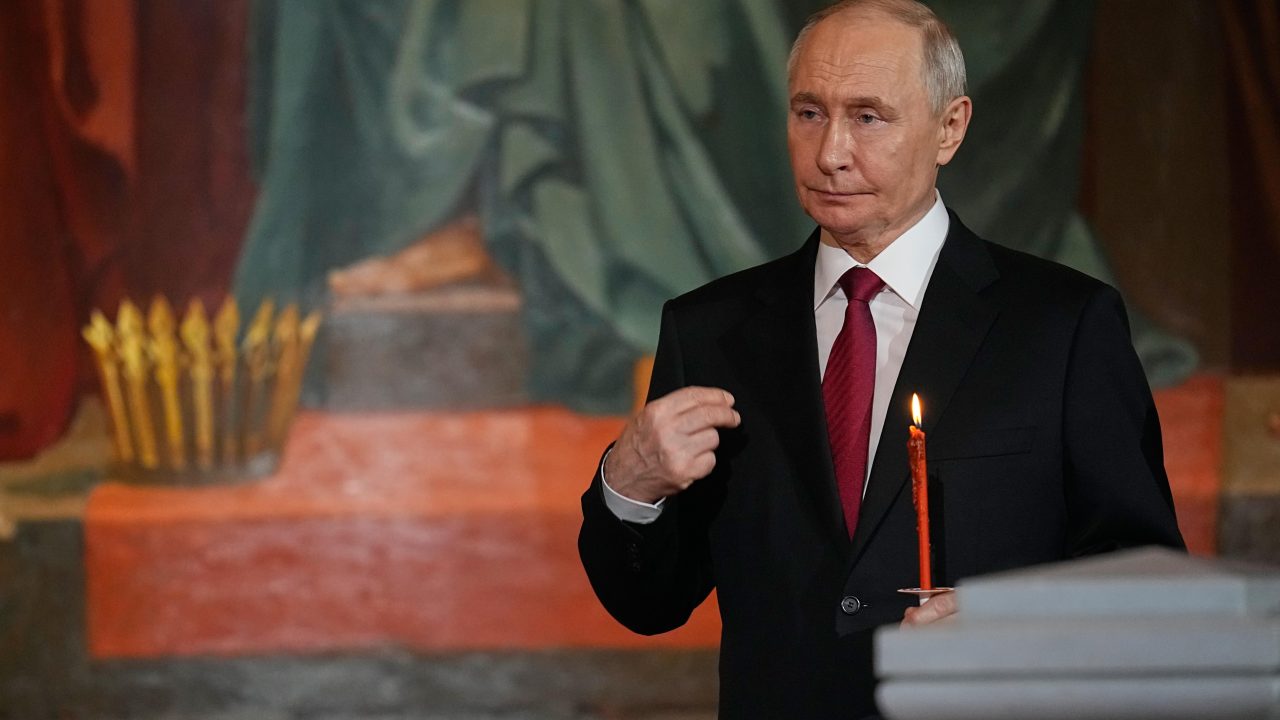
This morning Putin attended the Orthodox Easter midnight service at Moscow’s Cathedral of Christ the Saviour, crossing himself amid the rituals of Resurrection as the liturgy unfolded under Patriarch Kirill. The images were broadcast as a display of piety on one of Christianity’s holiest days.
Shaped by the Soviet era’s official atheism, Putin has long weaponized Orthodox imagery for political ends. This public display – just as his offers to mediate for peace or offer Ester truce – should fool no one. The former KGB officer has no other faith except diversion and aggression.
Caption: Russian President Vladimir Putin crosses himself during the Orthodox Easter service at the Cathedral of Christ the Saviour in Moscow, Russia, 12 April 2026. Easter is the main religious celebration for Russian Orthodox Christians. EPA/ALEXANDER ZEMLIANICHENKO / POOL
Updated: April 12, 2026 - 19:03


