Edit
EditPolice action at Belgrade University: Vučić vows students will face defeat in upcoming elections
EU representatives call for transparent investigations into a student death and into the irregularities over the recent elections in 10 municipalities
Officers from the Anti-Corruption Department of the Criminal Police Directorate conducted on 31 March a raid on the University of Belgrade Rectorate offices. The students’ protest in response to the police check was met with strong opposition, while President Aleksandar Vučić declared that the student movement had no prospects in the upcoming elections.
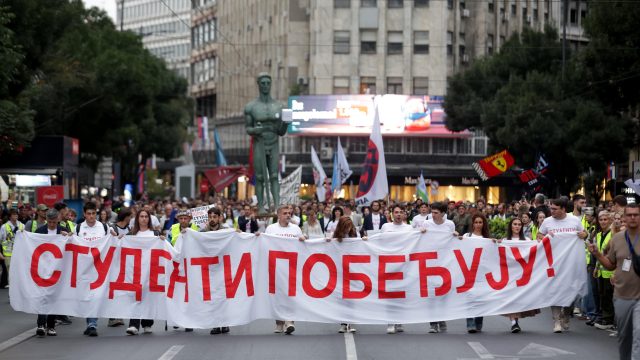
The operation, carried out on orders from the Higher Public Prosecutor’s Office and the High Court, formed part of the ongoing investigation into the death of a 25-year-old female student who fell through a fifth-floor window at the Faculty of Philosophy on the night of 26 March. Police seized servers and equipment storing surveillance camera recordings, along with other items discovered during the search. This development unfolded against a backdrop of prolonged student-led anti-government protests that have persisted for more than a year, fueled initially by the deadly collapse of a railway station concrete canopy in Novi Sad in late 2024 that claimed 16 lives.
The raid has heightened suspicions of political motivations, especially given repeated government statements about revoking university faculties’ legal autonomy and official claims blaming senior university staff for the student’s death.
The police operation and official justifications
Police Director Dragan Vasilijevic explained that the primary goal was to clarify the circumstances surrounding the young woman’s tragic death. Acting under directives from the Higher Public Prosecutor’s Office, officers aimed to establish facts and determine whether university rules had been respected. The search, which continued for some time due to the size of the building, uncovered flares, sprays, a large number of radios, gas masks, numerous banners, significant medical supplies including needles and bandages, and several packages containing various liquids. Authorities also confiscated devices holding video surveillance recordings, which they indicated could reveal compliance with prescribed security protocols.
The Higher Public Prosecutor’s Office announced that, in cooperation with police, pre-trial actions in the Rectorate focused on identifying possible omissions that allowed pyrotechnic devices to be introduced and ignited in the Faculty of Philosophy building. These inquiries also extended to any other irregularities potentially linked to the events of 26 March. Additionally, it warned that criminal proceedings would be initiated against any protest participants in front of the Rectorate found to have attacked police officers.
University Rector Vladan Jokić addressed a gathered crowd from the Rectorate balcony, describing the police entry as sudden and lacking proper legal grounds. He noted that officers seized computers and documents unrelated to the student’s death investigation, framing the event as a political spectacle staged for cameras despite the university’s offer of full cooperation. Jokić pointed out that the Rectorate computers held no relevant information for the probe, a fact he claimed was widely known. He highlighted the spontaneous arrival of students, who entered through another entrance without coordination or transport, underscoring their commitment to the institution.
Government criticism and accusations of politicisation
President Vučić commented on the incidents between demonstrators and police, asserting that the state was fulfilling its responsibilities diligently. He attributed the protests to multiple factors, including what he described as post-election trauma stemming from opposition disappointment after unexpected electoral setbacks, during which false hopes had been raised among supporters. Another element, according to Vučić, involved unexplained items found in the Rectorate, such as pyrotechnics, firecrackers, pepper spray and syringes, which he said no one could justify.
Speaking to Informer television, he noted that some areas of the building resembled a “pigsty” and accused protesters of showing no empathy toward the deceased student. He claimed they treated her death casually, lacked interest in a thorough investigation into whether it was murder or suicide, and prioritised their own political interests over the young woman’s life. Vučić characterized the evening’s protest as “pure, unadulterated violence” involving attacks on police officers, suggesting it signaled the end of the broader movement. He estimated the crowd at no more than around 3,900 people, describing those remaining as radicalized elements and extremists driven by high expectations, frustrations, and complexes.
Vučić further remarked that education was being undermined by “the most incompetent people in the country,” arguing it would take years to repair the damage from inaction and internal sabotage.
On the possibility of Rector Vladan Jokić entering future elections, Vučić said he had no objection, viewing it as a democratic right, but suggested it should not occur while Jokić held his university position. He sarcastically noted that Jokić was seen by some as a strong favorite for prime minister or even president, despite claims of 75 percent public support that did not always translate into electoral success. Vučić also used the occasion to float the idea of early elections once again.
Pro-government tabloids, including Informer, launched what appeared to be a coordinated campaign discrediting Jokić and Faculty of Philosophy Dean Danijel Sinani shortly after news of the student’s death emerged. Headlines accused them of responsibility due to inadequate security, with one prominent slogan echoing protester language: “Djokić and Sinani – your hands are bloody.” Education Minister Dejan Vuk Stanković echoed these sentiments on public broadcaster RTS, stating the Ministry must assume control over faculties from negligent deans to safeguard students.
Opposition MP Djordje Pavičević, a professor at Belgrade University’s Faculty of Political Sciences, argued that such statements sought to fabricate a causal link between the year-long student movement and the Faculty of Philosophy tragedy. EU Ambassador Andreas von Beckerath urged all parties to avoid politicising or instrumentalising the incident, calling on media to show respect in their coverage. European Commissioner for Enlargement Marta Kos highlighted unacceptable voting irregularities, threats, and violence observed by Council of Europe monitors in Serbia’s recent local elections, pressing national authorities for swift, transparent investigations and accountability. She reaffirmed that free and fair elections remain fundamental, particularly for EU candidate countries like Serbia.
The rector and deans have maintained that the university faces an orchestrated attack, viewed by authorities as a threat and opponent due to its support for student protests.
While authorities insist the probe focuses solely on establishing facts and ensuring justice, critics see the raid, seizures, and accompanying rhetoric as tools to undermine university autonomy and suppress dissent.
Sources: Informer, N1, BETA, BGNES, Balkan Insight
Caption: Protesters hold a banner reading ‘Knowledge is power’ during a student demonstration in Belgrade, Serbia, 27 January 2026. Students are rallying to demand core changes to educational reforms and early elections. The demonstrations are part of a wave of civil unrest that began following the fatal canopy collapse at the Novi Sad railway station in late 2024, with protesters calling for increased accountability and social justice. EPA/ANDREJ CUKIC
Updated: April 1, 2026 - 12:06