 Edit
Merz’s shock defeat in Chancellor vote signals fragile start for Germany’s new coalition
This is the first time a designated chancellor has lost the initial ballot in post-war Germany
On 6 May, German conservative leader Friedrich Merz suffered a surprising and unprecedented setback, failing to secure the chancellorship in the first round of voting in the Bundestag.
Garnering only 310 of the required 316 votes, Merz fell short despite his Christian Democratic Union (CDU/CSU) having secured a coalition agreement with the Social Democrats (SPD) just one day prior.
This historic failure – the first time a designated chancellor has lost the initial ballot in post-war Germany – exposes deep fissures in the newly formed coalition and raises questions about Merz’s ability to lead Europe’s largest economy. While he is likely to win in a second or third vote within the next 14 days, this stumble marks a faltering start, undermining Germany’s political stability and its influence on critical European Union issues at a pivotal moment.
A stunning setback
Merz, 69, led the CDU/CSU to victory in the February 2025 federal election, securing 28.5% of the vote. However, with no absolute majority, the conservatives needed a partner to govern. After months of negotiations, they signed a coalition deal with the SPD on 5 May, despite the SPD’s historic low of 16.4%—their worst result in post-war history. The coalition, holding a slim 12-seat majority in the 630-seat Bundestag, was expected to propel Merz to the chancellorship. Yet, his shortfall of six votes suggests defections, possibly from within his own ranks or from SPD members wary of his conservative agenda.
Bundestag President Julia Klöckner announced the result, promptly interrupting the session to allow parliamentary groups to consult on next steps. The lower house now has 14 days to elect a chancellor with an absolute majority, with another vote possible as early as later in the day.
If no candidate secures a majority, President Frank-Walter Steinmeier could appoint the candidate with the most votes or dissolve parliament, triggering new elections. While Merz remains the frontrunner, his failure to unite his coalition in the first round is a significant blow to his credibility.
Posts on X reflect the shock, with one user calling it a “capital failure” for the CDU-SPD alliance and another noting Merz’s visible dismay, labeling the outcome a “huge setback.” “This is absolutely dismal news for Merz,” a third post stated, warning of a chancellorship “consumed by instability.” The public reaction underscores the gravity of the moment, as Germany faces economic challenges, a resurgent far-right, and pressing EU responsibilities.
Coalition fragility and internal tensions
The vote’s failure exposes the fragility of the CDU-SPD coalition, cobbled together after a divisive election. The SPD’s youth wing, Juso, has openly criticized the coalition deal, particularly over Merz’s push for stricter migration policies and limited concessions on social issues like the minimum wage. Some SPD lawmakers, facing pressure from their base, may have withheld support, fearing backlash for aligning with Merz’s conservative platform. Similarly, CDU hardliners, wary of compromises with the centre-left, may have defected, preferring a more right-leaning government.
The coalition’s slim majority leaves little room for dissent, making unity critical. “Merz starts on the wrong foot,” an X post noted, predicting a “tough road ahead” if internal tensions persist. The far-right Alternative for Germany (AfD), which secured 20.5% in February’s election, looms as a disruptive force, capitalizing on coalition instability to gain ground. The AfD’s opposition to constitutional changes, such as those needed for increased defense spending, further complicates Merz’s governance prospects.
Merz’s leadership style—described as assertive and pro-business—may have alienated potential allies. Unlike his predecessor Angela Merkel, known for her consensus-building, Merz has leaned into a more polarising conservative agenda, emphasizing economic deregulation and a hardline stance on migration. This approach, while galvanizing the CDU base, risks alienating coalition partners and moderates, as evidenced by the vote’s outcome.
Implications for German leadership
Merz’s stumble undermines his ability to project strength at a time when Germany faces significant domestic and international challenges. Economically, Germany is grappling with inflation, energy cost spikes, and sluggish growth, with the Bundesbank forecasting only 0.9% GDP growth for 2025. Merz has promised tax cuts and labor market reforms to spur investment, but coalition disunity could stall these plans, eroding public confidence. “Germany can’t afford a weak chancellor,” an X post warned, reflecting fears of prolonged instability.
Internationally, Merz’s weakened position hampers Germany’s role as a leading EU power. A transatlanticist and pro-European, Merz has pledged to strengthen Europe’s strategic autonomy, boost defense capabilities, and deepen EU integration. He has warned that it is “five minutes to midnight for Europe,” urging greater competitiveness in the face of U.S. and Chinese economic pressures. However, his immediate focus will be on stabilising his coalition, limiting his capacity to lead on EU priorities, such as enlargement or climate policy.
Relations with U.S. President Donald Trump, whose scepticism of European unity is well-documented, add complexity. Merz, a proponent of transatlantic cooperation, faces the challenge of navigating Trump’s unpredictable foreign policy while managing domestic turmoil. A distracted or weakened chancellor could embolden populist movements across the EU, including Germany’s AfD, which shares ideological ties with Trump’s base.
If Merz fails to consolidate his coalition, Germany risks political paralysis, potentially leading to new elections. This would exacerbate economic uncertainty and delay critical reforms, further eroding Germany’s global standing. The AfD, already a significant force, could exploit voter frustration, particularly if coalition infighting dominates headlines. “Merz’s failure fuels the far-right,” an X post cautioned, highlighting the stakes.
Even if Merz secures the chancellorship in subsequent rounds, his authority will be diminished. Governing with a fractious coalition will require constant negotiation, leaving little bandwidth for bold initiatives. His ability to unify the CDU and SPD, let alone address Germany’s structural challenges, will be tested early and often. “Merz’s chancellorship is off to a disastrous start,” a political analyst on X remarked, predicting “months of gridlock.”
Finally, Merz was elected chancellor by parliament on Tuesday in a second round of voting, securing 325 votes—nine more than the required 316.
In the hours between the first vote (around 10:00 AM CEST) and the second (starting at 3:15 PM CEST), Merz’s team and coalition leaders scrambled to salvage his candidacy.
The CDU/CSU and SPD leadership moved swiftly to enforce party discipline. Jens Spahn, CDU/CSU parliamentary group leader, announced the second vote for 3:15 PM, emphasizing the global stakes: “All of Europe—perhaps even the whole world—is watching this second round of voting.”
Between votes, Merz and coalition leaders likely offered assurances—possibly verbal commitments to balance fiscal reforms with social protections—to placate dissenters. While no public concessions were announced, the secret nature of the ballot allowed MPs to adjust their stance without losing face.
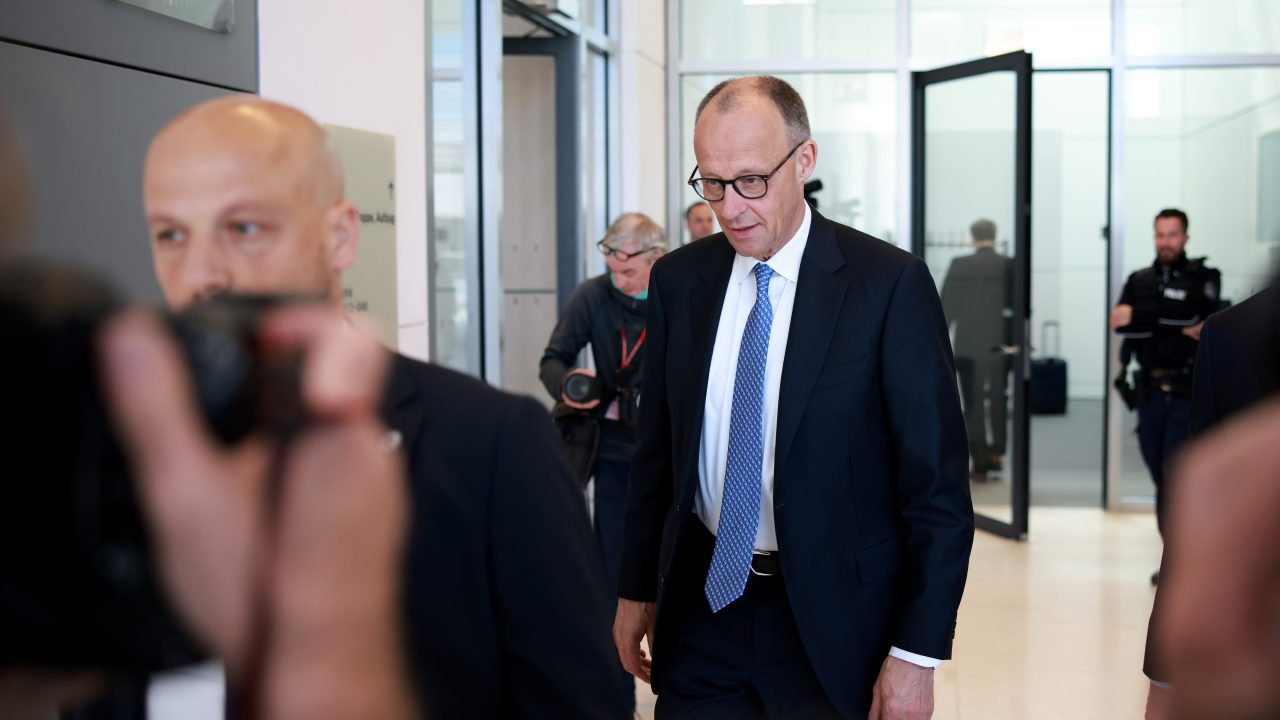
Caption: Designated German Chancellor Friedrich Merz leaves a parliamentary group meeting after he was not elected in the first ballot at the Bundestag in Berlin, Germany, 6 May 2025.EPA-EFE/CLEMENS BILAN
Updated: May 7, 2025 - 10:03