 Edit
Erdoğan wants families to have 4–5 children to match Turkey’s global ambitions
The Turkish President said that the nation’s fertility rate, now at 1.7 children per woman, is tantamount to “suicide”
Turkish President Recep Tayyip Erdoğan has intensified his campaign for population growth, calling on families to have at least four or five children – up from his previous benchmark of three.
Speaking to reporters on his return flight from Azerbaijan over the weekend, Erdoğan warned that the nation’s fertility rate, now at 1.7 children per woman, is tantamaount to “suicide” for a country with global ambitions.
“Our population growth rate is unfortunately 1.7. This is suicide. We must absolutely solve this,” he declared. “I’ve always said at least three children. Why not four or five? We must accelerate this. With a rising population growth rate, our country will advance more strongly into the future.”
Erdoğan, who frequently highlights the family as the cornerstone of Turkish society, views demographic decline as an existential threat. A father of four himself, the 71-year-old leader often urges newlyweds at wedding ceremonies to have at least three children, framing larger families as a patriotic duty.
In May, he designated 2025 as the “Year of the Family” and the decade from 2026 to 2035 as the “Decade of Family and Population” during the International Family Forum in Istanbul.
Official data from the Turkish statistical institute (TurkStat) reveal a stark trend: the total fertility rate has collapsed from 2.38 children per woman in 2001 to 1.48 in 2024 – well below the replacement level of 2.1 and lower than in France (1.79), Britain (1.56), or the United States (1.62). This sharp drop has occurred over Erdoğan’s 22 years in power, first as prime minister and now as president, in a nation of 85 million.
Economic headwinds and policy shortfalls fuel fertility crisis
Economic pressures, however, are driving the decline. Persistent double-digit inflation since 2019, standing at around 33 percent in October 2025, combined with a Turkish lira that has lost over 75 percent of its value against the U.S. dollar since 2021, has fueled a cost-of-living crisis. Housing shortages, childcare expenses, and low female workforce participation (around 34 percent) have delayed marriages, increased divorces, and led to a surge in single-child households.
Critics contend that Erdoğan’s rhetoric lacks substance, as his government has introduced few meaningful incentives to ease these burdens. Without affordable housing, robust childcare support, or policies enabling women to balance work and family, calls for more children appear detached from reality.
A higher target for Turks abroad?
This is not Erdoğan’s first provocative demographic appeal. In 2017, while campaigning in Eskisehir for a referendum to expand presidential powers amid tensions with Europe – particularly after Dutch authorities blocked Turkish ministers from holding rallies, he urged Turks living abroad to have at least five children.
“Go live in better neighborhoods. Drive the best cars. Live in the best houses. Make not three, but five children,” he said. “Because you are the future of Europe. That will be the best response to the injustices against you.”
Hungary’s controversial experience
Hungary offers a contrasting case study in state-driven pronatalism. Under Prime Minister Viktor Orbán, the government has poured over €10 billion into family policies since 2010. Married couples can access interest-free loans of up to 10 million forints (approximately €30,590), forgiven upon having three children and usable for any purpose. Mothers of four or more children receive lifetime personal income tax exemptions. Additional benefits include scaled child allowances (with significant increases after the second child), housing loans, and grants of up to €7,500 for larger family vehicles.
On paper, the results are positive: Hungary’s fertility rate rose from 1.23 in 2011 to 1.55 in 2021. Yet the gains have proven fragile, dipping slightly in recent years. The policies favor employed, middle-class, conservative families, excluding freelancers, single parents, and low-income households. Benefits, often €40–50 monthly per child, are tied to parental salaries and formal employment.
Orbán makes no secret of his vision: a Christian, traditional family model with little emphasis on gender equality. While popular in rural areas and among conservative voters, the policy’s impact is undermined by the emigration of educated young Hungarians seeking higher wages abroad—a brain drain that offsets birth rate gains.
Experts note that similar incentives have failed elsewhere. Japan offers cash gifts and childcare expansion with no sustained reversal in its ultra-low fertility (1.26). Sweden, despite generous parental leave and benefits, has seen its rate decline. Hungary’s tax exemption for mothers of four or more, introduced in 2019, has shown limited long-term effect.
Turkey, by contrast, spends far less on family support as a share of GDP and operates in a far more unstable economic environment. Without addressing inflation, currency depreciation, housing affordability, and structural barriers to women’s employment, experts warn that fertility could fall below 1.5 in the coming decade, accelerating population aging and straining pensions, healthcare, and economic growth.
Erdoğan and his wife Emine have two sons.
Sources: Haberler, Daily Sabah, BGNES, edited by a.k.
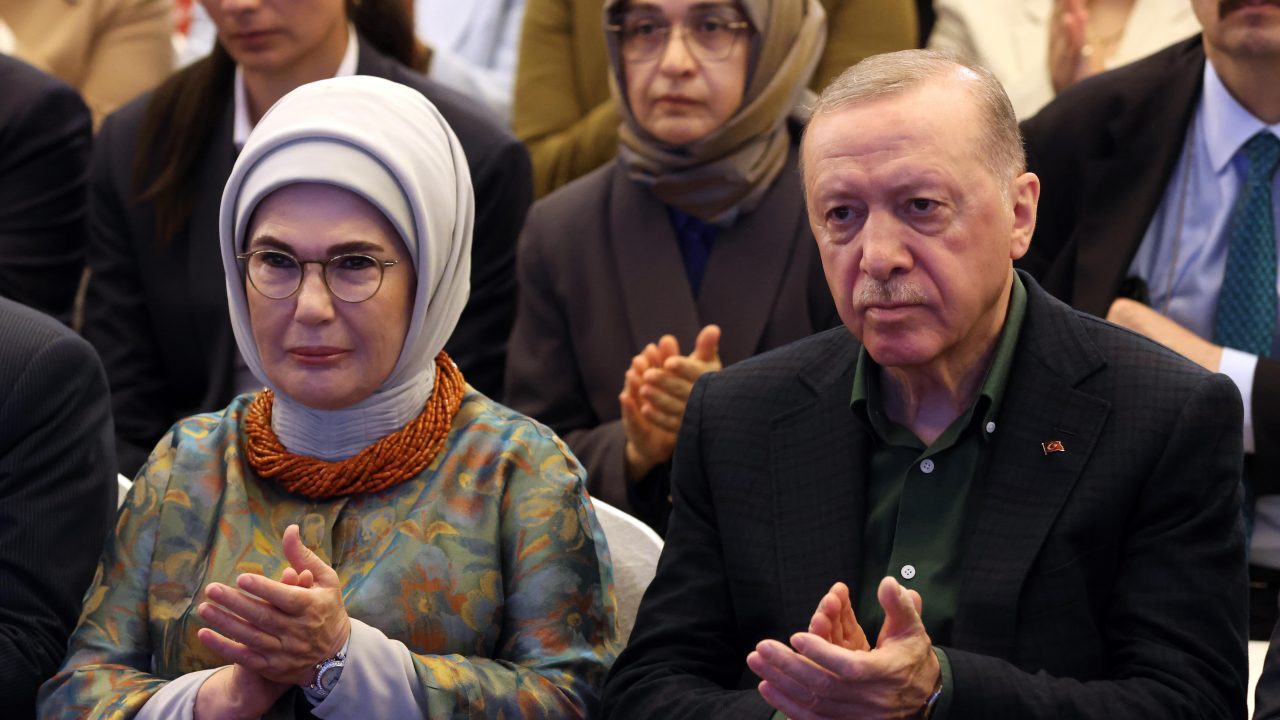
Caption: Turkish President Recep Tayyip Erdogan attends the 32nd Consultation and Evaluation Meeting along with his wife Emine Erdogan, in Ankara, Turkey, 12 July 2025. President Erdogan made remarks after the PKK’s symbolic disarmament ceremony held on 11 July. EPA/NECATI SAVAS
Updated: November 11, 2025 - 12:58