Edit
Turkey and Armenia agree student exchanges amid hopes of border reopening
The two countries, long divided as arch-foes over the 1915 events widely described as the Armenian genocide, have taken several steps toward normalisation
Turkey and Armenia are stepping up efforts to normalise relations, expanding academic cooperation as Armenia signals that their long-closed land border could reopen sooner than expected, although Ankara continues to link progress to the broader peace process between Armenia and Azerbaijan.
Armenian Deputy Parliament Speaker Vahagn Aleksanyan said on Thursday that the two countries had agreed on university student exchanges, under which Armenian students would travel to Turkey to study and Turkish students would come to Armenia. Aleksanyan, a member of Armenia’s ruling Civil Contract party, made the announcement during a broadcast on Armenian Public Television.
The agreement builds on commitments made during earlier diplomatic talks. At a meeting in Yerevan on 12 September 2025, Turkish special representative Serdar Kılıç and his Armenian counterpart, Ruben Rubinyan, agreed to strengthen cooperation in culture and academia, particularly by creating scholarship opportunities for university students, according to the Turkish Foreign Ministry.
In March, Armenian Foreign Minister Ararat Mirzoyan said the two countries were discussing scholarship programmes for each other’s university students. The academic exchanges are part of a broader rapprochement between the two neighbours, which have no diplomatic relations and have kept their land border closed since 1993.
Turkey and Armenia, long divided as arch-foes over the 1915 events widely described as the Armenian genocide, have taken several steps toward normalisation in recent years, including appointing special representatives to lead talks and restoring direct flights.
At their meeting, held in July 2024 at the Margara-Alican border crossing, the representatives from both countries agreed to assess the technical requirements for reopening the railway crossing and to simplify visa procedures for holders of diplomatic and official passports.
Previous efforts have failed to produce an open border. In 2009, Turkey and Armenia signed the Zurich Protocols, which aimed to establish diplomatic relations and reopen the frontier. The agreements were never ratified amid political disagreements and tensions over Turkey’s alliance with Azerbaijan.
Ankara has continued to link normalisation with Armenia to the broader peace process between Armenia and Azerbaijan, reflecting the strategic importance of its alliance with Baku in Turkish policy towards the South Caucasus.
The issue also remains politically sensitive within Armenia. In a separate exchange concerning a domestic dispute involving the Armenian Apostolic Church, Aleksanyan rejected opposition accusations that the government was pursuing Turkey’s agenda and accused its critics of promoting Turkey’s image.
Border reopening could come sooner than expected
Aleksanyan also pointed on Tuesday about the progress in air transport and trade, saying that the opening of the Akhalkalaki-Kars railway for Armenian exports had made it possible to transport goods between the two countries via Georgia without commercial intermediaries. He said the pace of normalisation had changed considerably in recent years and that the border could reopen sooner than expected, although he gave no timetable.
U.S. secures strategic transit corridor in Armenia-Azerbaijan peace deal
On 16 October, the Armenian foreign minister said the normalisation process had reached an advanced stage and that the shared border could reopen for passenger and freight traffic at any time.
“The dialogue between Armenia and Turkey has become so intensive and the process so mature that we could wake up tomorrow, so to speak, and find that both sides have decided to open the border,” Mirzoyan told reporters on the sidelines of the COP17 conference.
He said the two countries had come a long way since the early stages of their dialogue, when mutual mistrust was considerably greater, and had already begun co-operating on a range of issues.
Asked whether Azerbaijan was hindering the process, Mirzoyan said both Baku and Ankara had made clear that the normalisation of Armenian-Turkish relations should proceed in parallel with the Armenian-Azerbaijani peace process. “Life goes on,” Mirzoyan added.
Armenia’s efforts to diversify its foreign and security partnerships come amid growing disillusionment with Russia, its traditional security ally, after Moscow failed to prevent Azerbaijan’s takeover of Nagorno-Karabakh in 2023.
Yerevan has since stepped up engagement with the EU, which has deployed a civilian mission to help the country counter hybrid threats and allocated €30 million in non-lethal assistance to its armed forces.
The first EU-Armenia summit, held in Yerevan in May 2026, marked a further step towards closer political, economic and security ties, although Armenia has not formally severed its relationship with Moscow.
Sources: Panorama.am, Turkish minute, BGNES
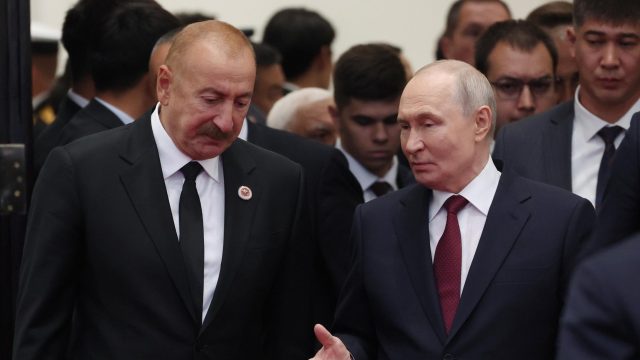
Caption: A handout photo made available by the Turkish Presidential Press Office shows Turkish President Recep Tayyip Erdogan (R) and Armenian Prime Minister Nikol Pashinyan (L) during a welcoming ceremony in Istanbul, Turkey, 20 June 2025. Pashinyan is in Turkey for a one-day visit. EPA/TURKISH PRESIDENTIAL PRESS OFFIC HANDOUT
Updated: October 23, 2026 - 05:49