One of the key players during the Gaza Peace Summit in Sharm El Sheikh was Turkish President Recep Tayyip Erdoğan, whose active participation underscored Turkey’s growing prominence in Middle Eastern affairs. The summit, convened on 13 October, brought together U.S. President Donald Trump and dozens of world leaders to solidify a fragile ceasefire in Gaza after two years of devastating conflict.
At the Egyptian beach resort of Sharm el-Sheikh on Monday, Trump and President Abdel Fattah al-Sisi hosted more than 20 world leaders for a summit intended to cement the truce.
At the opening of the summit, Trump signed a document with Egypt, Qatar and Turkey’s leaders welcoming the agreements on Gaza and pledging to “work collectively to implement and sustain this legacy.”
Egypt’s presidency said that discussions included the governance, security and reconstruction of Gaza.
“Now the rebuilding begins,” Trump said at the summit, delivering an expansive speech where he described in grand terms the Gaza agreement he helped broker, saying it could be “the greatest deal of them all.”
Israel and Hamas were not represented at the summit, while the leaders of Saudi Arabia and the United Arab Emirates did not attend.
Erdoğan’s role was particularly notable as Turkey emerged as one of the four guarantor countries – alongside the United States, Qatar, and Egypt – tasked with overseeing the peace agreement’s implementation. This position reflects Turkey’s longstanding commitment to Palestinian causes, a cornerstone of its foreign policy under Erdoğan.
Born in Istanbul in 1954 to a modest family, Erdoğan served as prime minister from 2003 to 2014, overseeing economic growth and infrastructure booms that transformed Turkey. Elected president in 2014, Erdoğan has centralized power through constitutional changes, surviving a 2016 coup attempt and reshaping Turkey’s institutions. Now in his third decade of leadership, he has positioned Turkey as a bridge between East and West, often challenging Western allies while pursuing an independent foreign policy.
His vocal support for Palestine, including condemnation of Israel’s actions in Gaza and provision of humanitarian aid, marks a shift from Turkey’s pre-Erdoğan Kemalist era, when relations with Israel were warmer. Turkey has become Gaza’s top aid donor, delivering medical supplies, food, and reconstruction support, while advocating for a two-state solution amid the ongoing humanitarian crisis.
On the summit’s sidelines, Erdoğan engaged in a flurry of bilateral meetings with key figures, highlighting Turkey’s strategic manoeuvring. He first met with the Crown Prince of the United Arab Emirates, Mansour bin Zayed Al Nahyan, to discuss bilateral ties and opportunities in trade, investment, and defence. This encounter builds on recent thawing in Turkey-UAE relations, which had been strained by regional rivalries, including differing stances on Libya and the Muslim Brotherhood. Since 2021, diplomatic normalization has accelerated, with trade volumes surging to over $20 billion annually and agreements on energy and technology. Erdoğan emphasized how the Ankara-Abu Dhabi political alignment has fortified cooperation in strategic sectors. He reiterated Turkey’s efforts to “end the massacre in Gaza and initiate a lasting peace process,” aligning with the UAE’s own pivot toward regional stability post-Abraham Accords.
“The window for a just and lasting peace has opened and must be used responsibly,” Erdoğan stated, stressing the need for full ceasefire compliance, unrestricted humanitarian aid, and immediate Gaza reconstruction as prerequisites for enduring stability. These remarks echo Turkey’s active role in ceasefire negotiations, including its involvement in a multinational task force and joint statements with Egypt, Qatar, and the U.S. that emphasize equality and aid without explicitly endorsing Palestinian statehood.
Next, Erdoğan conferred with UK Prime Minister Keir Starmer, focusing on expanding Ankara-London collaboration, especially in defence. The two agreed that Middle East stability is vital for European security. UK-Turkey relations have strengthened in recent years, with Britain designating Turkey a “key partner” in its 2025 national security strategy. Defence ties include joint training exercises and a 2023 statement of intent on cooperation, encompassing co-production of military hardware. This partnership has reshaped Europe’s defence landscape, with Turkey’s drone technology and NATO contributions complementing UK interests in countering regional threats.
Erdoğan also held talks with French President Emmanuel Macron, addressing both bilateral issues and the Gaza situation. He affirmed Ankara’s resolve to “strengthen cooperation with France in all areas” and highlighted the ceasefire’s continuation alongside Palestinian humanitarian relief. “Peace cannot be temporary—the only viable solution is the creation of two states,” he underscored. France-Turkey relations, rooted in five centuries of diplomacy, remain complex as NATO allies. While France opposes Turkey’s EU accession and tensions persist over Eastern Mediterranean energy disputes, bilateral trade exceeds €20 billion, with France as a major investor in Turkey. Recent efforts, including Erdoğan’s pledges to boost ties in trade, energy, and defence, aim to bridge divides.
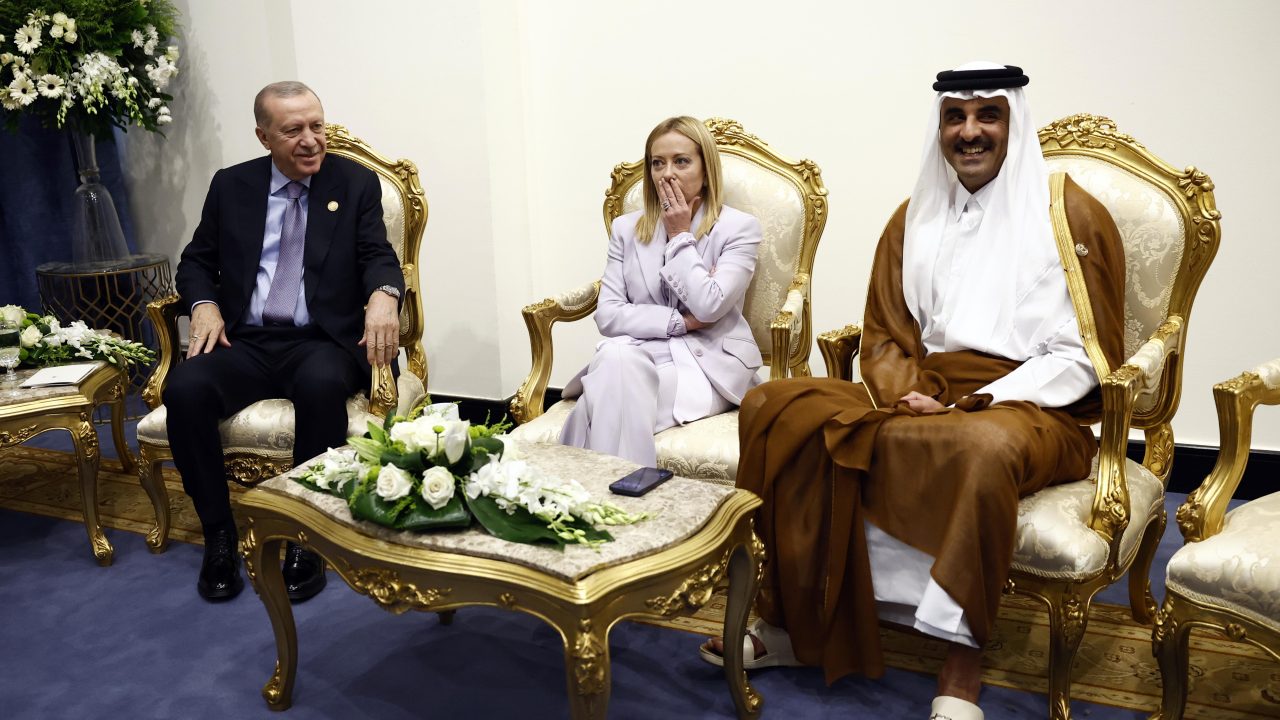
Additionally, on the summit’s margins, Erdoğan met with Italian Prime Minister Giorgia Meloni and Qatari Emir Tamim bin Hamad Al Thani to deliberate on the peace monitoring mechanism under the guarantors’ supervision. Italy-Turkey relations, institutionalized since 1856, are thriving in a “golden era,” with trade growth and strategic partnerships in defence and security as fellow NATO and Mediterranean Union members. Prospects for unmanned systems co-production underscore their bridging role across the Mediterranean. Meanwhile, Turkey-Qatar ties represent one of the Middle East’s closest alliances, forged during the 2017 GCC crisis when Turkey supported Qatar against a blockade. Military pacts, including Turkish bases in Qatar and equipment exports, have deepened, with Qatar funding Turkey’s regional ambitions in Libya and Syria.
Turkish diplomatic sources indicate Ankara is pushing for an international coordination centre to enforce ceasefire terms, prioritising aid delivery, Gaza rebuilding, and de-escalation prevention. From the summit podium, Erdoğan reminded attendees that Turkey, the U.S., Qatar, and Egypt are the peace guarantors, responsible for upholding the truce, ensuring stability, and facilitating post-war recovery. “Peace in Gaza is not just a regional issue; it is a test for the international community,” he declared, affirming Turkey’s commitment to a justice-based solution fostering cooperation and coexistence.
Erdoğan’s summit activities not only amplified Turkey’s voice but also positioned it as a pivotal player in post-conflict Gaza, leveraging historical ties and recent diplomatic gains to influence the region’s future.
Turkey unveils $1.5 billion technology hub to power Steel Dome air defence system
Edited by g.g.
Caption: Italian’s Prime Minister Giorgia Meloni (C), attends a bilateral meeting with Emir of Qatar Sheikh Tamim ben Hamad al-Thani (R) and Turkish President Recep Tayyip Erdogan (L) at the Gaza International Peace Summit in Sharm el-Sheikh, Egypt, 13 October 2025. US President Donald Trump alongside Egypt’s President Abdel Fattah al-Sisi with leaders from more than 20 countries attend the summit in Sharm El-Sheikh. The first phase of Gaza peace plan between Israel and Hamas involves the release of Israeli hostages and Palestinian prisoners, the partial withdrawal of Israeli forces, and the delivery of humanitarian aid to Gaza. EPA/YOAN VALAT /POOL
Updated: October 14, 2025 - 06:49