 Edit
Diaspora vote: the temptation of the ‘patriotic’ ballot
Nostalgic ethno-nationalism has taken hold of a significant part of Bulgarian emigrants
In the parliamentary elections in June 2024, the newly established patriotic party “Velichie” (Greatness) surprisingly ranked third in terms of votes among Bulgarians in the UK. Four months later in Toronto, in the vote on 27 October, “Vazrazhdane” (Revival) – an openly pro-Russian and anti-European formation – became the preferred party among emigrants in the Canadian capital.
This party, led by Kostadin Kostadinov, is in the top three of political forces preferred by Bulgarians abroad in successive elections over the last three years. In the elections held after the significant civil protests in 2020-2021, the most votes abroad went to “There is Such a People” (ITN) – the then-established national populist party of showman Slavi Trifonov.
According to data from the Open Society Institute for 2023, about 1.6 million Bulgarians live outside their homeland, and nearly ⅔ of them are concentrated in five countries – Germany, Turkey, the United Kingdom, Spain, and the United States.
An average of only 12-14% of them vote in Bulgarian elections abroad, with a significant part of them betting on nationalist and conservative parties, and much less on liberal ones.
Such results are paradoxical at first glance, since most Bulgarian emigrants live in societies built on the principles of liberal democracy and benefit from its achievements.
Similar picture on both sides of the Danube
The trend is visible after 2020, when hybrid campaigns became more active, and populist and patriotic formations such as “Vazrazhdane” began to gain momentum, using topics such as COVID restrictions and anti-vaccination for political mobilization.
Similar processes are underway in Romania, the country, which was “packaged” with Bulgaria on its way to EU accession. Since 2020, when the COVID pandemic broke out, anti-system parties such as S.O.S România and the Party of Young People (POT) have gained momentum. They won among younger and disillusioned emigrants, thanks to anti-globalist messages, with an emphasis on national identity.
The “Alliance for the Unification of Romanians” (AUR) was also born as an anti-vaccine movement – an anti-system formation with a strongly nationalist profile, which today sends its leader George Simion to the runoff for president of the country on 18 May.
In the first round, the far-right Eurosceptic Simion led not only in Romania but also achieved an impressive victory among the Romanian diaspora, which showed record activity.
Romanians who voted abroad numbered 973,129, with the largest number of votes coming from Italy (over 63,000), the United Kingdom (56,000), Spain (around 47,000), and Germany (44,520). Simion won nearly 70% of the vote in Germany, Spain, and Italy, where a large proportion of Romanians are blue-collar workers.
Reportedly, the roots of this support go back to 2020, when many Romanians working in Italy and Spain voted for AUR in the parliamentary elections.
The same trends are observed among Bulgarian emigration. In the 2021 presidential election, the candidate for a second term, Rumen Radev – a pro-Russian Eurosceptic with anti-elite rhetoric – was the favorite of Bulgarians abroad and received 66.97% of their vote in the run-off.
Nostalgic ethno-nationalism has taken hold of a significant part of Bulgarian emigrants, who use it to “apologise” for their emigration. And the algorithms of social networks reinforce it, directing them to content that affirms the feeling of betrayal by the country, disappointment with the present – “corruption and lawlessness reign” – and idealisation of the past.
Nostalgia, education, or projection of the “sweet native image”?
The shortest answer to the question: “Why is Bulgarian emigration not (mostly) liberal?” is: “Because Bulgaria is not liberal either.” Liberalism has never flourished in Bulgaria, and there are deep historical reasons for this – there are no such traditions.
After the Liberation in 1878, although liberal parties appeared, they were often torn apart by internal conflicts. In the 20th century, political elites showed a tendency towards authoritarian models of governance – from the interwar period to the totalitarian regime after 1944, which destroyed pluralism and civil liberties. After 1989, Bulgarians associated liberalism with unpopular policies such as economic liberalisation, which they blamed for social inequalities and impoverishment during the transition, rather than the post-communist elites who actually controlled the transformation.
In addition to historical reasons, there is also a contemporary context. Growing nationalism in Europe, discontent with globalisation, and crises such as the pandemic, migratory pressure, inflation caused by high energy prices, and the war in Ukraine have increased support for anti-establishment parties.
The diaspora from the former Eastern Bloc is particularly susceptible to these processes.
“The lack of mass support for liberal parties among Bulgarian emigrants in Western democracies can be explained both by the low level of integration of a large part of them, and by the limited perception of the values characteristic of the local socio-cultural environment,” says Dobromir Zhivkov, managing director of the sociological agency Market Links, in exclusive comments to EUalive.
In his words, closed enclaves of Bulgarian communities are often formed, which are encapsulated, without showing active interest in learning the local language, becoming engaged in civil society, and fully included in public life. He notes that this is not a phenomenon characteristic only of the Bulgarian diaspora, but as a highly symptomatic example, he gave the example of the Bulgarians who spied for the Kremlin regime in Great Britain.
UK jails Bulgarian spy ring as Sofia stays silent on Kremlin links
Zhivkov summarises a profile of a Bulgarian emigrant, “who is not particularly highly educated, has not been able to start or continue his professional career in the local economy, feels rejected and alienated, and is susceptible to the extremely simplified picture of the world that anti-democratic and anti-European propaganda paints.” Such people perceive themselves as patriots and nostalgic for the past and, at the same time, are often in a deep value conflict with the basic principles of democracy and liberalism, he notes.
Commenting for EUalive, political scientist and co-founder of the Trend Research Center Dimitar Ganev distinguishes two types of emigrants: the first is the young person who goes to the West to study and has the opportunity to stay and integrate into the labour market; the second type is the emigrant who leaves the country due to economic coercion in search of higher incomes that Bulgaria cannot provide.
“Young people go with the idea of becoming part of this community, they are open to it, and they are not typical emigrants. While the second type of people do not go by choice, but by incident, they are not culturally connected to this environment and do not accept the liberal culture dominant in Western countries. They believe that it is liberal democracy that is to blame for the state of Bulgaria – the narrative being that the West came to Bulgaria, closed factories, imposed various rules, and they are angry with it,” Ganev commented.
This translates in their electoral behavior, he explains. Ganev describes three waves of emigration to Western Europe and the United States, defining the profile of the Bulgarian emigrant and his more conservative attitudes. The first includes people from small industrial communities who became unemployed and emigrated between the 1990s and 2001. The second wave includes legal migrants after 2007, when Bulgaria became part of the EU, seeking better work opportunities to support their families. The third wave is almost entirely ethnic, mainly Roma and Turks, and is most pronounced in Germany.
In the near future, the electoral attitudes of the Bulgarian diaspora are unlikely to undergo serious changes. For such processes to begin, they must first manifest themselves in Bulgaria, where the bad example was given by the president himself, who now leads the fight against the euro.
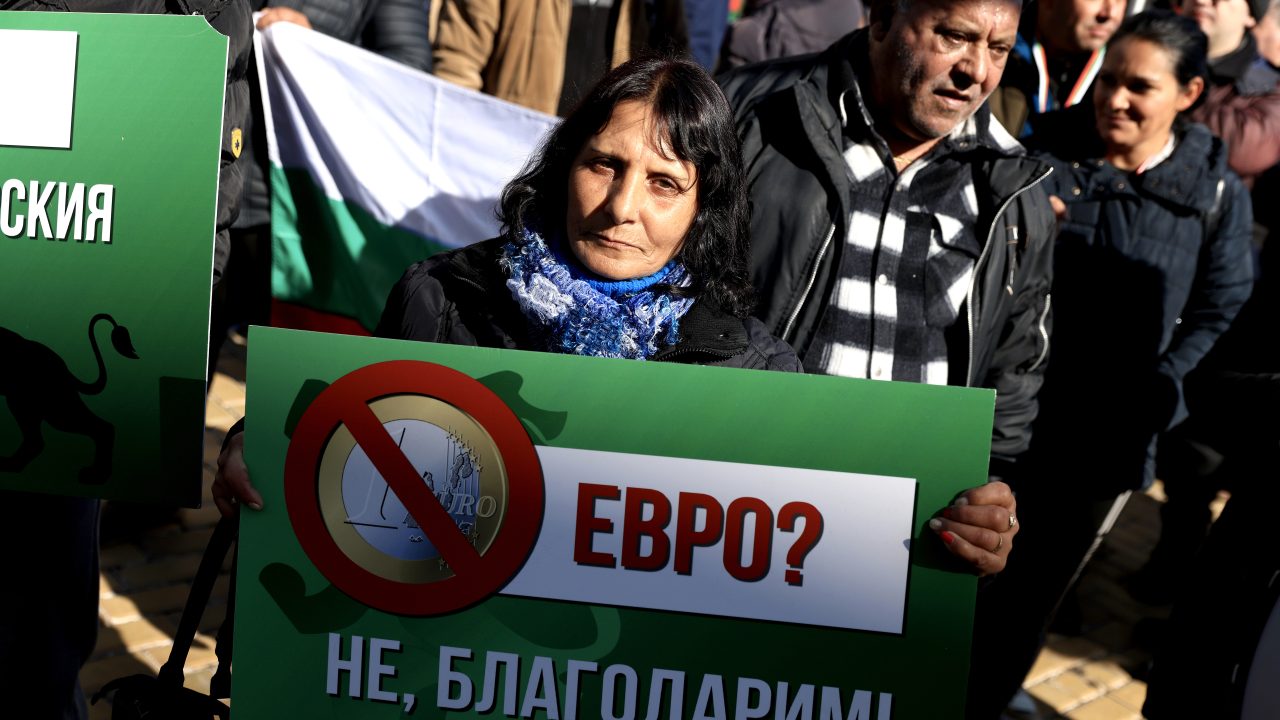
Caption: A participant holds a placard reading ‘Euro no thanks’ during a protest in front of the Bulgarian National Bank, in Sofia, Bulgaria, 22 February 2025. The protest, called by the Revival (Vazrazhdane) party, is against Bulgaria’s entry into the Eurozone and adoption of the euro planned for 2026. [EPA-EFE/VASSIL DONEV]
Updated: May 14, 2025 - 06:39