 Edit
Coordinated narrative? Claims of Russian inspections at NATO bases resurface
From Romania to Bulgaria and Poland, recurring claims of Russian access to NATO facilities raise questions of coordination
A claim that Russia inspected Romanian military bases in 2023, while it was waging war against Ukraine, has revived a recurring narrative across Central and Eastern Europe: that Moscow retains the right to enter and inspect NATO military facilities under international security agreements.
The claim was made on 20 July by retired General Dorin Toma, former commander of NATO’s multinational division. In a Facebook post, Toma argued that, under the Treaty on Conventional Armed Forces in Europe (CFE), Romania had been legally required to provide all signatory states, including Russia, with detailed annual information about the number and location of certain categories of weapons.
He further claimed that, until the treaty was suspended in 2023, Russian military inspection teams had physically travelled to Romania, entered military bases and depots and counted equipment to ensure that the country did not exceed the treaty’s limits.
The retired general also said that, during his time as commander, he had personally received an unannounced visit from a Russian delegation. He referred separately to the OSCE Vienna Document, under which Romania provided annual information on the organisation of its armed forces, the number of active military personnel and major weapons systems entering service, such as its first F-16 aircraft and HIMARS systems acquired before 2022.
Two days later, Romania’s Defence Ministry rejected the claim through the Inforadar platform, describing it as false and seriously distorting the international mechanisms for arms control and verification.
According to the ministry, the European security architecture established through the OSCE over the past three decades was built around several key instruments: the Treaty on Open Skies, the 2011 Vienna Document on confidence- and security-building measures and the CFE Treaty.
The CFE Treaty was signed in 1990 and ratified by Romania in 1992. Romania and the Soviet Union, later represented by the Russian Federation, were among its signatories. However, Russia unilaterally suspended its participation in the treaty in 2007 and subsequently ceased fulfilling its obligations under it. In June 2023, Moscow notified the treaty’s depositary, the Netherlands, of its decision to withdraw. The withdrawal took effect on 7 November 2023.
As a result, the Defence Ministry says, Russia had neither carried out nor received inspections under the CFE Treaty since 2007. Romania suspended its own implementation of the treaty in 2023 as part of a coordinated move by NATO allies following Russia’s decision to withdraw. The legal effects for Romania took effect on 14 December 2023.
The Vienna Document is a different instrument. It is a political, rather than legally binding, OSCE document establishing confidence- and security-building measures among participating states. Romania and Russia remain signatories.
The last verification activity carried out by Russia in Romania under the Vienna Document took place in 2021. After Russia’s full-scale invasion of Ukraine on 24 February 2022, Moscow did not conduct further verification activities under the document on Romanian territory.
The Defence Ministry also stressed that these instruments were limited in scope. The CFE Treaty, for example, covered only five categories of conventional weapons: battle tanks, armoured combat vehicles, artillery, combat aircraft and attack helicopters.
Nor did Russia continue to conduct observation flights over Romania under the Open Skies Treaty. Following Russia’s withdrawal from the treaty in 2021, no further Russian observation flights took place; the last one over Romanian territory was conducted in 2020.
The broader narrative, however, is not new.
In Bulgaria, claims circulated on Facebook and Telegram in 2023 and 2024 that the Novo Selo military base, used jointly by Bulgaria and the U.S., could be inspected by Russian officials under international agreements. The messages suggested that Russia therefore had access to Bulgarian military installations.
Bulgarian authorities and security experts explained that no agreement gave Russia automatic access to the country’s military bases. The narrative was based on a distorted interpretation of OSCE transparency mechanisms. The claims referred to a 2015 Russian inspection at Novo Selo and other locations in Bulgaria, but that activity had taken place under the Vienna Document and was subject to its rules.
Similar claims have circulated in Poland and Germany, where pro-Kremlin channels have suggested that Russia has the right to inspect NATO bases and facilities hosting U.S. troops. In both cases, the Vienna Document or the former CFE Treaty has been invoked to imply that Moscow enjoys unrestricted access to Western military infrastructure.
The common feature of these narratives is the use of real treaties and verification mechanisms while omitting the conditions governing them. Reciprocal inspections and verification activities were subject to specific procedures, notifications and agreements between states. They did not give Russia free access to NATO bases.
The narratives are also rooted in the fact that, before the war in Ukraine, Russia did conduct inspections in NATO countries under existing international mechanisms, including in the Baltic states in 2017 under the Vienna Document.
But the existence of such mechanisms does not mean that Russia can inspect NATO bases at will. As the security relationship between Moscow and the West has deteriorated and key arms-control arrangements have been suspended or collapsed, the conditions under which such activities could take place have fundamentally changed.
The article in Romanian by EUalive’s partner Espress.ro can be found here.
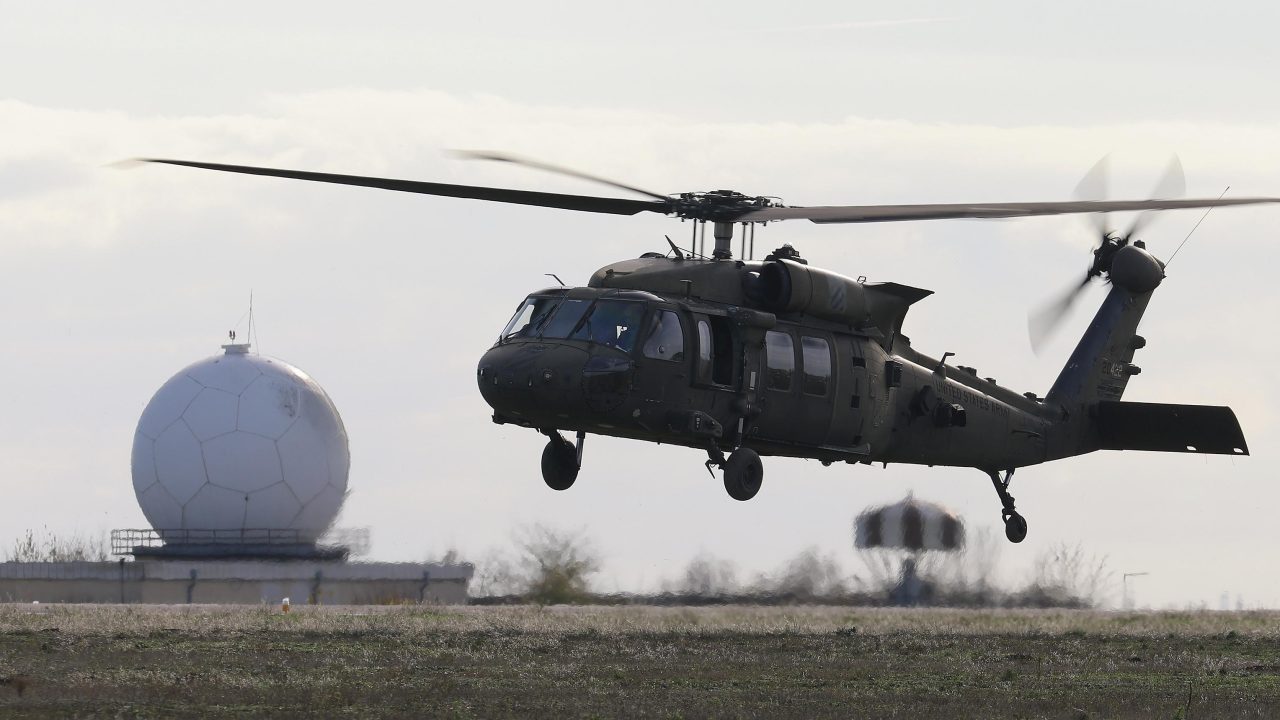
Caption: A U.S. military Black Hawk helicopter makes the last check near the ground while preparing for the aerial base inspection of US Army Europe and Africa Commanding General Gen. Christopher Donahue (not pictured) at the U.S. Army garrison Black Sea, at the 57-th military airbase Mihail Cogalniceanu, near Constanta city, Romania, 25 November 2025. EPA/ROBERT GHEMENT
Updated: July 27, 2026 - 17:56