 Edit
Confrontation between the UAE and Saudi Arabia – extremism versus modernity
While currently focused on Iran, Washington must also manage a complex situation involving its two most important partners in the region
Rivalry between Arab actors create new anxiety for the future of a region emerging from one of the most traumatic phases in recent history, writes Prof. Dr. Zoran Dragišić.
Prof. Dr. Zoran Dragišić is is a full professor and vice dean at the Faculty of Security Studies, University of Belgrade.
The achievement of a ceasefire in Gaza and the movement toward post-conflict consolidation and reconstruction in this area have brought relief not only to the Middle East but also globally. The end of the Israeli campaign, which followed the Hamas terrorist attacks in October 2023, also marked the beginning of an important political process in the Middle East, in which Arab actors will play a central role.
However, their mutual relations and rivalry create new anxiety for the future of a region emerging from one of the most traumatic phases in recent history.
The confrontation between Saudi Arabia and the UAE, undoubtedly among the most important and influential actors in the Arab world, threatens to severely complicate processes in the region that have already begun to move toward de-escalation and diplomacy.
Tensions between Riyadh and Abu Dhabi are multidimensional, as is their potential fallout. Their rivalry is open in some of the most critical global hotspots, such as Yemen and Sudan, where these two powerful monarchies support opposing warring parties.
In addition, both Saudi Arabia and the UAE are key allies of the United States in the Middle East, and their confrontation has a very negative impact on American strategy in the region.
It should not be forgotten that the ambition of Donald Trump’s administration was to use the pacification of the conflict and reach a permanent rapprochement between Israel and its Arab neighbors through the Abraham Accords. Growing tensions between America’s two main allies in the Middle East are seriously hampering this process.
The escalation of relations between Abu Dhabi and Riyadh is often simplified as just another conflict between two wealthy Gulf kingdoms, a dispute over oil market dominance, regional influence, or even as a clash of personal vanities. Such interpretations may appeal to the casually curious about the Middle East, especially in the West, but they are dangerously simplistic.
What we are witnessing today regarding the tensions between the UAE and Saudi Arabia is a deep and complex conflict between former partners. This rivalry is rooted in the clash between modernity and extremism.
On one side is the United Arab Emirates, which, under the leadership of Mohamed bin Zayed Al Nahyan, has made a series of strategic choices that have positioned it as one of the most reliable partners of Europe and the United States.
Mohamed bin Zayed, a diplomatically poised, pragmatic, and strategically disciplined leader, consolidated power after the death of his half-brother, Sheikh Khalifa, and quickly positioned the UAE among the world’s most developed economies.
Investments in innovation, artificial intelligence, and future industries have transformed the Emirates into a global powerhouse not only of capital and business but also of ideas and development.
The Emirates has become a rare place in the Middle East where people of different religions and nationalities truly feel at home and where rights are respected consistently, not just in principle.
The culmination of this clear and comprehensive strategy was the UAE’s accession to the Abraham Accords in September 2020, marking a historic rapprochement with Israel. The signing of the Abraham Accords not only confirmed the UAE’s closest alliance with the United States, the initiator of this process, but also brought significant mutual benefits for both the UAE and Israel as political, economic, and security heavyweights in the Middle East.
On the other hand, Saudi Arabia, larger in both territory and population, has for years tried to catch up with the Emirates in the processes they lead, but with limited success. Riyadh seeks to adopt the Emirati model to gain greater international stature to rapidly develop sectors that were until recently underdeveloped, such as tourism and technology hubs – in short, to enhance its soft power, an area in which the UAE is clearly leading.
This is where the crucial difference between the former allies becomes evident. Although the conflict between Riyadh and Abu Dhabi is often attributed to the proxy wars they wage through their representatives in Yemen or Sudan, these conflicts are a consequence, not a cause.
The escalation between the two influential kingdoms followed immediately after Crown Prince Mohamed bin Salman visited Washington in November 2025 and spoke with President Donald Trump. According to many, this was an extremely important visit, not only because it came seven years after the previous one, but also because it brought a significant thaw in mutual relations.
During the visit, according to reports, the Saudi de facto leader asked the US to impose sanctions on the UAE, accusing his former ally of supporting the “wrong side” in the war in Sudan.
What followed was not a diplomatic dispute but a coordinated campaign. Attacks on the Emiratis and their leader appeared on social media, aided by extremist Islamist networks, accusing the Emiratis of betraying Islam by cooperating with Israel. The goal was clear: to personally delegitimize Mohamed bin Zayed, with the calculation that weakening him would also weaken the UAE.
Riyadh recognized the opportunity and used Mohamed bin Salman’s “reconciliation visit” to Washington as a sign of his political rehabilitation, seven years after the brutal murder of journalist Jamal Khashoggi in Istanbul. The friendly reception at the White House was, for the Saudi Crown Prince, a sign of forgiveness for the crime against a dissident journalist with whom he was directly associated in the international public. More importantly, it was an act that restored the Saudi leader’s full legitimacy on the world stage.
In this way, President Trump smoothed previously damaged relations with one of his most important allies in the Middle East. At the same time, he allowed Riyadh’s informational and ideological aggression against America’s most consistent ally in the region, the United Arab Emirates, to flare up.
This provided scope for much broader security challenges that go beyond bilateral tensions between the two powerful Gulf monarchies. The frequent accusations that the Emirates have “abandoned Islam” are not mere propaganda; they revive narratives of hatred, revenge, and holy war.
At the base of this strategy lies a major and new danger for the hard-won stability in the Middle East: the use of religious extremism as a geopolitical weapon.
In the extremely fragile security situation in the Middle East, such narratives will not remain confined to the Gulf. They risk inspiring attacks not only on non-Muslim sites in the UAE, Bahrain, or Jordan, but also across Europe, the Balkans, and even the United States.
Their reactivation directed at the UAE shows that Saudi Arabia has not truly confronted its own extremist legacy. That heritage is only disguised in the image of a young, apparently modern leader inclined to open his country to the world. Under the surface, however, the old tendencies persist: revenge, dominance, and a willingness to destabilize the region for political advantage.
The United States bears the primary responsibility for mitigating this wave of destabilization. The administration of Donald Trump must actively confront the conflict and do so quickly. While currently focused on Iran, Washington must also manage a complex situation involving its two most important partners in the region.
The sooner Washington establishes a clear red line and stops this dangerous trend of new extremism, the lower the risk will be to Middle Eastern and global security. Tensions between the UAE and Saudi Arabia extend beyond regional disputes.
This is a long-term test: whether the Emirate’s modern, tolerant, and responsible state strategy will be upheld as a model for the Middle East’s future or sacrificed for short-term political convenience.
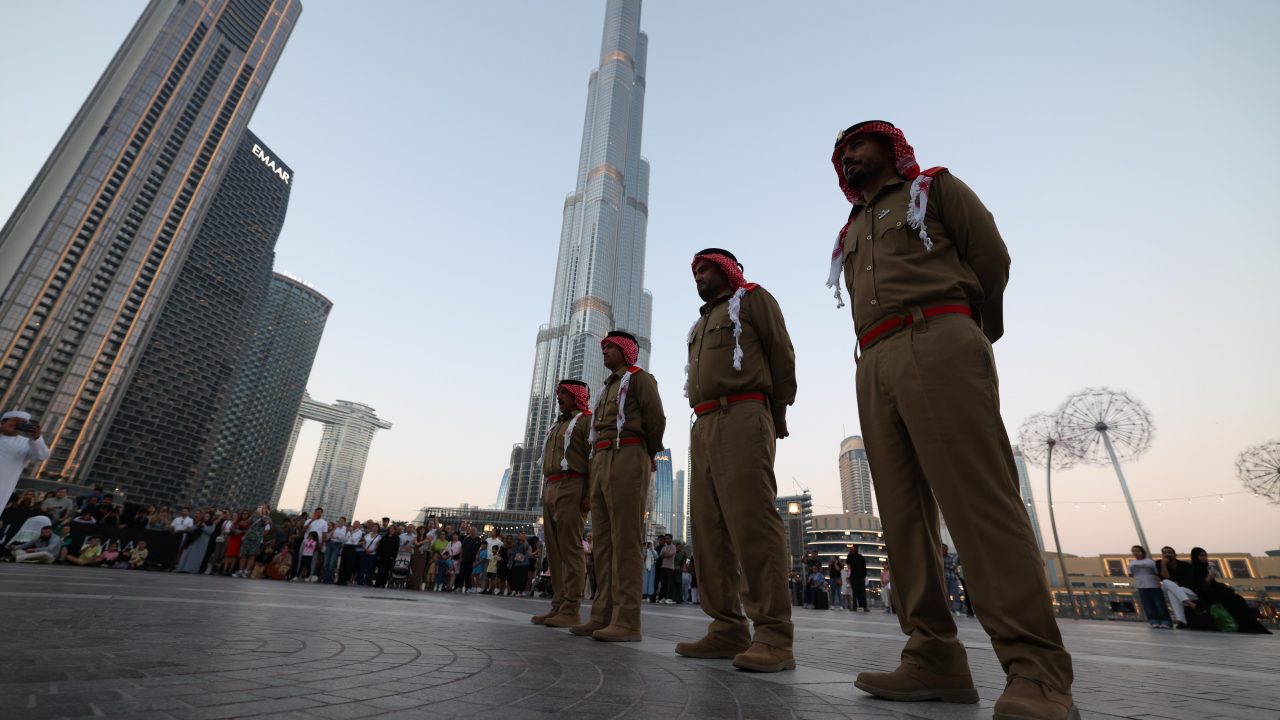
Caption: Dubai police officers prepare to fire a salute from a 1940 British-made 25-pounder cannon to signal the end of the fasting day during the Muslim holy month of Ramadan in front of the Burj Khalifa in Dubai, United Arab Emirates, 22 February 2026. Muslims around the world observe Ramadan by praying at night and abstaining from food and drink between sunrise and sunset. Ramadan is the ninth month of the Islamic calendar, and it is believed that the first verses of the Koran were revealed during its last 10 nights. EPA/ALI HAIDER
Updated: February 24, 2026 - 16:53