 Edit
Civil society demands in Brussels: No more blank checks for Vučić from the EU
Civil society groups urge the EU commission to tie Serbia’s accession talks to democratic reforms, instead of seeking short-term deals
As Ursula von der Leyen met Serbian President Aleksandar Vučić in Belgrade on Wednesday (15 October), civil society groups were in Brussels delivering a blunt message: the EU must stop turning a blind eye to Serbia’s slide away from democracy and defend the rule of law.
The European Commission president’s visit — part of her “Western Balkans Tour” — came with a noticeably tougher tone, but not enough to satisfy the protesters.
Von der Leyen in Belgrade: hesitating between soft diplomacy and firm demands
“We need to see progress on the rule of law, the electoral framework, and media freedom,” von der Leyen said after meeting Vučić. “These reforms are not easy … but they must include all parts of society and the political spectrum.”
Her comments mark a departure from the EU’s previously cautious rhetoric toward Belgrade — and come ahead of a politically charged anniversary that could test Serbia’s stability.
Novi Sad anniversary
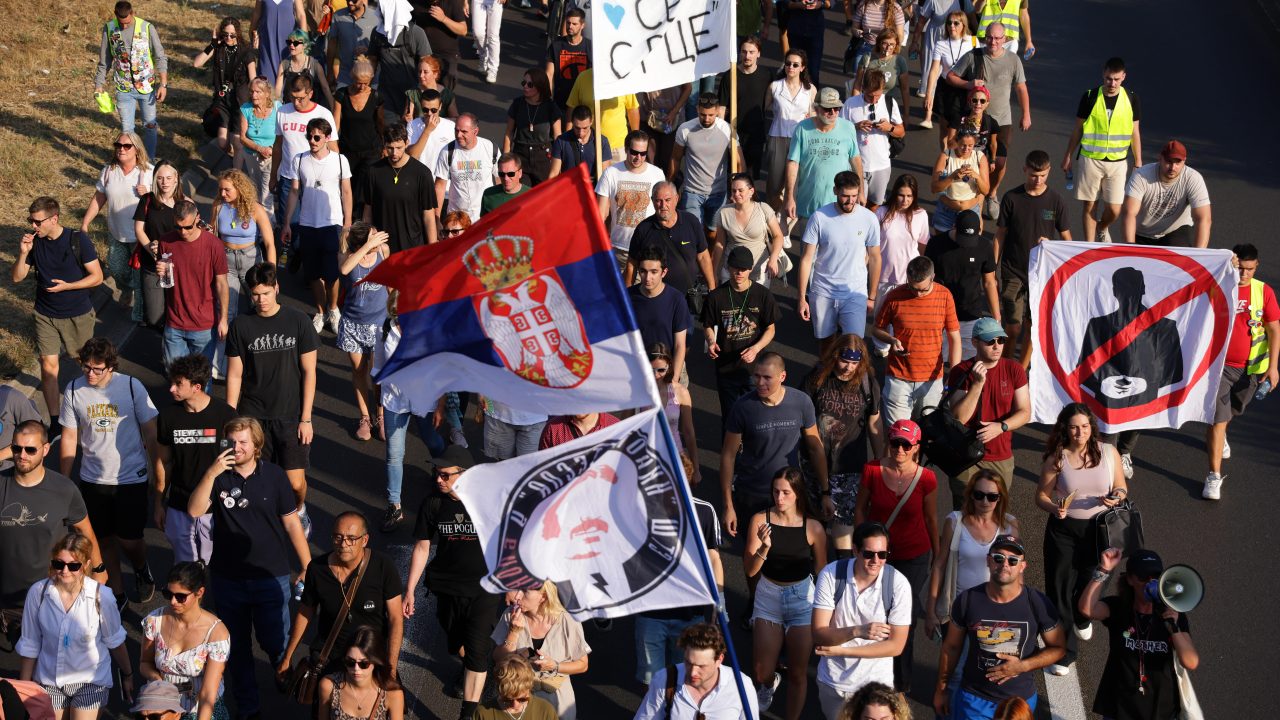
On 1 November, Serbia will mark one year since the collapse of a concrete canopy at Novi Sad’s main railway station, which killed 16 people. The disaster triggered mass protests over alleged corruption in public procurement and oversight.
On 15 March, those demonstrations were brutally dispersed. Police used an acoustic cannon to break up crowds, while witnesses say authorities assembled thousands of pro-government agitators to incite violence — tactics reminiscent of Ukraine’s anti-Maidan operations.
Human rights groups now fear the anniversary could bring another heavy-handed response.
Shift in Brussels
Von der Leyen’s harder line mirrors a broader recalibration in Brussels. Slovenia’s Marta Kos, the new commissioner for enlargement and a member of the Renew Europe group, has been hailed as a significant improvement over her predecessor, Olivér Várhelyi, who was widely criticized for accommodating autocratic tendencies in candidate countries.
EU Commissioner urges Serbia to reform amid political stalemate and student protests
Kos has publicly supported Serbia’s student-led protest movement, which Renew recently nominated for the Sakharov Prize for Freedom of Thought, praising the activists for “igniting a historic movement for a free, democratic Serbia.”
Inside the European People’s Party (EPP), scrutiny of Vučić’s ruling Serbian Progressive Party (SNS), affiliated to the EPP since 20015, is also intensifying. An internal review of the SNS’s membership in the EPP is underway, this was confirmed by an EPP MEP who met with civil society representatives this week.
Clashing narratives
Pressed in Belgrade about police violence, Vučić sought to minimize the issue.
“Police reactions and the excessive use of force – if it happened – happened to the least possible extent,” he said.
Rights defenders tell a different story. During a press briefing with a delegation of leading Serbian human rights defenders organised by Amnesty International, Sanja Radivojević, senior legal adviser at the Belgrade Centre for Human Rights (BCHR), and Dragiša Ćalić of YUCOM, the Lawyers’ Committee for Human Rights, said they had collected hundreds of testimonies from students and citizens alleging police brutality.
Radivojević warned that opening new accession chapters with Serbia “would send the wrong message” as the situation deteriorates. “Public trust in the EU is already fragile,” she said.
Beyond transactional politics
According to Marko Drajic of the Belgrade Center for Security Policy (BCSP), Brussels must break with what he calls a “transactional approach” – rewarding Belgrade for cooperation on migration or regional stability while overlooking democratic backsliding.
“There are signs this logic is changing,” Drajic told EUalive, pointing to polls showing record levels of public disillusionment with Vučić’s government, despite overwhelming media control.
The student movement that emerged from the Novi Sad protests has become a powerful political force. Its central demand: snap elections.
Civil society leaders are skeptical that those elections would be free or fair – but, they note, for the first time Vučić cannot count on an easy win.
Survey suggests Serbia nears tipping point: 44% back the Student List, only 32% support Vučić
Caption: People march during a protest against police brutality in Belgrade, Serbia, 08 September 2025. The protest was organized by university students during ongoing protests following the collapse of the Novi Sad railway station canopy on 01 November 2024, which killed 16 people, and has since grown into demands for early elections. EPA/ANDREJ CUKIC
Updated: October 17, 2025 - 06:01