 Edit
Trump-Zelenskyy lunch: balancing missiles, mediation, and mutual understanding
Central to the talks was the prospective Trump-Putin meeting, slated for Budapest in the coming weeks
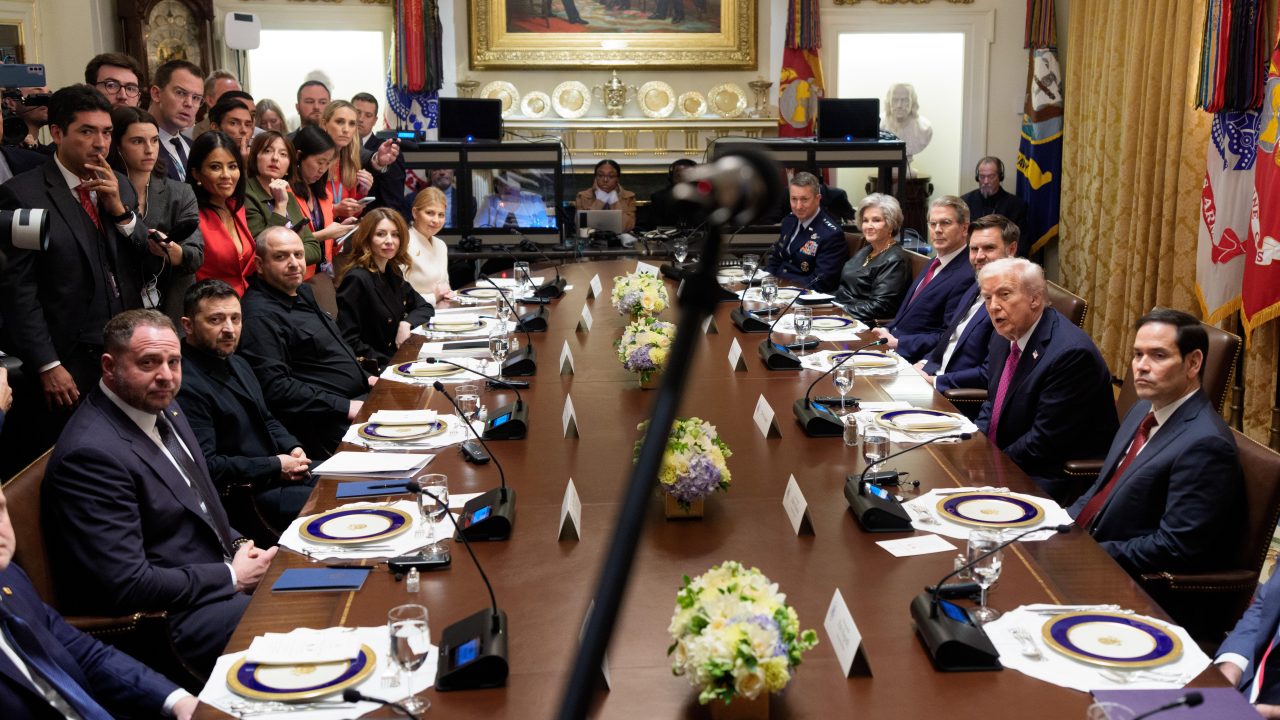
In a bilateral lunch that stretched well beyond its scheduled hour, Ukrainian President Volodymyr Zelenskyy and U.S. President Donald Trump convened at the White House on 17 October, navigating the delicate interplay between bolstering Ukraine’s defences and pursuing a swift end to the war with Russia. EUalive’s partner Suspilne reports from Washington.
The meeting, the fourth between the two leaders, unfolded not in the Oval Office but over a private meal, underscoring the informal yet intensive nature of their dialogue. Zelenskyy arrived with a high-level delegation, including Andriy Yermak, head of the President’s Office; Rustem Umerov, Secretary of the National Security and Defence Council; Svitlana Hrynchuk, Minister of Energy; and Olha Stefanishyna, Ukraine’s Ambassador to the United States.
The discussions zeroed in on Tomahawk missiles, air defence enhancements, energy resilience, and the shadow of an impending Trump-Putin summit – topics that revealed both alignment and friction in the transatlantic partnership.
The encounter began later than anticipated, kicking off around 8:30 p.m. Kyiv time instead of the planned 8:00 p.m., allowing the leaders extra time to delve into pressing matters. Trump, fresh from a phone call with Russian President Vladimir Putin the previous day, positioned himself as a mediator eager to broker peace.
“We inherited this and we would like to see if we can finish it, finish it. We want it to end. So many people have died,” Trump remarked, evoking the human toll of the conflict that has raged for over three and a half years since Russia’s full-scale invasion in 2022. He praised Zelenskyy as a “strong leader” with whom he “gets along very well,” crediting their rapport for “significant progress” toward resolution.
Clash of visions
Yet, beneath the cordiality, Zelenskyy’s pleas for advanced weaponry clashed with Trump’s vision of an immediate ceasefire, even if it required Ukraine to concede territory along current battle lines.
Central to the talks was the prospective Trump-Putin meeting, slated for Budapest in the coming weeks. Trump indicated it would likely proceed in a bilateral format, with Zelenskyy kept “in touch” amid the “lot of negative emotion” between the Ukrainian and Russian presidents.
“It hasn’t been determined yet, but I would say that it will most likely be a bilateral meeting,” Trump said, adding that Putin “wants to make a deal.”
Drawing on his self-proclaimed deal-making prowess – boasting of eight prior successes – he vowed to secure a ninth, emphasizing the need for the leaders to “understand each other.”
Zelenskyy, ever pragmatic, affirmed Ukraine’s readiness for negotiations in any configuration – bilateral or trilateral – stressing that “the main thing is to achieve peace.” However, he tempered optimism, noting the ceasefire’s elusiveness: “We want this. Putin doesn’t want it.”
Trump’s post-meeting comments amplified his urgency for de-escalation. En route to his West Palm Beach residence, he implored both sides to “stop the war immediately,” suggesting a freeze at the current front lines. “You stop at the battle line, and both sides should go home, go to their families. Stop the killing. And that should be it. Stop right now at the battle line. I told that to President Zelenskyy. I told it to President Putin,” he declared.
Zelenskyy, in response, acknowledged the logic: “President Trump is right, and we have to stop where we are. This is important, to stop where we are, and then to speak.” Yet, the Ukrainian leader confided in reporters that he was “realistic” about outcomes, having just spoken with European counterparts to coordinate pressure on Moscow.
The spectre of the Budapest summit loomed large, especially after the Kremlin’s tepid response to Trump’s overtures. Moscow suggested the talks might slip “a little later” than the two-week timeline floated by the U.S. president, fuelling suspicions of stalling tactics.
Trump brushed off concerns that Putin might be “playing” him, quipping, “You know, I’ve been played all my life by the best of them, and I came out really well, so it’s possible.” Analysts echoed these doubts. Max Bergmann, a Russia expert at the Center for Strategic and International Studies, viewed Putin’s engagement as a ploy to forestall U.S. arms transfers.
“Putin’s move appeared meant to make the U.S. transfer of such weapons less likely,” Bergmann observed. Similarly, Michael Carpenter, a former U.S. official now at the International Institute for Strategic Studies, noted the meeting fell short of Zelenskyy’s expectations, reflecting Washington’s reluctance “to impose costs on Russia.”
At the heart of Zelenskyy’s agenda were long-range Tomahawk missiles, seen as a game-changer to counter Russia’s territorial advances—nearly 5,000 square kilometers gained in 2025 alone, per Putin, atop the 20% of Ukraine already occupied.
Map shows Russia’s pain points
“We don’t have Tomahawks, that’s why we need Tomahawks,” Zelenskyy said bluntly, highlighting Ukraine’s arsenal of thousands of drones primed for strikes but lacking the range for deep incursions. An informed Ukrainian source revealed that the delegation presented maps pinpointing “pain points” in Russia’s defence-industrial complex – key facilities and vulnerabilities that could compel Putin to the table. “The maps show the pain points of the Russian defence industry and military economy that can be tapped to force Putin to end the war,” the source told Suspilne.
Trump did not outright reject the request, confirming it as a discussion point alongside authorization for strikes on Russian soil – a potential “leverage over Moscow to advance negotiations.” Yet, he voiced reservations about escalation and U.S. stockpiles: “We want Tomahawks also. We don’t want to be giving away things that we need to protect our country.”
Zelenskyy countered with a vision of reciprocity, proposing technology swaps. “The US has Tomahawk and other missiles, but they can also have our drones. Therefore, we can work together, we can strengthen American production,” he suggested, touting Ukraine’s “very good drones” as a commodity the U.S. could acquire.
Mykola Bielieskov, a senior analyst at the Ukrainian NGO Come Back Alive, underscored the strategic imperative: Tomahawks would “level a playing field that is tipped toward Russia,” enabling “constant pressure” on Moscow’s war machine without expecting overnight collapse.
Trump touched on global ripples, fielding a Suspilne query about Russian oil exports. He claimed India – previously sourcing 38% of its crude from Russia – had “practically stopped” purchases, a shift he attributed to diplomatic pressure. On Hungary, he lamented its “difficult” position as a landlocked nation reliant on a single aging pipeline, complicating diversification.
Lighter moments pierced the gravity. Trump lauded Zelenskyy’s attire – a recurring “same suit” from prior visits – as “very stylish,” quipping, “He looks beautiful in his jacket. I hope people notice.” Zelenskyy parried with humour: “Same suit, because same president… The next president will have a different suit.”
In a whimsical aside, Trump floated a journalist’s idea of a tunnel linking Russia and Alaska, deeming it “interesting” but novel. He mentioned a recent Alaskan road unlocking mineral riches, in which the U.S. holds a “good ownership stake.” Zelenskyy demurred: “I’m not happy with it.”
A longer version of this article by Suspilne can be found here.
With Reuters. Edited by g.g.
Caption: President of Ukraine Volodymyr Zelensky (sitting, 2-L) and US President Donald J. Trump (2-R) participate in a bilateral meeting in the Cabinet Room of the White House in Washington, D.C., USA, 17 October 2025. Ukrainian President Zelensky is visiting the United States as Trump pursues a peace deal in the Russia-Ukraine war. EPA/AARON SCHWARTZ / POOL
Updated: October 18, 2025 - 07:19