 Edit
Study: EU influence holds in Europe’s East but falters against China in Africa and Turkey
The GEOII index underscore the Union’s urgent need to deploy more economic power if it wants to counter Beijing’s growing presence
The European Union remains the dominant geo-economic force in its eastern neighbourhood, but faces mounting challenges from China in Africa, Turkey and parts of the Mediterranean, according to a new study measuring regional influence.
The findings underscore the Union’s urgent need to deploy economic power more strategically if it wants to counter Beijing’s growing presence and preserve political leverage in its own backyard.
A joint project by the Vienna institute for international economic studies, the Bertelsmann Stiftung and the European centre for international political economy (ECIPE) has produced the first Geo-Economic Interconnectivity Index (GEOII).
The index tracks trade, financial flows and political ties across four neighbouring regions – the Eastern Partnership states, the Western Balkans, Turkey, and North Africa and the Middle East – between 2010 to 2023.
Overall, the EU still leads in every region assessed. However, the study highlights that China is now its primary competitor, expanding its influence through infrastructure projects, investment and growing exports. Beijing’s reach is most visible in North Africa, the Middle East and Turkey, where it has seized ground in high-tech trade and strategic investments.
“The Middle East, North Africa and Turkey are good examples of how, for the EU, stronger political ties do not necessarily translate into more intensive economic cooperation. The opposite is true, even though the EU is still the most important trading and investment partner for these countries. For stronger economic ties, the Union would also have to intensify its economic efforts, so as not to leave the field to China,” said Philipp Lamprecht, director at ECIPE.
While Brussels remains the main trading and investment partner in the southern periphery and Turkey, the report warns that this lead is increasingly under threat. Chinese projects linked to the Belt and Road Initiative have provided a visible alternative in countries often frustrated by slow EU decision-making.
Strength in the East, decline for Russia
In Eastern Europe, the EU has overtaken Russia as the dominant player, particularly in Ukraine and Moldova, where candidate status has shifted the balance decisively. Trade, finance and political ties all now favour the EU. Moscow, by contrast, has suffered a sharp decline in influence since its 2022 invasion of Ukraine.
Arms deliveries also highlight the reversal. Once the leading supplier, Russia has been replaced by EU member states supporting Kyiv. Moscow now maintains strong influence only in Belarus and Armenia, while China has failed to establish a major presence in the region.
Richard Grieveson, deputy director at Vienna institute, stressed the strategic importance of sustaining momentum: “Brussels and the member states must redouble their efforts to successfully integrate Ukraine and Moldova, but they must not forget Georgia in the process, lest they cede the field to Russia again or invite China into the EU’s direct sphere of influence.”
EU influence in Western Balkans at risk
The report confirms that the EU continues to dominate in the Western Balkans across trade, finance and politics. All six states in the region remain on the accession track, and four are already in negotiations. Yet slow enlargement and waning political attention in Western Europe are creating opportunities for China, which has entrenched itself through infrastructure projects and partnerships, particularly in Serbia and Montenegro.
Russia, by contrast, has steadily lost ground, while the United States plays only a marginal economic role.
However, China is already in second place, having significantly expanded its position through strategic partnerships and infrastructure investments, particularly in Serbia and Montenegro. Russia, on the other hand, has steadily lost geo-economic influence in the six Western Balkan states.
Although the US maintains a certain degree of political cooperation, it plays hardly any role economically.
“In order to maintain its strong position in the Western Balkans, limit the influence of external competitors and bring these countries closer to Europe more quickly, the EU needs a reformed accession process that allows for gradual EU membership in certain areas before full membership,” says Etienne Höra of the Bertelsmann Stiftung.
“It is more important than ever to view the Western Balkans more from a geo-economic perspective and to make strategic geo-economic issues in this region a clear priority for policy makers in Brussels,” Philipp Lamprecht added.
In Turkey Beijing and Moscow gain ground
Turkey represents the most delicate challenge for Brussels. The 1995 customs union boosted bilateral trade, but geopolitical tensions and rival investment have eroded the EU’s influence. China has captured significant shares of Turkey’s high-tech imports and is investing in large-scale projects, including an electric car plant by BYD.
At the same time, Russia has deepened its grip through energy supply and defence cooperation, epitomised by Ankara’s purchase of the S-400 missile system. Washington’s economic presence, meanwhile, has continued to fade amid political frictions.
“It is therefore of strategic importance for the EU to modernise the customs union with Turkey and expand it to the areas of agriculture, services and public procurement. This could unlock the full economic potential and keep competitors China and Russia at bay,’ says Richard Grieveson.
“Ultimately, a modernised customs union is also a matter of strengthening Turkey’s political ties to the EU,” he continues.
Strategic crossroads
The GEOII report emerges against a backdrop of intensifying global rivalry. Russia’s war in Ukraine is escalating, tensions over Taiwan are sharpening, and US economic policy is turning inwards as it gears up for confrontation with China. The EU, caught between these forces, is under pressure to transform its geo-economic weight into political influence.
Analysts warn that Brussels risks complacency. While the Union remains the strongest player in its immediate vicinity, a combination of slow institutional processes, internal divisions and enlargement fatigue has undermined its ability to capitalise on its strengths. By contrast, Beijing often moves faster, offering financing with fewer political conditions attached, making its proposals attractive for governments seeking immediate results.
“Whether the Union can use its economic power to consolidate its neighbourhood will define its role in a new era of great power competition,” said Etienne Höra, co-author of the study.
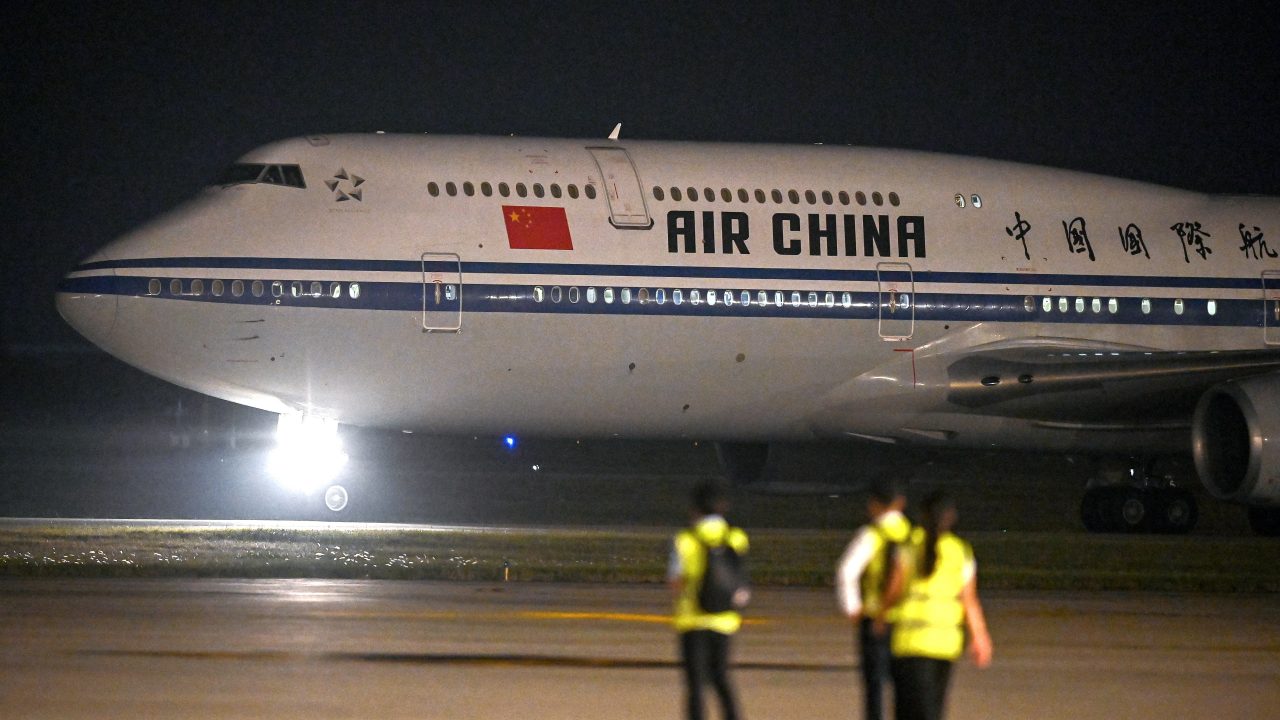
Caption: An airplane carrying China`s Premier Li Qiang arrives at Noi Bai International Airport in Hanoi, Vietnam, 12 October 2024, at the start of an official visit to Vietnam. EPA/NHAC NGUYEN / POOL
Updated: September 26, 2025 - 11:56