Edit
ECB warned over Bulgarian central bank’s inaction on Magnitsky sanctions
Bulgarian National Bank is accused of turning a blind eye in relation to the sanctioned politician and tycoon Delyan Peevski
The Bulgarian opposition liberal party We Continue the Change (Renew Europe) announced on Wednesday (20 August) that it will submit information to the European Central Bank regarding the passivity of Bulgarian institutions towards individuals sanctioned for corruption under the Global Magnitsky Act.
The signal to ECB will be mainly directed at the Bulgarian National Bank (BNB), which is accused of turning a blind eye to the enforcement of sanctions, including in relation to the sanctioned politician and businessman Delyan Peevski.
Peevski has been sanctioned by the United States for corruption under the Magnitsky Act in 2021, with identical sanctions imposed by the United Kingdom 2 years after. However, this did not prevent his party, the Movement for Rights and Freedoms (DPS), from continuing to operate its account at Bulgarian Municipal Bank.
Currently, the DPS leader is a key political player as his party supports the minority ruling coalition led by GERB (EPP) with leader the former prime minister Boyko Borissov. Peevski is accused by his opponents of wielding vast informal influence over the judiciary and security services — and calling the shots in the country. Commentators believe that he aims for the post of Prime Minister.
Peevski Über Alles: Bulgaria’s descent into political turmoil
In response to questions from We Continue the Change, the Bulgarian central bank said it could not order banks to refuse services to certain individuals because of the lack of a national legal framework. The liberal party, however, argued that the central bank has sufficient supervisory powers to issue guidelines to commercial banks and prevent risks to depositors.
We Continue the Change reminded that four years ago, when the US sanctioned Peevski and businessman Vasil Bozhkov, BNB announced that it had taken measures under the Anti-Money Laundering Act.
“The refusal to exercise these powers allows individuals like Delyan Peevski to carry out all sorts of operations, jeopardising the stability of the banking system,” the party said in its statement.
The liberals also recalled the case of Latvia’s ABLV Bank, which in 2018 was declared “failing or likely to fail” due to transactions linked to money laundering and corruption after being cut off from the SWIFT system.
The party has tabled a bill that would allow the U.S. Magnitsky sanctions to take direct effect in Bulgaria, but it was rejected by the ruling majority made up of GERB, BSP and ITN, supported by DPS.
“The BNB is not a party to these relations and has no authority to order the opening or closure of accounts,” the central bank responded.
It further stressed that information about operations and balances on accounts constitutes banking secrecy and can only be disclosed under strictly regulated legal procedures.
The BNB reacted sharply to Wе Continue the Change’s threat to alert the European Central Bank about its passivity on Magnitsky sanctions. The bank described the party’s statements as “unacceptable political pressure.”
“Attempts to shift the problem of the lack of legislative framework onto the BNB represent a violation of its independence,” it said.
The dispute comes against the backdrop of rising tensions over the enforcement of the Magnitsky Act in Bulgaria. The country still lacks a national mechanism for transposing US sanctions, despite several legislative proposals.
Four years ago, the caretaker government of Galab Donev, in which We Continue the Change’s leader Assen Vassilev was finance minister, tried to introduce a blacklist of individuals sanctioned under Magnitsky. The effort collapsed in the Supreme Administrative Court, which struck down the list on the grounds that US legislation cannot be applied directly in Bulgaria.
In June this year, a group of MPs from the old DPS party, which had split due to Peevski, and loyal to its founder Ahmed Dogan, appealed to the US Office of Foreign Assets Control (OFAC), urging it to consider sanctioning their own party.
The appeal, described in a letter seen by EUalive at the time, focused on Peevski, then only co-chairman of the MRF but since then in full control of the party. The authors argued that the party could be used as a tool to circumvent sanctions and perpetuate corruption, in violation of the US Magnitsky Act.
Peevski, who at the time was a media mogul with a wide portfolio of businesses, was sanctioned by OFAC on 2 June 2021 for “having a significant role in corruption.” The sanctions also covered a number of companies under his control. US authorities highlighted his influence over the judiciary, prosecution and security services in Bulgaria.
Following an internal rift, he removed the party’s co-chair Dzhevdet Chakarov and became the sole leader, gaining control over the party’s structure and its state subsidy of about 1 million leva (0.5 million euro). The bank account holding this subsidy is now under his supervision, MPs loyal to Dogan have warned.
Bulgarian MPs urge U.S. to sanction political party controlled by Magnitsky-listed power broker
Peevski is not the only Bulgarian sanctioned under Magnitsky. Others include former gaming industry oligarch Vassil Bozhkov, former GERB finance minister Vladislav Goranov, two former directors of the Kozloduy nuclear power plant – Ivan Genov and Alexander Nikolov.
The Magnitsky list in Bulgaria continues with the leader of the “Russophiles” party Nikolay Malinov, former BSP energy minister Rumen Ovcharov, and former deputy chairman of the Bureau for Control of Special Intelligence Means Ilko Zhelyazkov. Separately, in 2023 the United Kingdom has imposed sanctions on Peevski, Zhelyazkov and Bozhkov.
The timing is delicate, as Bulgaria is expected to join the eurozone on 1 January 2026, when the ECB will assume significantly greater supervisory powers over the country’s major banks.
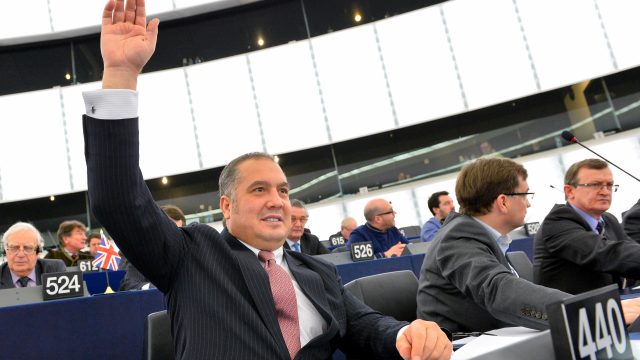
Caption: Delyan Peevski in the Bulgarian National assembly. Anton Chalakov/”Dnevnik”
Updated: August 21, 2025 - 05:58