 Edit
Czech Republic: Our support for Ukraine stays strong, but don’t take it for granted
The country's foreign minister stressed the need for Ukraine to uphold rule of law and continue the fight against corruption
Czech Republic’s Minister of Foreign Affairs Jan Lipavsky issued a diplomatic warning to Kyiv to uphold the rule of law and the continue the fight against corruption, amid the ongoing Russian invasion.
“Ukraine has our strong, though not unlimited, support. Ukraine must not slow down domestic reforms, nor should it call into question the rule of law and anti-corruption measures. These are fragile but essential elements of the rules of Ukraine’s path to Europe. We will not retreat from these demands”, wrote Lipavsky, who holds the post since 2021, in a recent column for European Pravda, a partner of EUalive.
On 23 July Ukraine witnessed its first significant wartime protests, as thousands took to the streets from Kharkiv to Kyiv and Lviv, demanding the reversal of a controversial law curbing the independence of anti-corruption agencies.
Ukraine’s wartime protests signal growing dissent against Zelenskyy’s anti-corruption rollback
In a rapid and highly scrutinised legislative reversal, Ukraine’s Verkhovna Rada adopted on 31 July Presidential bill, aimed at restoring the independence of the National Anti-Corruption Bureau (NABU) and the Specialized Anti-Corruption Prosecutor’s Office (SAPO).
Ukraine’s swift U-Turn: restoring anti-corruption independence amid western pressure
Lipavsky’s words highlight the firm stance Prague takes toward Kyiv’s European integration amid the ongoing conflict with Russia. For four years now, Ukraine has stood as a bulwark defending the values underpinning Europe itself.
Reflecting on the legacy of Central Europe’s resistance to Soviet domination, the minister referenced Czech writer Milan Kundera’s well-known essay The Stolen West, published in the early 1980s. Kundera lamented the loss of Central Europe to Soviet influence but notably excluded Ukrainians from the nations belonging to the West, instead describing them as subjects of Russian efforts to assimilate them into a wider imperial identity.
If Kundera (1929-2023) were to write today, Lipavsky suggests he would revise that view. “To die for one’s country and for Europe” – a phrase Kundera said could have originated only in cities such as Budapest or Warsaw – now applies to Ukrainian cities and their citizens who have courageously resisted Russian aggression since the Revolution of Dignity in 2014″, he wrote.
Thousands of Ukrainian soldiers and civilians have been victims of Russia’s brutal campaign marked by daily war crimes, including the forced abduction and re-education of children – crimes not witnessed in Europe since the era of Hitler, in Lipavsky’s words.
“The war concerns every one of us – directly and deeply”, the miniter stressed. “Ukrainians are defending the values on which Europe rests. They are defending the world we have built over decades for our children.”
Recalling Kundera’s description of how “Russian communism awakened the old Russian anti-Western obsession and turned it cruelly against Europe”, the minister said it is now necessary to replace “communism” with “Putinism” or “imperialism” to understand Russia’s aims.
Putin’s Russia seeks to “re-educate” Ukrainians as Russians and transform Ukraine into a satellite state, thereby threatening the entire Western civilisation.
Yet Ukrainians refuse to be “stolen” back to the East and see their future security and prosperity through integration with the European Union and NATO.
Looking ahead, Lipavsky announced plans to boost Czech economic interests in Ukraine, especially in its industrial heartland, Dnipro – a city whose residents, like many across Ukraine including Kherson, Zaporizhzhia, and Kryvyi Rih, are fighting for their homeland and for Europe.
“Donetsk, Luhansk, Mariupol, and Crimea will be Europe again when the Ukrainian flag flies over them”, Lipavsky said. “Ukraine is Europe, and it is fighting in a clash of civilisations for the future of Czechs, as well as French, Italians, Germans, Poles, and many other nations.”
Jan Lipavsky began his sixth visit to Ukraine on Monday (11 August), reaffirming the Czech Republic’s commitment to maximum support for Kyiv amid Russia’s ongoing aggression.
“I have started my sixth trip to Ukraine with a clear message – the Czech Republic will not give up its support for Ukraine in the fight against the Russian aggressor”, Lipavsky wrote on X.
The visit comes ahead of the autumn parliamentary elections in the Czech Republic, where the populist ANO party of former Prime Minister Andrej Babiš is leading in the polls. Recently, Babiš reiterated his opposition to supporting Ukrainian refugees.
Babiš has previously stated that if ANO wins the autumn elections, the government will cancel the ammunition initiative, which helps supply Ukraine with artillery shells. The Czech ammunition initiative delivered 1.5 million rounds last year, and deliveries are continuing this year.
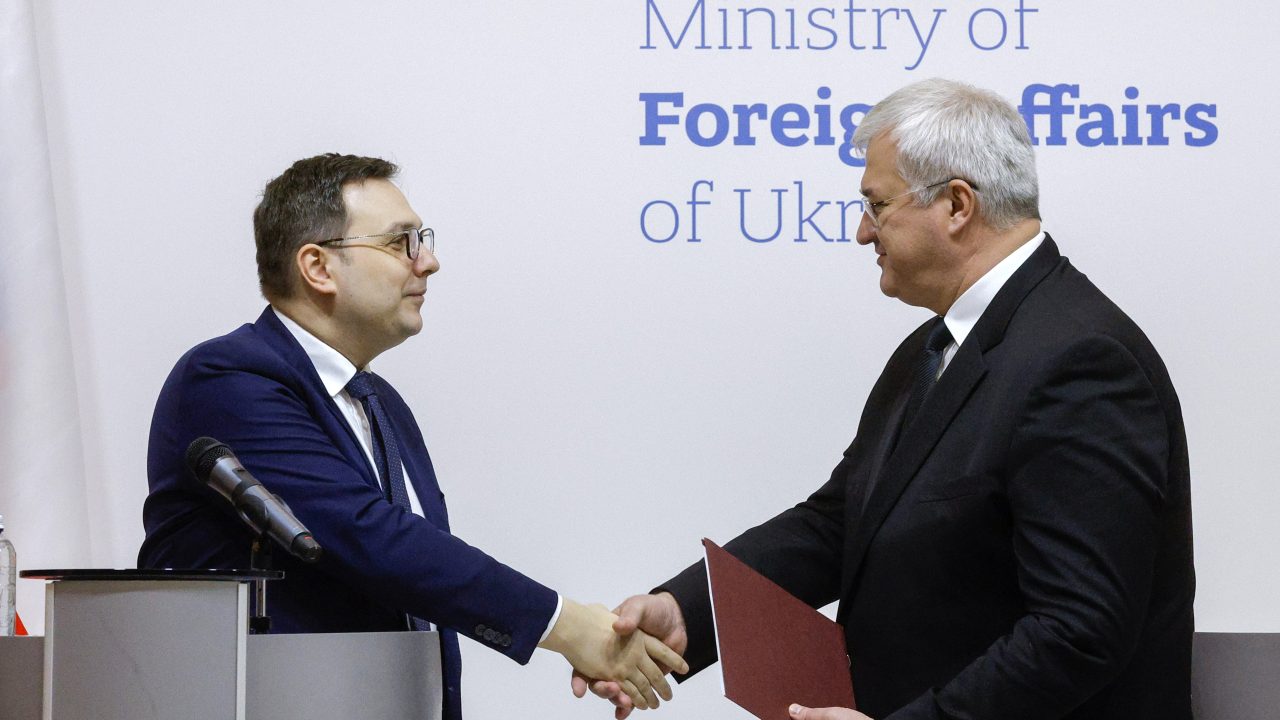
Czech Foreign Minister Jan Lipavsky (L) and Ukrainian Foreign Minister Andrii Sybiha (R) shake hands after a joint press conference following their meeting in Kyiv, Ukraine, 22 November 2024. Czech Foreign Minister Jan Lipavsky arrived in Kyiv to meet with top Ukrainian officials, amid the ongoing Russian invasion. EPA/SERGEY DOLZHENKO
Updated: August 11, 2025 - 16:43