 Edit
Ukraine’s wartime protests signal growing dissent against Zelenskyy’s anti-corruption rollback
The protests and international backlash highlight a critical moment for the Ukrainian president at a crucial time for the country
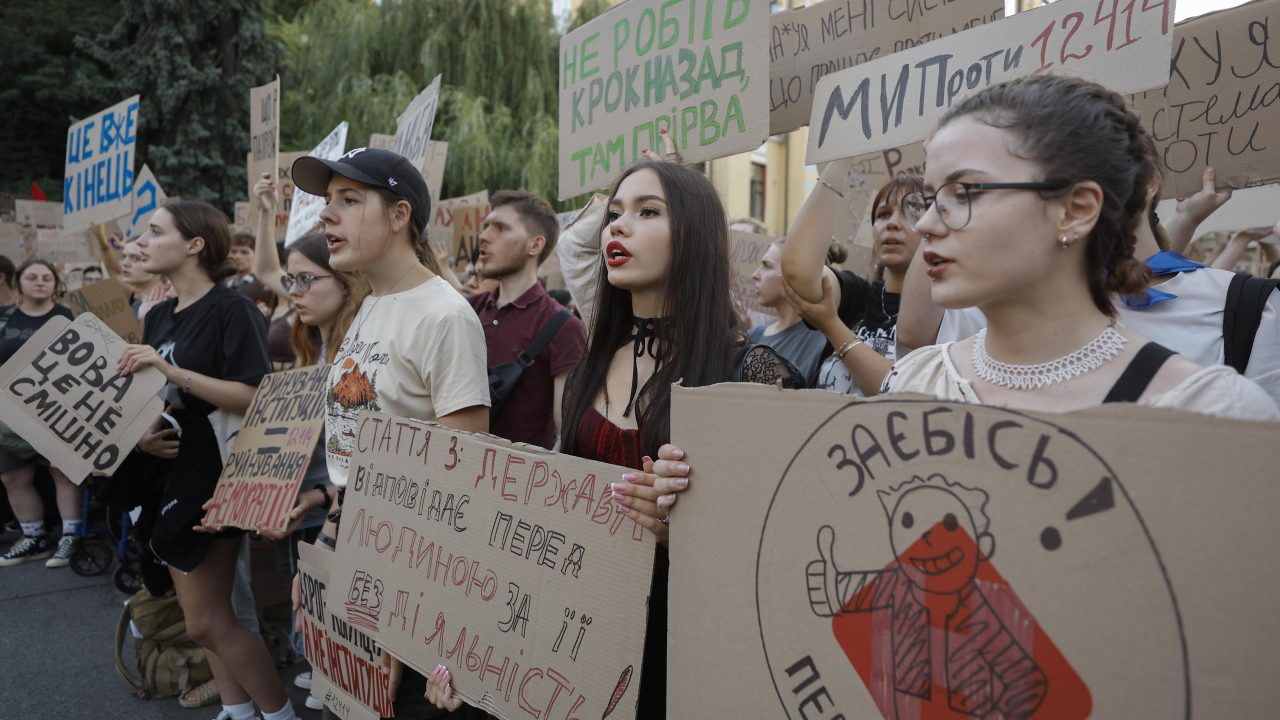
On 23 July Ukraine witnessed its first significant wartime protests, as thousands took to the streets from Kharkiv to Kyiv and Lviv, demanding the reversal of a controversial law curbing the independence of anti-corruption agencies.
The legislation, signed by President Volodymyr Zelenskyy on 22 July, grants his appointed Prosecutor General expanded control over the National Anti-Corruption Bureau of Ukraine (NABU) and the Specialised Anti-Corruption Prosecutor’s Office (SAPO), raising alarms among citizens, opposition lawmakers, European allies, and analysts.
The protests, coupled with rare international criticism, reflect mounting discontent with Zelenskyy’s leadership, threatening Ukraine’s EU accession ambitions and domestic cohesion amid Russia’s ongoing invasion.
The new law, rushed through parliament on 22 July, allows the Prosecutor General to transfer cases and reassign prosecutors within NABU and SAPO, undermining their autonomy. These agencies, established post-2014 Maidan Revolution, are pivotal to Ukraine’s anti-corruption reforms, a cornerstone for EU membership and securing billions in Western aid.
The timing of the legislation, following the arrest of two NABU officials for alleged Russian ties on 21 July, fuelled suspicions of political motives to shield corrupt officials. Both agencies issued a joint statement demanding legislative restoration of their independence, while NABU chief Semen Kryvonos called the law an attempt to “destroy” Ukraine’s anti-corruption framework.
The protests, the largest since Russia’s 2022 invasion, saw a diverse coalition of youth, activists, and war veterans chanting “Shame” and “Veto the Law” near Zelenskyy’s Kyiv office.
Maryna Mykhalchuk, a 26-year-old planning to enlist in the army, told Reuters the law felt like “a knife in the back,” echoing sentiments of betrayal among those who view anti-corruption efforts as integral to Ukraine’s European aspirations. In Zaporizhzhia, near the frontlines, protesters in military uniforms chanted “Ukraine is not Russia,” underscoring fears that centralized control risks mirroring Russian-style governance. Similar rallies in other cities highlighted widespread public discontent, a rare challenge to Zelenskyy’s wartime leadership.
European allies delivered some of their sharpest rebukes since the war began. European Commission President Ursula von der Leyen expressed “strong concern” to Zelenskyy, demanding an explanation, according to her spokesman. Dutch Foreign Minister Caspar Veldkamp warned that restricting anti-corruption institutions would be a “significant setback” for Ukraine’s reform path, while French European Affairs Minister Benjamin Haddad urged a reversal, noting it was “not too late.”
These criticisms underscore the EU’s view that robust anti-corruption measures are non-negotiable for Ukraine’s membership candidacy, granted in 2022. The rollback strengthens sceptics like Hungarian Prime Minister Viktor Orbán, who argues Ukraine’s governance weaknesses make it unready for EU integration, potentially complicating the unanimous approval needed for accession.
Domestic analysts warn that the law erodes public trust at a critical juncture. Valerii Pekar, a Kyiv-based commentator, wrote on Facebook that “only democracy and the European choice give us a chance to win” against Russia, emphasizing that public support for European integration sustains the war effort.
Political scientist Olena Yurchenko told The Guardian that the law risks alienating Ukraine’s youth and veterans, key pillars of national resilience, by signalling a retreat from democratic principles. The protests’ scale – thousands across multiple cities – reflects a growing divide between Zelenskyy’s government and a populace weary of corruption amid wartime sacrifices.
Zelenskyy responded on 23 July, pledging to submit a new bill to restore NABU and SAPO’s independence, acknowledging public outcry in his evening address: “Everyone has heard what people are saying… It’s not falling on deaf ears.”
Parliament is expected to hold an emergency session next week to consider the draft, per lawmakers cited by Euromaidan Press. However, the initial passage of the law, coupled with recent moves like charging a prominent anti-corruption activist with fraud, has fuelled perceptions of political retribution, further damaging Zelenskyy’s credibility. Bloomberg reported a 2% drop in Ukraine’s government bonds, reflecting investor concerns about governance stability.
The protests and international backlash highlight a critical moment for Zelenskyy, whose leadership faces scrutiny as Russian forces intensify attacks along a 1,000-kilometer frontline. The controversy risks straining ties with Western allies, particularly as Kyiv navigates relations with the U.S. under President Donald Trump, who has criticized Zelenskyy. With EU funding, including a €35 billion loan backed by frozen Russian assets, tied to reform progress, the government’s misstep could jeopardize financial and diplomatic support.
Sources: Reuters, The Guardian, Euromaidan Press, Bloomberg
Caption: Ukrainian people attend a protest against the restriction of the autonomy of Ukrainian anti-corruption authorities in Kyiv, Ukraine, 23 July 2025, amid the ongoing Russian invasion. Ukrainians gathered to protest the limited independence of anti-corruption agencies and their investigators, a measure that was voted on by the Ukrainian parliament on 22 July 2025. According to law No. 12414, the National Anti-Corruption Bureau of Ukraine (NABU) and the Specialized Anti-Corruption Prosecutor’s Office (SAPO) will become dependent on decisions made by the Prosecutor General. EPA/SERGEY DOLZHENKO
Updated: July 24, 2025 - 09:05


