 Edit
Kurdish PKK militants burn weapons in Iraq, signalling disarmament
The PKK’s disarmament could reshape regional dynamics, but it is unclear if the ceremony is a game-changer
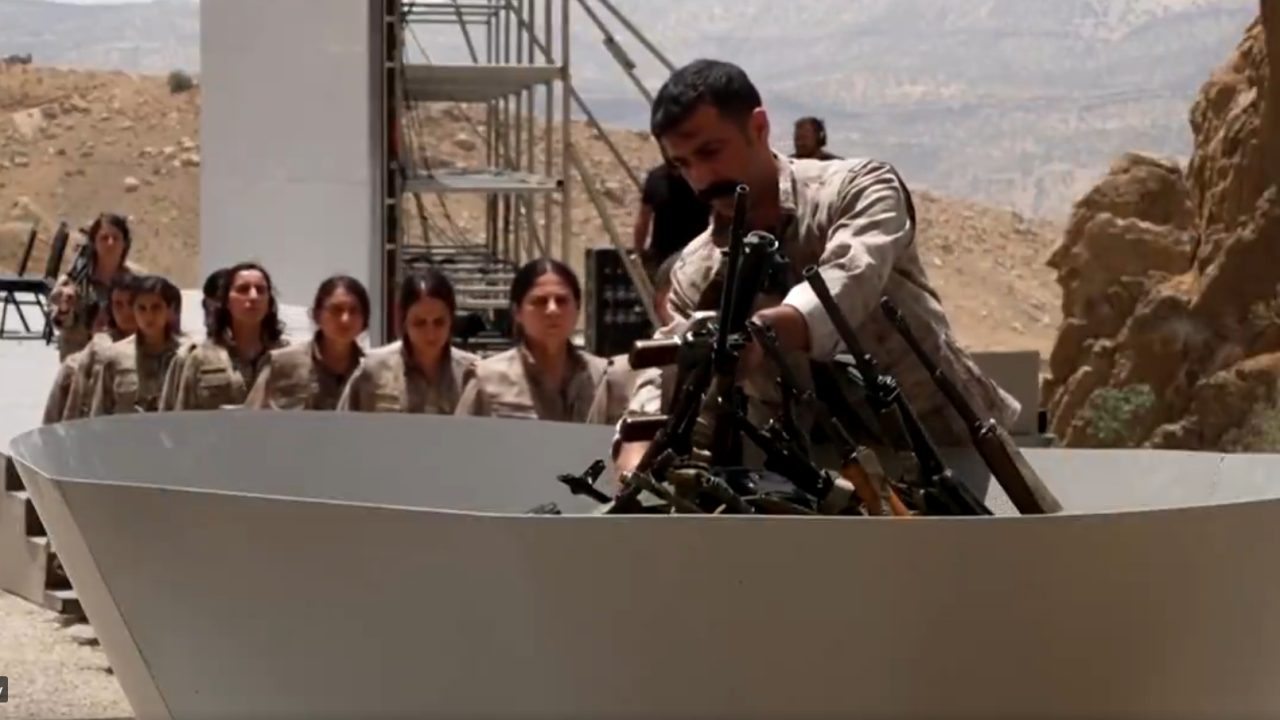
On Friday (11 July) thirty Kurdistan Workers’ Party (PKK) militants, including many women, symbolically burned their weapons at the entrance of Jasana cave in Dukan, northern Iraq, marking a significant step toward ending their decades-long insurgency against Turkey.
Thirty Kurdistan Workers Party militants, half of them women, burned their AK-47 assault rifles, bandoliers and other guns in northern Iraq, marking a symbolic step toward ending a decades-long insurgency against Turkey https://t.co/bMF3OaTKo3 pic.twitter.com/3iIrorNi6v
— Reuters (@Reuters) July 11, 2025
The ceremony, attended by Turkish and Iraqi intelligence officials, Iraqi Kurdish security forces, and representatives of Turkey’s pro-Kurdish DEM party, followed the PKK’s May 2025 decision to disband and disarm, prompted by a public call from its imprisoned leader, Abdullah Öcalan.
Background on the Kurds and the PKK
The Kurds are an ethnic group of approximately 30 million people spread across Turkey, Iraq, Syria, and Iran, with a distinct language and culture but no recognised nation-state. In Turkey, where Kurds make up about 20% of the population, the PKK, founded in 1978 by Öcalan, has fought for greater autonomy or independence since 1984.
Labelled a terrorist organisation by Turkey, the United States, and the European Union, the PKK’s insurgency has resulted in over 40,000 deaths, economic strain, and deep social divisions, particularly in Turkey’s Kurdish-majority southeast.
The group has long operated from bases in northern Iraq’s Qandil Mountains, where it retreated after intensified Turkish military operations.
Turkey’s role in toppling Bashar al-Assad
Turkey played a pivotal role in the December 2024 fall of Syrian President Bashar al-Assad, a game-changer in the region’s geopolitics. Ankara, a long-time opponent of Assad, supported Syrian opposition groups, including the Turkish-backed Syrian National Army (SNA), and conducted military operations to weaken the Syrian regime.
Turkey’s strategic involvement, including airstrikes and logistical support, alongside a broader offensive by rebel forces, led to Assad’s ousting, ending decades of his family’s rule. This shift disrupted the regional balance, particularly affecting Syrian Kurdish forces, such as the U.S.-backed Syrian Democratic Forces (SDF), which Turkey views as an extension of the PKK.
Turkey’s influence in post-Assad Syria has increased pressure on these Kurdish groups to integrate into Syria’s reconfigured security structure, aligning with Ankara’s broader goal of neutralizing PKK-affiliated forces.
The disarmament ceremony
The weapons-burning event saw PKK fighters, dressed in beige fatigues, place AK-47 rifles and other arms into a cauldron, which was later set ablaze. Senior PKK commander Bese Hozat declared, “We voluntarily destroy our weapons, in your presence, as a step of goodwill and determination,” in both Turkish and Kurdish.
Iraqi Kurdish forces secured the area, with helicopters overhead, while Turkish officials described the event as an “irreversible turning point” in the peace process.
The ceremony followed years of failed peace efforts, with the DEM party facilitating recent negotiations. Öcalan, whose image was displayed, urged Turkey’s parliament in a rare video to establish a commission to oversee disarmament and ensure a smooth transition to democratic politics.
Turkey in October 2024, eased Öcalan’s prison conditions and allowed visits from pro-Kurdish DEM Party members to facilitate negotiations for the PKK’s disarmament.
Broader implications
The PKK’s disarmament could reshape regional dynamics. In Syria, where the U.S. supports the SDF, Turkey seeks their integration into a new Syrian security framework post-Assad, viewing them as a PKK offshoot. The PKK’s dissolution may intensify this pressure, as analysts suggest.
In Turkey, the process could enable reconstruction in the southeast, where the conflict has caused significant damage. Turkish Finance Minister Mehmet Simsek noted that combating terrorism has cost Turkey nearly $1.8 trillion over five decades.
President Recep Tayyip Erdoğan emphasized the potential for enhanced security and regional stability, stating on X, “May God grant us success in achieving our goals… for the security of our country.”
While the ceremony marks a significant step, further arms handovers and the legal reintegration of PKK members into Turkish society remain unclear.
With Reuters, edited by g.g.
Caption: On 11 July thirty Kurdistan Workers’ Party (PKK) militants, including many women, symbolically burned their weapons at the entrance of Jasana cave in Dukan, northern Iraq, marking a significant step toward ending their decades-long insurgency against Turkey. (Screenshot from video, g.g.)
Updated: July 12, 2025 - 06:36