 Edit
Trump hails Israel-Iran ceasefire as NATO summit looms, but claims face scrutiny
The U.S. President’s assertion of a definitive ceasefire appears overly optimistic, if not premature
U.S. President Donald Trump announced a “complete ceasefire” between Israel and Iran on Monday (23 June), claiming to have brokered an end to a 12-day conflict that displaced millions in Tehran and stoked fears of a broader Middle East war.
Writing on Truth Social, Trump congratulated both nations for their “Stamina, Courage, and Intelligence” in ending what he dubbed “THE 12 DAY WAR.”
However, the Israeli military reported Iranian missile launches toward Israel early Tuesday, and Iran’s Foreign Minister Abbas Araghchi insisted hostilities would continue unless Israel halts its “illegal aggression” by 4:00 AM Tehran time (0030 GMT).
Trump’s optimistic portrayal of a done deal, set against the backdrop of the NATO summit in The Hague where he aims to assert U.S. dominance, faces scepticism as battlefield realities and diplomatic ambiguities undermine his narrative.
The ceasefire, reportedly brokered through Trump’s call with Israeli Prime Minister Benjamin Netanyahu and Qatar-mediated talks with Tehran, hinges on Iran refraining from further attacks, with Israel agreeing to pause operations if conditions hold.
A senior White House official described a staged process allowing ongoing missions to conclude, though details remain vague.
Vice President JD Vance, Secretary of State Marco Rubio, and envoy Steve Witkoff facilitated direct and indirect U.S.-Iran contacts, while three Israeli officials signalled a desire to wind down the campaign. Yet, Araghchi’s statement that a “final decision” on halting Iran’s operations would come later, coupled with Israeli evacuation warnings in Tehran and alarms in the Golan Heights, suggests the region remains far from calm.
Qatar skirmish
Earlier on Monday, Trump said he would encourage Israel to proceed towards peace after dismissing Iran’s attack on an American air base in Qatar that caused no injuries and thanking Tehran for the early notice of the strikes.
He said Iran fired 14 missiles at the U.S. air base, calling it “a very weak response, which we expected, and have very effectively countered.”
Iran’s handling of the attack recalled earlier clashes with the United States and Israel, with Tehran seeking a balance between saving face with a military response but without provoking a cycle of escalation it can’t afford.
Tehran appears to have achieved that goal.
Critical analysis of Trump’s claims
Trump’s assertion of a definitive ceasefire appears overly optimistic, if not premature, given conflicting reports and ongoing hostilities.
The Israeli military’s detection of Iranian missiles post-announcement directly contradicts Trump’s claim of a “complete” truce, echoing his pattern of exaggerating diplomatic successes, as seen in his 2019 claims of resolving North Korea’s nuclear threat after summits with Kim Jong Un.
His assertion that Iran’s nuclear program was “incapable” of producing a weapon, echoed by Vance on Fox News, lacks corroboration from U.S. intelligence, which has consistently assessed Iran is not actively building a bomb – a position reaffirmed by a source to Reuters last week.
The UN’s nuclear watchdog, IAEA chief Rafael Grossi, noted uncertainty about the extent of damage to Iran’s underground facilities, further casting doubt on Trump’s sweeping declarations. Iran’s claim of evacuating enriched uranium from Fordow before U.S. strikes adds to scepticism about the operation’s impact.
Trump’s rhetoric, framing the ceasefire as a triumph of his deal-making prowess, aligns with his broader strategy to project supremacy at the NATO summit in The Hague on 25 June.
Zelenskyy’s attendance at NATO summit uncertain amid Trump’s supremacy
The ceasefire announcement comes as Trump prepares to dominate the NATO summit, where he will likely tout the alliance’s commitment to unprecedented defence spending as a U.S.-driven achievement. The 5% GDP goal, finalised after overcoming Spain’s resistance, reflects Trump’s insistence on burden-sharing, a cornerstone of his “America First” agenda.
NATO secures Spain’s agreement on 5% GDP defence spending goal, overcoming resistance
By presenting the Israel-Iran truce as a personal victory, Trump aims to reinforce his narrative of restoring U.S. global influence, contrasting with what he calls the “weak” policies of his predecessors. Yet, NATO allies, especially France, remain cautious, mindful of Trump’s recent strikes on Iran and his regime change rhetoric, which echo U.S. interventions in Iraq and Afghanistan that only created chaos.
The conflict, sparked by Israel’s 13 June strikes on Iran’s nuclear sites and escalated by U.S. bunker-buster bombs, has killed over 430 in Iran and 24 in Israel, per local reports, with millions fleeing Tehran.
Israel’s targeting of Evin prison on Monday suggests an intent to weaken Iran’s regime, despite U.S. claims of focusing solely on nuclear capabilities. Iran’s restrained missile response, described by Trump as “very weak,” mirrors its past efforts to avoid all-out war. Markets reacted optimistically, with S&P 500 futures up 0.4% and oil prices dipping, but renewed fighting could reverse these gains.
As Trump heads to The Hague, his ceasefire claim will face scrutiny. If the truce holds, it could bolster his summit stature; if it collapses, it risks exposing his overconfidence. What is certain however is that the conflict directly bordering the EU – the Russian aggression against Ukraine, is now on the back burner, which ultimately plays in the hands of Vladimir Putin.
With Reuters, edited by g.g.
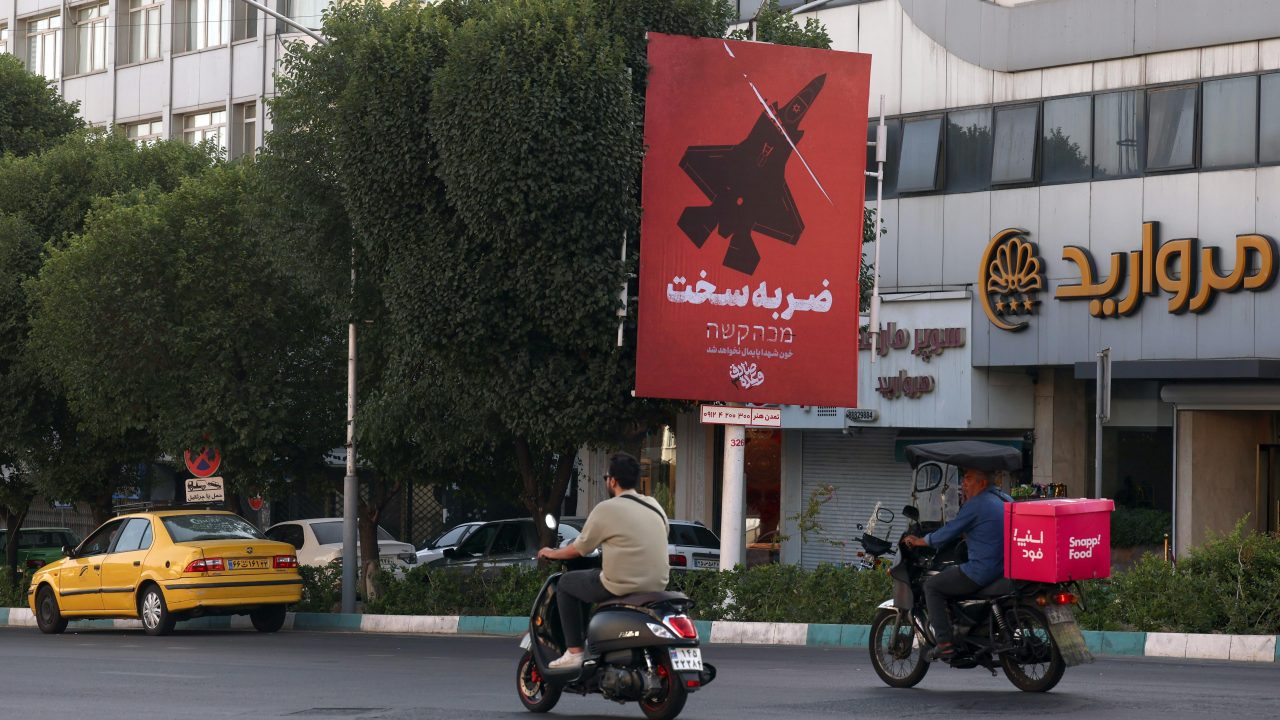
Caprtion: Iranians on motorbikes pass a billboard reading ‘Harsh Response’, in Tehran, Iran, 23 June 2025. The US forces struck three of Iran’s key nuclear sites: Natanz, Isfahan and Fordo, US President Trump announced on 21 June. Israel and Iran have been exchanging fire since Israel launched strikes across Iran on 13 June 2025 as part of Operation ‘Rising Lion.’ EPA/ABEDIN TAHERKENAREH
Updated: June 24, 2025 - 05:38