 Edit
Turkey: Prosecutors target opposition leaders in controversial case over party congress
The episode is part of a broader strategy to weaken Turkey’s opposition through judicial means
The Ankara Public Prosecutor’s Office has launched a high-profile legal offensive against 12 leaders of Turkey’s main opposition party, the Republican People’s Party (CHP), including Istanbul Mayor Ekrem İmamoğlu, Izmir Mayor Cemil Tugay, Istanbul CHP chair Özgür Çelik, and Beşiktaş Mayor Rıza Akpolat.
The indictment, accepted by the Ankara 26th First Instance Court of Misdemeanors, accuses the group of orchestrating irregularities during the CHP’s 38th Regular Congress in November 2023, where Özgür Özel was elected party leader. Prosecutors are seeking up to three years in prison for the defendants under Article 112 of Turkey’s Law on Political Parties and provisions of the Turkish Penal Code, alongside a potential ban on their political rights under Article 53.
Allegations and evidence
The investigation stems from a complaint by Lütfü Savaş, the former mayor of Hatay, who is listed as a “whistleblower” in the case. Former CHP leader Kemal Kılıçdaroğlu, who lost the leadership race to Özel, is named as a “victim.” The indictment alleges that the defendants engaged in a systematic effort to manipulate the congress vote through cash payments, promises of municipal positions, shopping cards, and jobs for congressmen’s relatives in CHP-run enterprises. Prosecutors claim that congressmen were asked to photograph their ballots to verify votes and that false information about Kılıçdaroğlu’s withdrawal was spread after the first ballot to sway the second round in Özel’s favor.
The prosecution’s case relies on reports from Turkey’s Financial Crimes Investigation Board (MASAK), Land Registry documents, Supreme Electoral Council records, Turkish Statistical Institute data, and technical evidence from CDs, DVDs, and surveillance footage. These materials purportedly demonstrate a coordinated effort to undermine the electoral will of the congress.
Defendants’ responses
Ekrem İmamoğlu, who chaired the congress proceedings, denied any involvement in a brief testimony on 2 May, declining to provide a detailed defence. Cemil Tugay, mayor of Izmir, rejected claims of offering financial incentives, while Özgür Çelik called the allegations of money distribution baseless. Rıza Akpolat, Beşiktaş mayor, denied appointing relatives to municipal roles, and Bursa CHP chair Nihat Yeşiltaş dismissed claims linking his son’s employment at Kültür A.Ş. to political favours, stating he did not know the witnesses testifying against him.
İmamoğlu’s arrest and Turkey’s political landscape
The case against İmamoğlu and other CHP leaders unfolds against a backdrop of intensifying political repression in Turkey. Ekrem İmamoğlu, a prominent opposition figure and mayor of Istanbul since 2019, was arrested in late 2024 following a separate conviction for insulting public officials during his 2019 mayoral campaign. That conviction, widely criticised as politically motivated, resulted in a prison sentence and a political ban, though İmamoğlu remains a key figure in the CHP and a potential challenger to President Recep Tayyip Erdoğan’s ruling Justice and Development Party (AKP). His arrest sparked protests and international condemnation, with critics arguing it was a deliberate move to sideline a popular opposition leader ahead of future elections.
Turkey’s political environment has grown increasingly authoritarian under Erdoğan’s 20-year rule. The judiciary, often accused of lacking independence, has been repeatedly used to target opposition figures, journalists, and activists. The CHP’s strong performance in the March 2024 local elections, where it reclaimed major cities like Istanbul, Ankara, and Izmir, posed a significant challenge to the AKP’s dominance, making the timing of this prosecution particularly suspicious. Many analysts view the case as an attempt to weaken the CHP’s momentum and tarnish its image, especially given İmamoğlu’s national prominence and potential as a presidential candidate.
Effectiveness against terrorism: a misplaced connection
Turkey’s government has frequently justified legal actions against opposition figures by invoking national security or public order. Such rhetoric is often used to frame dissent as a threat, a tactic seen in cases against Kurdish politicians, journalists, and academics. However, the allegations against the CHP leaders center on internal party irregularities, not terrorism, making any connection to counterterrorism measures tenuous at best.
Turkey’s anti-terrorism laws are notoriously broad, often applied to suppress political opposition rather than address genuine security threats. For example, the government has used anti-terrorism pretexts to arrest members of the pro-Kurdish Peoples’ Democratic Party (HDP) and others, despite limited evidence of terrorist activity. In the CHP case, the absence of terrorism-related charges suggests the prosecution is more about political control than security. The targeting of İmamoğlu, a figure with no documented ties to terrorism, further undermines claims that such measures enhance national security.
The erosion of judicial independence and the use of legal mechanisms to silence opposition figures like İmamoğlu risk deepening societal divisions, which could indirectly undermine efforts to combat extremism. A 2023 Freedom House report classified Turkey as “not free,” citing judicial overreach and restrictions on political freedoms, which highlights the broader context of this case.
Political and social implications
The prosecution threatens to damage the CHP’s reputation just months after its electoral successes, potentially weakening its ability to challenge the AKP in future elections. The requested deprivation of political rights for the defendants, including İmamoğlu, could further cripple the opposition by barring key figures from public office. This move aligns with a pattern of judicial harassment against opposition leaders, as seen in the cases of HDP co-chairs Selahattin Demirtaş and Figen Yüksekdağ, who remain imprisoned on controversial charges.
Public reaction has been polarised. CHP supporters view the case as a blatant attempt to suppress the party’s rising influence, while AKP-aligned media outlets have amplified the allegations to discredit the opposition. The case could also strain Turkey’s relations with Western allies, particularly the European Union and the United States, which have previously criticized Ankara for undermining democratic norms.
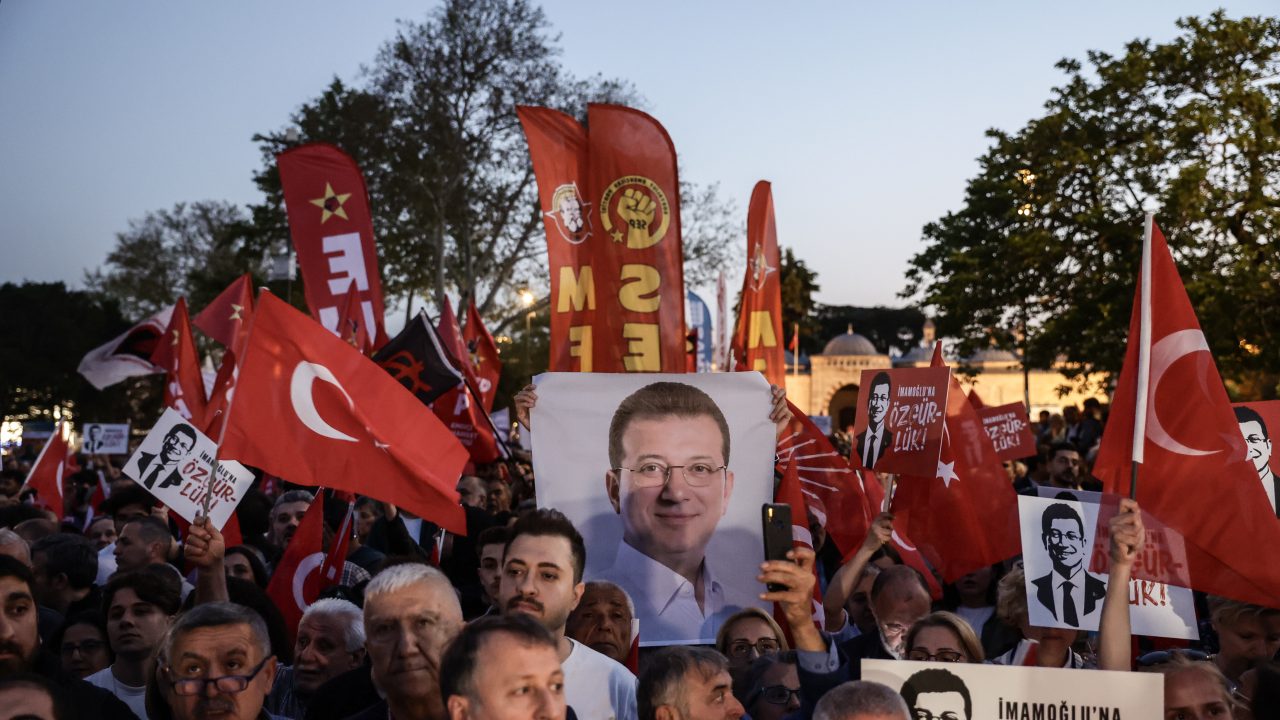
Caption: People hold Turkish flags and placards reading ‘Freedom for Imamoglu’ as they take part in a demonstration organised by the country’s main opposition Republican People’s Party (CHP) against the detention of the mayor of Istanbul, Ekrem Imamoglu, in Istanbul, Turkey, 7 May 2025. [EPA-EFE/ERDEM SAHIN]
Updated: June 5, 2025 - 05:32