 Edit
Poland’s 2025 presidential election: a divided nation faces a turbulent future
ECFR commentators say that Nawrocki’s presidency will make Poland a “cacophonic European player”
Poland remains deeply divided, with Nawrocki’s narrow victory – 50.89% to Trzaskowski’s 49.11% – underscoring a nation at a crossroads. Analysts from the European Council on Foreign Relations (ECFR) have provided incisive commentary on the election’s implications, highlighting a nation polarised by fear, a resurgent right-wing, and a presidency poised to disrupt Poland’s domestic and foreign policy ambitions.
The Polish presidential election, culminating in a narrow victory for Karol Nawrocki on 1 June, has sent shockwaves through Poland and the European Union, signalling a deepening political divide and a challenging road ahead for Prime Minister Donald Tusk’s pro-European government.
Piotr Buras, head of ECFR’s Warsaw office, frames the election as a clash of “two strong negative emotions – or ‘projects fear’” between public rejection of Tusk’s government, elected in 2023, and dread of the Law and Justice (PiS) party’s return to power.
Nawrocki, backed by PiS, capitalized on anti-government sentiment, securing support from right-wing and far-right voters who had backed candidates like Sławomir Mentzen and Grzegorz Braun in the first round. Meanwhile, Rafał Trzaskowski, Tusk’s centrist ally and Warsaw mayor, failed to mobilize the liberal voters who had propelled Tusk’s coalition to victory in 2023. Buras notes that Trzaskowski’s campaign, which leaned heavily on attacking Nawrocki’s controversial past – including allegations of football hooliganism and other personal scandals – backfired. While it undermined Nawrocki’s credibility, it did not deter right-wing voters, echoing a “Trumpian effect” where personal controversies fail to sway a loyal base. Unlike Romania’s recent election, where a centrist defeated a nationalist, Poland saw no equivalent liberal mobilization.
Nawrocki’s presidency, Buras predicts, will be a “rough ride” for Tusk’s government, effectively stalling its agenda to restore the rule of law and advance social liberalization. With Nawrocki’s veto power, major reforms – such as liberalizing Poland’s near-total abortion ban or reversing PiS’s judicial overhauls – are likely dead in the water. Nawrocki, a historian with no prior political experience, is expected to act as a PiS loyalist, using his position to undermine Tusk and pave the way for PiS’s return in the 2027 parliamentary elections. His radical right-wing views, more extreme than those of outgoing President Andrzej Duda, foreshadow a contentious cohabitation.
Marta Prochwicz Jazowska, deputy head of ECFR Warsaw, warns that Nawrocki’s presidency sets Poland “on a path away from Europe.” While Poland will remain a military and economic power, committed to NATO and its Eastern Flank role, Nawrocki’s anti-European, anti-German, and anti-migration rhetoric will constrain Tusk’s vision of aligning Poland with core EU nations. Jazowska emphasizes that Nawrocki’s vetoes will block legislation on judicial reform and social issues, dimming Tusk’s prospects for the 2027 election. On Ukraine, Nawrocki supports logistical aid but opposes Polish troop deployment and attaches strict conditions to Ukraine’s EU bid, exacerbating anti-Ukrainian sentiment stoked during his campaign. This, she argues, will make Ukraine policy a major domestic flashpoint.
Foreign policy, particularly within the EU and transatlantic relations, faces significant disruption. Buras highlights that Nawrocki’s alignment with PiS and his anti-Ukrainian tones- such as opposing NATO membership – could politicise Poland’s relations with the U.S. and Ukraine, a new and divisive trend. Nawrocki and PiS are likely to leverage ties with Donald Trump’s America to criticize Tusk for allegedly prioritizing EU alliances over transatlantic partnerships, limiting Tusk’s foreign policy maneuverability. Rafael Loss, an ECFR policy fellow, adds that Nawrocki’s victory threatens the Weimar Triangle (Poland, Germany, and France), a key EU cooperation format. PiS, PiS’s anti-German rhetoric, exemplified by mocking Trzaskowski as “Monsieur Bonjour” for his cosmopolitanism, could undermine German-Polish defence cooperation, critical for NATO’s northeastern flank.
Pawel Zerka, another senior policy fellow, draws parallels with French politics, likening Poland’s liberal mobilization to France’s “front républicain” against the far-right, which failed due to strong anti-elitist and anti-government sentiment. He warns that Nawrocki’s presidency will make Poland a “cacophonic European player,” undermining the recent Polish-French treaty aimed at deepening defence and EU cooperation. Nawrocki’s agenda – reaffirming ties with Trump’s America, distrusting Berlin and Paris, and amplifying anti-Ukrainian rhetoric – clashes with Tusk’s pro-EU vision. Zerka suggests this outcome could embolden France’s far-right ahead of its 2027 election, signalling a broader European trend.
The ECFR analysts paint a grim picture of Poland’s political future. Buras foresees “political conflict and instability,” with a weakened Tusk government struggling to maintain its coalition. While a snap election in 2025 is unlikely, a lame-duck government could collapse by 2026, especially given right-wing dominance in polls. Poland’s role as a promoter of EU defense and Ukraine’s integration is at risk, and Tusk’s ambition to cement Poland as a leading EU player faces formidable obstacles. As Jazowska concludes, Nawrocki’s presidency threatens to “spoil” Tusk’s term, pulling Poland away from Europe and toward a nationalist, confrontational path.
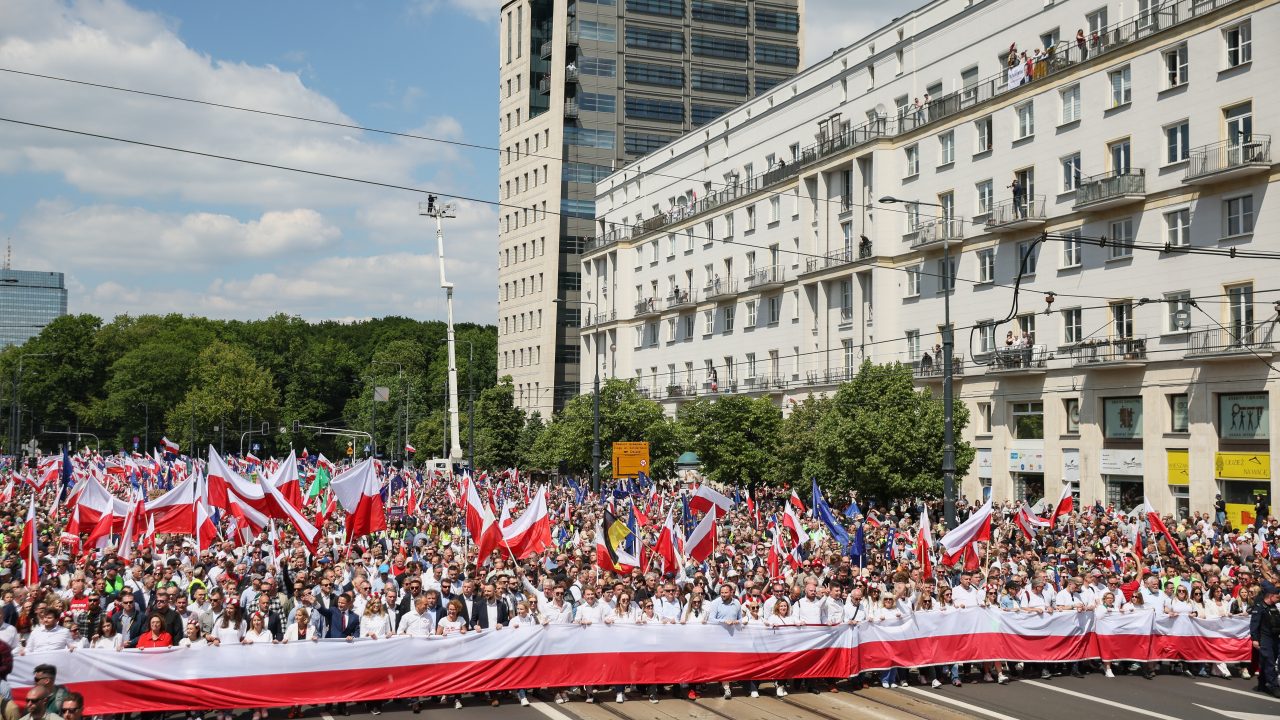
Caption: Supporters of Polish presidential candidate Rafal Trzaskowski participate in the ‘March of Great Patriots’ in Warsaw, 25 May, 2025. Participants will march from Bankowy Square and then through Dmowski Roundabout to Konstytucji Square. Rafa³ Trzaskowski will compete against Karol Nawrocki in the second round of Poland’s presidential election on June 1, 2025, after neither candidate received more than 50 percent of the vote in the first round on 18 May. [EPA-EFE/Leszek Szymanski]
Updated: June 2, 2025 - 15:07