 Edit
Armenia moves towards EU membership bid as Russia warns of consequences
Prime Minister Nikol Pashinyan says Yerevan will soon prepare an EU membership application and has no plans to return to the Russian-led security bloc
Armenia is preparing to begin the process of formally applying for European Union membership, Prime Minister Nikol Pashinyan told parliament, signalling another step in Yerevan’s increasingly distant relationship with Moscow.
Pashinyan said Armenia could begin preparing its application “in the near future”, while also making clear that the country does not intend to resume its activities in the Russian-led Collective Security Treaty Organisation (CSTO).
“Armenia first needs to submit an official application for membership in the EU,” Pashinyan told lawmakers during parliamentary discussions on the government’s 2026-2031 programme. “We can start this process in the near future”.
The prime minister said that after submitting an application, Armenia would hold a referendum on possible EU membership.
The announcement comes as Armenia, formally still a Russian ally and a member of the Moscow-led Eurasian Economic Union (EAEU), has accelerated its rapprochement with Brussels. The shift follows growing frustration in Yerevan over what Armenian authorities have described as Russia’s failure to provide adequate security support during conflicts with neighbouring Azerbaijan.
Russia maintains a military base in Armenia and retains significant influence in the country. But relations between the two governments have deteriorated sharply since Azerbaijan’s military campaigns against the Armenian-populated Nagorno-Karabakh region and the subsequent collapse of the separatist entity in 2023.
Pashinyan, who came to power following mass protests in 2018, has increasingly argued that Armenia needs to diversify its foreign and security partnerships.
No return to the Russian-led security alliance
Pashinyan has reiterated that Armenia will not unfreeze its participation in the CSTO, saying that Yerevan no longer sees an interest in the organisation.
He told MPs the CSTO had failed to provide answers to Armenia’s concerns and that the country’s interest in the alliance had therefore been exhausted.
“It is clearly stated in our [election manifesto] programme that we have no plans to return to the CSTO over the next five years,” Pashinyan said. “I can say with certainty that we will not step up our activities in the CSTO.”
He added that he would welcome a decision by the organisation to expel Armenia, saying this would remove the dilemma of whether Yerevan should withdraw itself.
The CSTO is a military alliance comprising Russia, Armenia, Belarus, Kazakhstan, Kyrgyzstan and Tajikistan. Armenia has frozen its participation in the organisation since early 2024, citing its failure to fulfil its security commitments.
Armenia-Russia ties undergoing a “natural process”
Pashinyan said Armenia’s strategic partnership agenda with the EU was progressing visibly, pointing to a law adopted last year that launched the process of Armenia’s accession to the bloc.
He also said Armenia was currently the only country with which the EU was actively negotiating visa liberalisation and that Yerevan intended to achieve visa-free travel with the EU by 2029.
According to Pashinyan, Russia’s concerns about Armenia’s closer relationship with the EU were real but were not the fundamental cause of the deterioration in bilateral ties.
“In my opinion, the development of our relations with the European Union has actually given rise to this, but is not its underlying cause,” he said.
“The fundamental reason for the concerns that have emerged in Russia is the transformation that has begun in Armenia-Russia relations.”
Pashinyan argued that this transformation was a natural consequence of changing regional circumstances following the end of the conflict between Armenia and Azerbaijan.
He said Armenia’s relationship with Russia had historically been viewed primarily through the prism of military and security issues, with Moscow seen as the guarantor of Armenian security.
“I have never doubted Russia’s commitment to fulfilling this role,” Pashinyan said. “But the events of 2021, 2022 and 2023 showed that, due to having its own security problems, the Russian Federation can sometimes face significant limitations in fulfilling that role.”
He also pointed to the changing regional environment, noting that peace has been established between Armenia and Azerbaijan while relations between Armenia and Turkey are no longer marked by tension and prospects for their development are positive.
Moscow warns of a clash with the Eurasian Economic Union
Kremlin spokesman Dmitry Peskov said on Monday that Armenia was free to leave the organisation if it no longer considered membership necessary.
“If Yerevan no longer needs to be a part of such an important organisation that ensures regional security and serves its national interests, then it is free to make the decision to leave,” Peskov said.
He noted, however, that Moscow had so far heard Armenian representatives say that membership had been frozen but that Armenia did not currently plan to withdraw.
Russia has also repeatedly warned Armenia about the consequences of pursuing EU membership while remaining part of the EAEU. Brussels is offering tariff-free access for most Armenian exports, following signs that Russia has increasingly used trade restrictions as leverage against Armenia amid Yerevan’s efforts to diversify its foreign policy and economic partnerships.
Peskov said the EU accession application would create “deep legislative contradictions” within the Russian-led economic bloc and could ultimately harm Armenia itself.
The Kremlin spokesman also pointed to Turkey’s long-running EU candidacy as a cautionary example.
“As for [Armenia’s] application for EU membership, I always recommend recalling the experience of Turkey and other countries whose applications were submitted decades ago yet remain stuck in the same place,” Peskov said.
Turkey, a historic rival of Armenia, has been an EU candidate for decades and has seen its accession process largely stall.
Moscow has stepped up pressure on Yerevan over its growing ties with Brussels, including through restrictions on imports. In June, Russian President Vladimir Putin warned Armenia that the “Ukrainian scenario” had begun with Kyiv’s European ambitions.
The Kremlin’s concerns centre not only on Armenia’s potential EU membership but also on the broader transformation of its relations with Russia.
Sources: BGNES, Armenpress, TASS
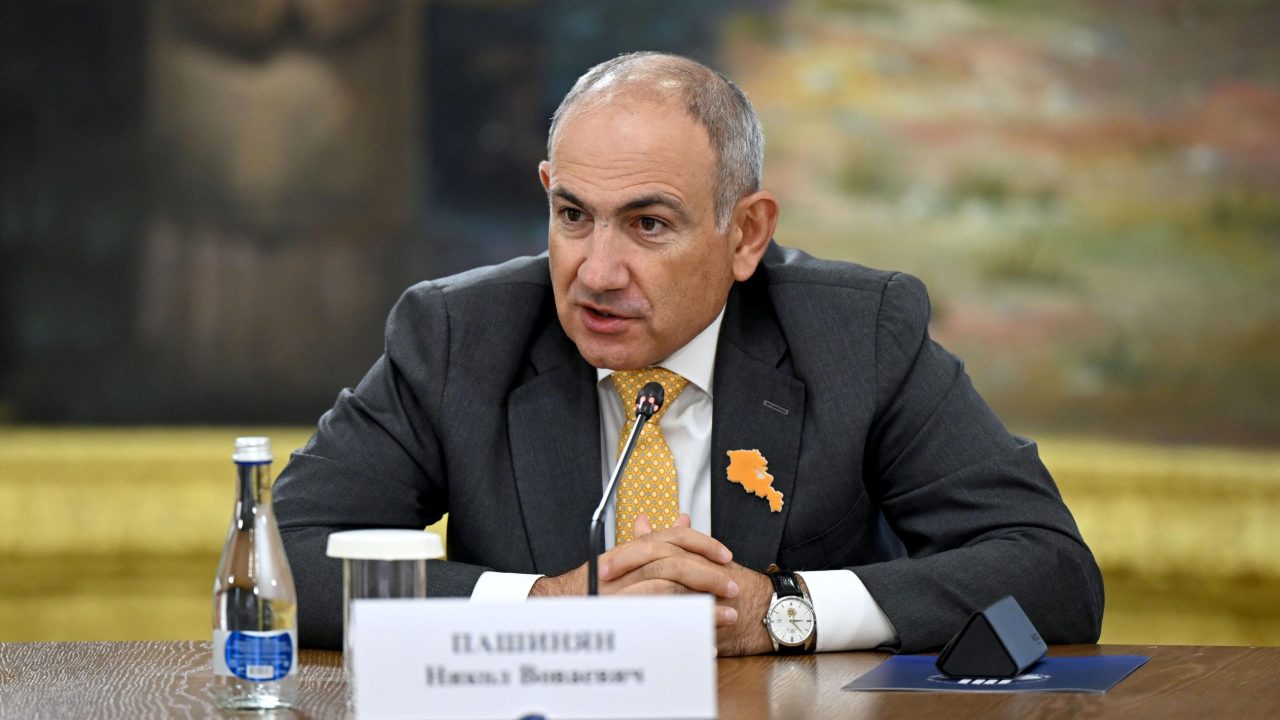
Caption: Armenian Prime Minister Nikol Pashinyan attends a meeting with Kyrgyz President Sadyr Japarov before the start of an expanded format meeting of the Eurasian Intergovernmental Council in the resort city of Cholpon-Ata, Kyrgyzstan, 7 August 2026. EPA/IGOR KOVALENKO
Updated: August 25, 2026 - 06:23