 Edit
The price of normalisation: Belgrade’s losing battle over the Mitrovica bridge
Vučić described the process as a “great disgrace and disappointment,” claiming it reflected nervousness among international actors seeking to force Serbia to accept Kosovo’s independence
For many years since the 1999 NATO military campaign against Slobodan Milošević’s Serbia, the NATO-led Kosovo Force (KFOR) has served as a key guarantor of stability in the region, but the mission now needs to be scaled down.
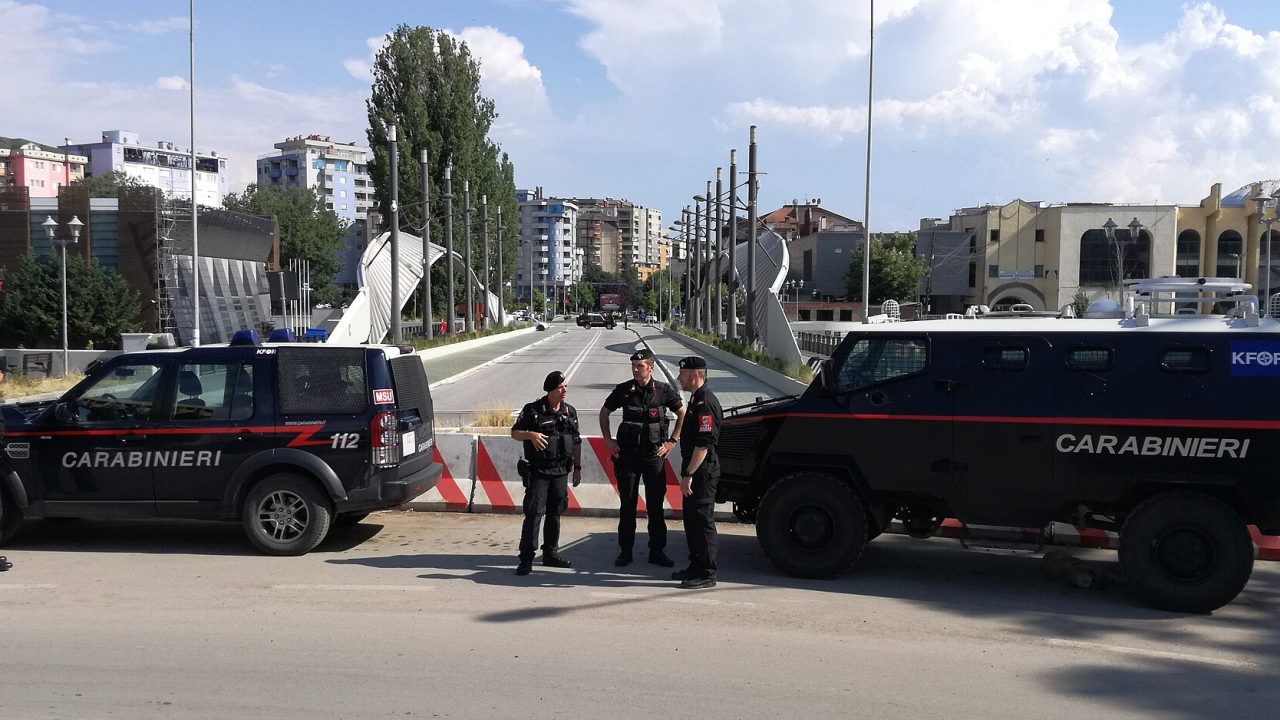
KFOR has begun the gradual transfer of security responsibilities at the main bridge over the Ibar River in Mitrovica to the Kosovo Police, ending nearly three decades of continuous international control over one of Kosovo’s most symbolically charged and sensitive sites.
The shift, confirmed by multiple independent outlets and visible on the ground, marks a concrete step in the optimisation of the NATO-led mission’s presence and the empowerment of local institutions. Serbian President Aleksandar Vučić has strongly opposed the process, announcing he will write to NATO Secretary General Mark Rutte to seek its reversal, while the European Union has stated that technical and security conditions for opening the bridge more fully have been fulfilled.
The bridge, also known as the Austerlitz Bridge, has long divided the predominantly Serb north of Kosovo and the Albanian-populated south of Mitrovica and served as a physical and political fault line since the end of the 1998–1999 conflict. For 27 years it remained under the primary responsibility of international security missions. Radio Television of Kosovo reported that Kosovo Police have now started assuming security duties at the site, describing the change as another stage in the transfer of responsibilities to Kosovo institutions. The Serbian-language portal KoSSev noted that the permanent tent and static post of the Italian KFOR carabinieri on the northern half of the bridge had been removed, with the unit remaining only on the southern side. KFOR itself confirmed a parallel, gradual process of including Kosovo Police in the security structure around the Visoki Dečani monastery, while stressing that the mission remains the first responder there and that any further steps will depend on conditions on the ground and close coordination with the Serbian Orthodox Church, Kosovo institutions, EULEX and the Kosovo Police.
The developments form part of a broader “optimisation” of KFOR’s posture that the mission attributes to an improved security environment. At the same time, the European Union has moved from long-standing preparatory language to an explicit assessment that the conditions for opening the bridge have been met. An EU spokesperson told Gazeta Express on 17 August that once the works on the bridge, additional assessments and consultations were completed, the structure should be opened, referencing the previous year’s annual report on Kosovo. The EU noted it had been informed by NATO of KFOR’s gradual transition of its permanent presence at the bridge, while underlining that decisions on KFOR posture remain a NATO matter.
On 18 August, European Commission spokesperson Anitta Hipper reiterated the position at a Brussels press conference. The bridge “must serve all communities” and “must connect” people, she said. The EU expects effective coordination and meaningful consultations between the affected municipalities and Kosovo’s central institutions. Kosovo Police must guarantee the safety of all communities in line with democratic principles, human rights and the rule of law so that everyone feels secure. An assessment has been made and steps taken, yet improved coordination and consultations are still required. The bridge remains open only to pedestrians and has not yet been opened to vehicle traffic. Separate EU comments earlier in August had criticised related Serbian statements about possibly altering the course of the Ibar River as unhelpful to normalisation between Belgrade and Pristina.
Serbian President Vučić opposes KFOR withdrawal from sensitive Kosovo bridge
Vučić calls KFOR chief “the Turk”
Vučić responded sharply on 18 August, saying he would send a letter to NATO Secretary General Mark Rutte asking him to prevent Kosovo authorities from taking greater security control or fully reopening the bridge. He criticized the Turkish commander of KFOR, Major General Özkan Ulutaş, referring to him in ethnic terms as “the Turk” and expressing deep dissatisfaction with the mission’s approach. The Serbian president has previously accused Turkey of “Ottoman ambitions” in the region.
Serbia-Kosovo tensions escalate as Vučić accuses Turkey of reviving Ottoman Empire ambitions
Vučić described the process as a “great disgrace and disappointment,” claiming it reflected nervousness among international actors seeking to force Serbia to accept Kosovo’s independence and that it was harassing and driving people from their homes. He emphasized that the steps were being taken without the consent of North Mitrovica Mayor Milan Radojević.
The Serb List sent an open letter to the European Union Office in Pristina the previous day, expressing disappointment at the EU’s assessment and demanding clear answers. It asked on the basis of which specific security analysis the EU had concluded that conditions for opening the bridge had been met, who prepared the analysis, when it was drawn up, and which parameters were considered, given earlier meetings in which detailed information about alleged rights violations against Serbs had been provided. The party questioned how the security of Serbs could be guaranteed by reliance on the Kosovo Police in light of what it described as numerous allegations of mistreatment, excessive use of force and procedural violations. It insisted that people’s security must not become the subject of a political experiment and that issues arising from the Dialogue should be resolved through dialogue rather than unilateral decisions.
Serbia’s Office for Kosovo and Metohija Director Petar Petković wrote to EU Special Representative for the Belgrade–Pristina Dialogue Peter Sørensen expressing great concern. He argued that the EU assessment did not reflect the real situation on the ground or the fact that main preconditions agreed within the Dialogue had not yet been met. Citing the 25 August 2015 Bridge Agreement, Petković recalled that free movement, infrastructure works and the opening of the bridge had been considered together with security issues of direct importance for Serbian citizens in the area around the bridge, in Suhadoll and other sensitive locations. He maintained that the current security situation in northern Kosovo indicated that opening the bridge at this time would not be safe and would further increase feelings of insecurity among Serbian citizens.
Experts question political conditions and international responsibility
Several analysts and civil-society voices from the Serbian community have argued that technical readiness is being treated as sufficient while political and consultative requirements are being sidelined. Journalist Miloš Garić told Kosovo Online that the EU, KFOR and EULEX were shirking responsibility by maintaining that the security situation permitted the opening even though, in his view, necessary conditions did not exist on the ground. He saw two dangerous levels at work: Prime Minister Albin Kurti’s objective of breaking Serbian resistance and presenting the takeover of the north as a fait accompli, and the willingness of international actors to create space for that objective. Garić described the EU and KFOR assessment as unserious and irresponsible given recent developments.
Political scientist Ivan Tomić from Gračanica noted that the 2024 report had clearly stated that the decision to open the bridge would be made through a political agreement, in accordance with the security situation and through consultations with those responsible for security. The 2025 report, by contrast, focused on technical conditions having been met. He asked why the political component had disappeared and what had changed in the interim.
Milica Andrić Rakić, executive director of the New Social Initiative, acknowledged that the EU considered the security condition fulfilled and that North Mitrovica now has a legitimate mayor following local elections. She stressed, however, that political conditions remain, including consultations with the local community and implementation of obligations from the Brussels Agreement. She called on the media to press the EU on what had become of those political requirements, including earlier discussion of a memorandum of cooperation between the two municipalities on cadastral demarcation.
The EU continues to insist that all decisions concerning the bridge must take into account the interests and concerns of all communities and contribute to cooperation and good relations. Following the transfer of local government in the north after elections, it says effective coordination and meaningful consultations between the relevant municipalities and central institutions need to be improved. EULEX has been informed of KFOR’s gradual transition and will continue close cooperation with the Kosovo Police and KFOR to ensure adequate security for all communities.
Sources: Radio Television of Kosovo, Gazeta Express, Kosovo Online, N1, BETA
Caption: KFOR-MSU Carabinieri Patrols, in front of the Ibar Bridge, in Mitrovica, Kosovo. (Wikipedia)
Updated: August 19, 2026 - 10:27