 Edit
Attack drone found near Ukrainian plane at German airport; DHL jet damaged in mid-air collision
Security incident at Leipzig/Halle disrupts operations at key logistics hub supporting Ukraine, raising questions about hybrid threats in Europe
On the night of 4-5 August, German authorities responded to a serious security incident at Leipzig/Halle Airport in eastern Germany. A drone carrying what security sources described as an unknown mass and a detonator was discovered on the tarmac near a Ukrainian Antonov cargo aircraft. Around the same time, a DHL cargo plane collided mid-air with an unidentified object at 6 kilometres from Leipzig airport and was forced to divert with minor damage.
According to police and multiple media reports citing security circles, the drone was spotted shortly before midnight in the immediate vicinity of the Antonov plane. Bomb disposal teams, including a robot, were deployed. X-ray examination revealed a detonator, which some accounts said was defective. Tests reportedly indicated the presence of nitrates consistent with explosive material. The southern runway was closed for investigation while the northern runway resumed operations after a temporary suspension of flights. Several aircraft, including a passenger flight, were diverted.
Separately, a DHL cargo aircraft that had to abort its approach or depart amid the disruption struck an unknown object roughly six kilometres from the airport at about 400 meters altitude. The plane sustained minor damage to its nose section and landed safely in Hanover. DHL confirmed a collision with an object that caused operational disruption. Airport drone detection systems had reportedly tracked multiple objects. An Interior Ministry spokesperson acknowledged both the drone find and the mid-air incident.
Leipzig/Halle is one of Europe’s busiest cargo airports and a major base for DHL. Since Russia’s full-scale invasion of Ukraine in 2022, it has also served as an operating hub for Ukraine’s Antonov Airlines and handled logistics relevant to Western support for Ukraine, including military-related cargo. NATO confirmed the drone was found near a Ukrainian aircraft.
German police are investigating the events as a security-related matter, with some elements treated as a potential state-security offense. No injuries were reported, and authorities stated there was no ongoing danger to the public. As of the morning of 5 August, operations had largely resumed, though the southern runway remained restricted for evidence collection. Photos of the recovered drone and video of the bomb disposal robot circulated in German media.
Laut Polizei handelt es sich um eine »unkonventionelle Spreng- und Brandvorrichtung«. Die Bombe fand sich am Leipziger Flughafen in der Nähe ukrainischer Flugzeuge. Nun fahnden die Ermittler nach dem Drohnenpiloten. https://t.co/DX3B2cYe2a
— DER SPIEGEL (@derspiegel) August 5, 2026
The incident fits into a broader pattern of unauthorized drone activity over German airports, military sites, energy infrastructure, and logistics facilities in recent months. Federal police have previously warned that some overflights could involve Russian agents, though Moscow has denied any involvement in such episodes.
What these episodes mean – and the question of Russian involvement
Incidents like the one at Leipzig/Halle highlight the vulnerability of critical European infrastructure to low-cost, deniable drone threats. A single prepared drone near a high-value Ukrainian aircraft, combined with a mid-air collision affecting a commercial cargo jet, demonstrates how such tools can disrupt logistics hubs that support Ukraine without requiring large-scale conventional attacks. They force temporary closures, divert resources to bomb disposal and investigation, and generate uncertainty about airspace security.
If deliberate, the targeting of an Antonov aircraft at a known support hub would align with a hybrid warfare approach aimed at raising costs and psychological pressure on countries aiding Ukraine. Even failed or defective devices can achieve disruption and media attention. The defective detonator, if confirmed, may indicate amateur construction, rushed deployment, or technical limitations rather than sophisticated state capability – though state actors sometimes use proxies or crude means for deniability.
Attribution remains unproven. German authorities have not publicly named a perpetrator. Speculation about Russian links draws from the pattern of prior unexplained drone flights, the strategic value of the target, and earlier warnings by federal police. Russia consistently denies involvement in European drone incidents and infrastructure sabotage. Alternative explanations – ranging from domestic extremists, copycat actors, or non-state groups opposed to Western support for Ukraine – cannot be ruled out while investigations continue. Forensic examination of the device, tracking of launch points, and any digital or material traces will be decisive.
These episodes underscore the need for improved counter-drone systems at European airports and logistics centres, clearer rules of engagement for intercepting small unmanned aircraft, and closer intelligence sharing among NATO allies. They also illustrate how the war in Ukraine continues to generate secondary security challenges far from the front lines.
Edited by g.g.
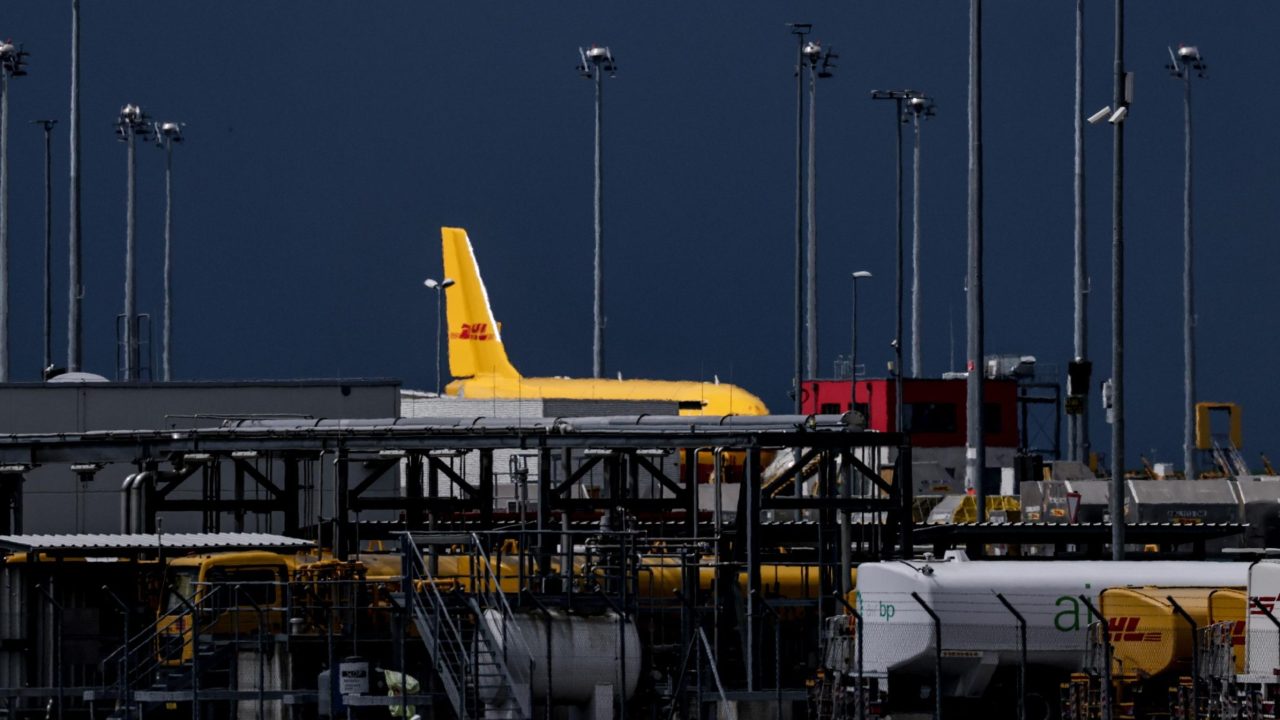
Caption: File photo. Fuel trucks at the DHL hub at Leipzig/Halle Airport in Schkeuditz, Germany, 12 May 2026. EPA/FILIP SINGER
Updated: August 5, 2026 - 14:20