 Edit
Serbia, Hungary move closer to NIS deal as Belgrade seeks greater control over the strategic oil company
Belgrade and Budapest have completed a key phase of the negotiations, but the final deal depends on the Russian side and of U.S. approval
Serbia and Hungary have moved a step closer to reshaping the ownership structure of Serbia’s Naftna Industrija Srbije (NIS) after Hungarian energy group MOL concluded negotiations with the Serbian government on a shareholder agreement linked to the acquisition of a controlling stake in the company.
The development marks an important stage in efforts to resolve the future of NIS, which has come under increasing pressure due to U.S. sanctions targeting its Russian ownership structure.
Serbian Mining and Energy Minister Dubravka Đedović Handanović said Belgrade and MOL have reached agreement on all outstanding issues related to the proposed acquisition of the majority stake currently held by Russian interests. According to the minister, the next step will be negotiations between the Hungarian company and the Russian side regarding the purchase of the Russian-owned shareholding in NIS.
Last January Serbian President Aleksandar Vučić announced that MOL has struck a deal to acquire a controlling stake in NIS from its Russian shareholders, in a transaction valued between 900 million and 1 billion euros.
Hungary’s MOL secures majority stake in Serbia’s NIS for up to 1bn amid Russian divestment pressure
Any final agreement will require approval from the U.S. authorities.
“Serbia conducted intensive and difficult negotiations in order to improve its position in NIS,” Đedović Handanović said.
NIS has long been one of Serbia’s most strategically important companies. The company was partially privatised in 2008, when Russia’s Gazprom Neft acquired a controlling interest. Today, Gazprom Neft holds a 56.15% stake in the company.
Under the arrangement agreed with MOL, Serbia would strengthen its influence within NIS if the transaction proceeds. According to the minister, if Gazprom Neft sells its stake to MOL and the U.S. Office of Foreign Assets Control (OFAC) approves the deal, the Serbian state will acquire an additional 5% shareholding in the company.
The move would give Belgrade greater authority when approving or blocking strategic decisions affecting NIS. The agreement also addresses the future of the company’s key refining asset in Pančevo, which plays a central role in supplying Serbia’s fuel market.
Đedović Handanović said the Hungarian side had committed to maintaining refinery operations at least at the average annual production levels recorded during the four years preceding the imposition of U.S. sanctions.
“The Hungarian side committed to ensuring that the refinery continues to operate as before, with at least the same production capacities as during the years when NIS achieved excellent results,” she said. According to the minister, preserving these production levels is essential for guaranteeing the stable supply of petroleum products to the Serbian market.
MOL confirmed that negotiations with the Serbian government on the shareholder agreement have been successfully completed. The company said discussions with the seller and relevant institutions remain ongoing as efforts continue to finalise the transaction.
The agreement also envisages a stronger role for Serbian state representatives on the NIS board.
According to Serbian officials, government-appointed board members would receive broader powers to approve or block decisions that could affect Serbia’s national interests.
Đedović Handanović said such influence is something Belgrade has not enjoyed since the company’s privatisation nearly two decades ago.
The proposed restructuring comes as Serbia attempts to navigate competing pressures from its traditional energy relationship with Russia and growing demands linked to international sanctions.
Negotiations between MOL and the Russian shareholders have yet to be completed, while U.S. approval remains a critical requirement before any transfer can take effect.
For Serbia, the deal represents not only an attempt to secure the future of NIS but also an opportunity to expand state influence over strategic decisions in the energy sector. The government has presented the agreement as a way to strengthen national interests while maintaining operational stability at a company that remains central to Serbia’s energy security.
Sources: BGNES, BETA
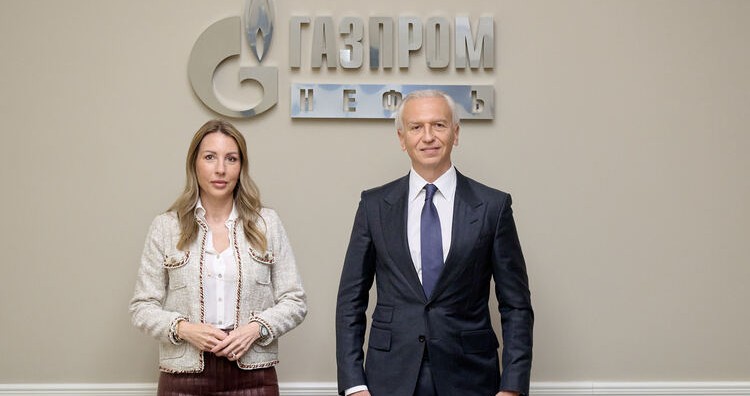
Caption: Minister of Mining and Energy Dubravka Đedović Handanović spoke on 3 June in St. Petersburg with the Chairman of the Board of Directors of Gazprom Neft, Alexander Djuokvim, about cooperation between Serbia and Russia in resolving issues of the Serbian Oil Industry. [www.mre.gov.rs]
Updated: June 12, 2026 - 05:25