 Edit
Serbia’s 2030-2035 national strategy: Vučić campaigns to extend his rule
The presentation effectively marks the start of Vučić's campaign for the upcoming parliamentary elections, expected within the next year
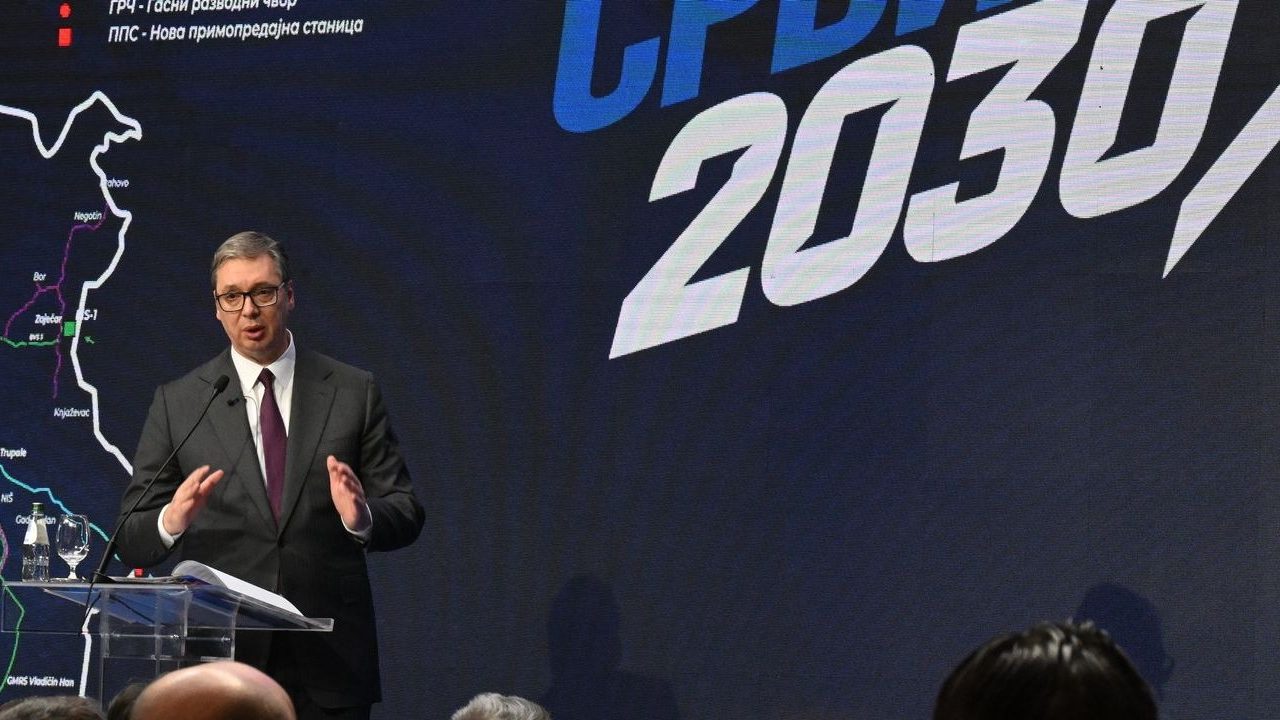
On 7 March Serbian President Aleksandar Vučić unveiled a national development strategy titled “Serbia 2030,” an extremely ambitious and voluminous program – the most extensive in the country’s history – envisaging €48 billion in capital investments by 2035. Yet the core message of his presentation was political rather than purely economic: Vučić is implicitly signalling to voters that achieving these grand plans requires his continued leadership in the years ahead.
The presentation effectively marks the start of Vučić’s campaign for the upcoming parliamentary elections, expected within the next year. Although economic planning falls under the government’s purview rather than the president’s, Vučić personally unveiled the strategy – as he has done with major initiatives in the past – to reinforce his role as the dominant figure in the ruling coalition. This has fuelled speculation that he is positioning himself for the prime minister’s post, aiming to prolong a rule that has already spanned nearly 14 years.
The plan
During the presentation, Vučić outlined €17 billion in capital investments by 2030, followed by an additional €31 billion through 2035 (excluding military and police spending). He specified that “no less than €15 billion” would go toward the army. The strategy projects GDP growth from last year’s €90 billion to €133 billion by 2030, lifting GDP per capita from €13,500 to €20,000. Average salaries are targeted at €1,320 in 2030 and €1,700 in 2035, with average pensions rising to €750 by the end of the decade.
Vučić envisions Serbia as an EU member by 2035 (potentially without full veto rights or a commissioner, aligning with a recent proposal he advanced alongside Albanian Prime Minister Edi Rama). He emphasized preserving peace and stability as his top priority over the next decade, alongside maintaining Serbia’s military neutrality.
Among the highlights, he announced aggressive development in artificial intelligence, including the opening of Serbia’s first humanoid robot factory by September at the latest. The plan calls for producing 1,000 multi-purpose humanoid robots and 10,000 robot dogs. A drone factory is slated to launch in April in partnership with a foreign investor (details on technology and identity withheld). Other elements include two new industrial parks and four industrial zones worth €314.3 million by 2035 to attract investors and enhance competitiveness; two new state data centers in Niš and Novi Sad by 2030, plus expansions in Kragujevac and Belgrade; and a National Center for Information Security in Kragujevac by 2030.
Infrastructure ambitions feature prominently: 380 km of roads under construction now, plus 578 km of highways and expressways by 2035; €1.5 billion for water infrastructure (including 30,000 km of pipes) by 2030; and €1.2 billion for sewage systems. Energy will claim a third of total investments by 2035 (€14.4 billion, including €6.5 billion for production capacities). Key projects include gas interconnectors with North Macedonia and Bosnia and Herzegovina, potential gas and oil links with Croatia, near-completion of documentation for a Serbia-Hungary oil pipeline, two pumped-storage hydropower plants, gas grids in eastern and western Serbia, the country’s first nuclear facility (construction to start before 2035, costing €3 billion), and €2.4 billion for power grid upgrades.
Recycled promises, questionable feasibility
Many announced projects are familiar from prior plans, such as the Serbia 2025 strategy—leading critics to accuse Vučić of recycling old ideas. Examples include the Kikinda-Sombor expressway, the Lazarevac-Bor highway segment, and the Požega-Duge Poljane road (started in 2022 and originally due this spring). Investments in sewage, water treatment, hospital renovations, and even a microchip factory echo earlier pledges, while the humanoid robot and robot dog factories strike many as promotional gimmicks aimed at voters.
Realisation will hinge on state borrowing and execution by entities close to Vučić, the Serbian Progressive Party, or powerful foreign partners. External factors will play a major role. Macroeconomics professor Milojko Arsić told Forbes Srbija the strategy is unfeasible, citing declining foreign investment, stagnating domestic investment, rising geopolitical tensions, and eroding stability. Achieving €20,000 GDP per capita by 2030 would require 48.1% growth over five years (about 8% annually per capita)—highly improbable. Raising average wages 41% to €1,320 by 2030 is challenging but not impossible, though Arsić warned that forcing the plan could undermine economic competitiveness.
The voter bait
Vučić’s presentation targets voters across the spectrum, not just his base. It follows a familiar playbook: promising a “golden age” of higher salaries and pensions, massive infrastructure, AI leadership, improved healthcare, and peace amid global uncertainty. Focus-group-tested messages emphasizing existential security resonate with government supporters and others alike.
In essence, the Serbia 2030 strategy doubles as political communication. Vučić’s personal delivery, detailed figures, and firm deadlines place him at the centre of the narrative, rebuilding legitimacy through a vision of stability and progress. Analysts rightly note that beyond economic goals, the plan conveys a clear political message: continuity of the current government is essential to deliver these promises. The strategy thus serves as a projection of political stability, crafted to help Vučić extend his hold on power.
Caption: On 7 March 2026 Serbian President Aleksandar Vučić unveiled a national development strategy titled “Serbia 2030”. [Website of the President of Serbia]
Updated: March 20, 2026 - 07:27