 Edit
Weimar Triangle leaders back Moldova ahead of elections amid Russian interference fears
Macron, Merz and Tusk mark Independence Day in Chisinau with strong backing for Maia Sandu ahead of September’s parliamentary vote
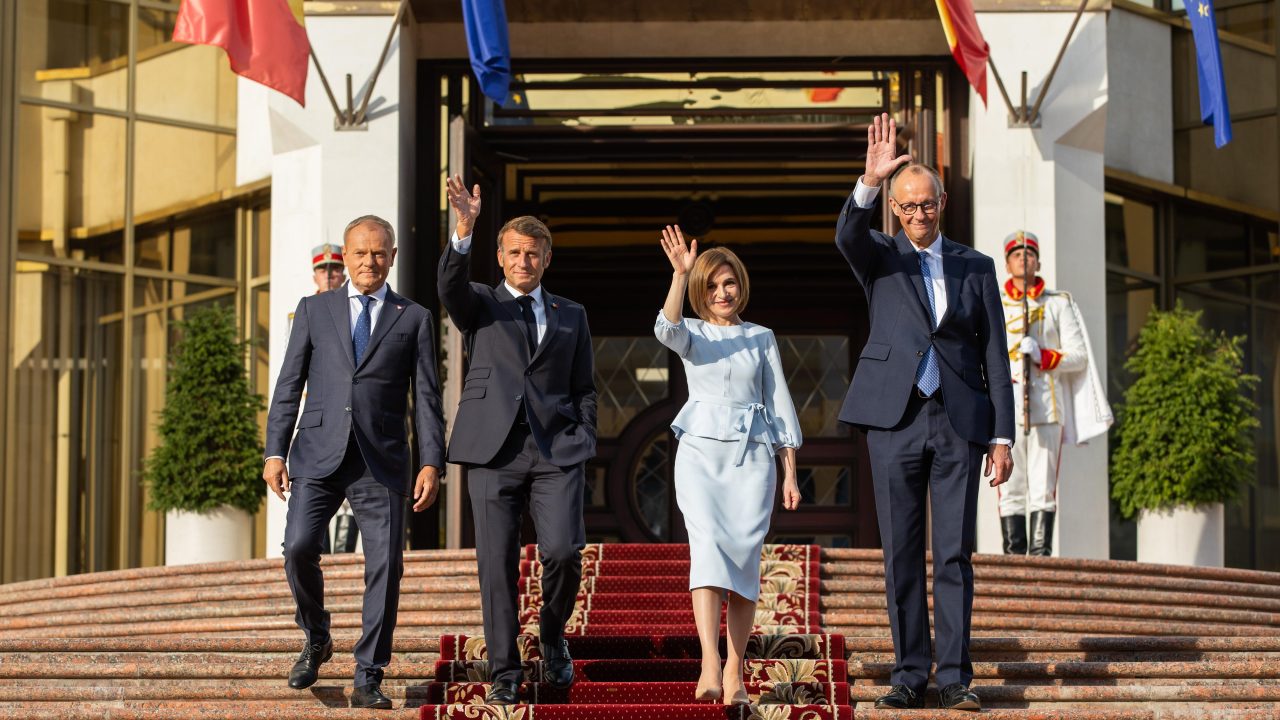
French President Emmanuel Macron, German Chancellor Friedrich Merz and Polish Prime Minister Donald Tusk travelled to Moldova on Wednesday (27 August) to express strong European support for President Maia Sandu and her pro-European government, as the country prepares for parliamentary elections on 28 September.
The joint visit coincided with the 34th anniversary of Moldova’s declaration of independence from the Soviet Union. Standing alongside Sandu in Chisinau, the three European leaders representing the Weimar Triangle pledged political backing, financial assistance and the prospect of eventual EU membership at a time when Moldova is facing mounting internal and external pressures. The Weimar Triangle is a regional alliance of France, Germany, and Poland created in 1991 in the German city of Weimar.
EU support ahead of decisive vote
Moldova, a majority Romanian-speaking country of 2.6 million people wedged between Romania and Ukraine, applied for EU membership in 2022 at the same time as Ukraine, days after Russia launched its full-scale invasion. Since then, Sandu has positioned EU integration as the central goal of her administration.
“We are moving decisively towards becoming a member state by the end of the decade,” Sandu said at a reception on the eve of Independence Day. “We have the historic chance to become part of the safest and most prosperous space of peace, freedom and justice.”
She warned, however, that “independence is not guaranteed: it depends on the choices we make,” citing risks from “illegal foreign financing, disinformation, cyber-attacks, [and] paid protests.”
According to Moldova’s Central Election Commission, 21 groups have been registered to contest next month’s vote. Sandu’s ruling Party of Action and Solidarity (PAS), which currently holds 61 seats in the 101-member parliament, faces a difficult challenge, with polls projecting no more than 41 seats.
The opposition has consolidated around two blocs with strong pro-Russian leanings. The Patriotic Bloc, uniting Socialists and Communists, is projected to win 36 seats. A second group, the Alternative Bloc, is forecast to win 13 seats but has been accused by the government of concealing a pro-Kremlin agenda.
Former prosecutor general Alexandr Stoianoglo, one of Alternative’s leaders, wrote on Telegram this week that the West would “soon lose interest in Moldova once the war in neighbouring Ukraine has ended”.
Sandu has repeatedly accused Russia of meddling in Moldovan politics. A month ago she alleged that Moscow intended to funnel some $100 million into the country through cryptocurrency channels to support pro-Russian political forces. Moldovan authorities have already banned one openly pro-Russian bloc led by a fugitive business magnate from participating in the elections.
Moldova’s president warns of ‘unprecedented’ Russian interference ahead of election
EU leaders send a clear signal
Against this tense backdrop, the visit of Macron, Merz and Tusk was intended as a symbolic show of solidarity.
“The door of the European Union is open,” Merz told Moldovan leaders. “From the bottom of our hearts – you are welcome in the European Union”. He said Germany would “do everything possible to get Moldova in a position to open the first chapter of EU accession negotiations in the autumn,” adding that experts would be dispatched to support reforms and that “German and European money is helping secure energy supplies and boosting small and medium companies”.
Macron echoed those remarks and referred to what he described as Moscow’s disinformation campaigns. “Kremlin propaganda says the Europeans want to prolong the war and that the European Union oppresses people. These are lies,” he said. Unlike Russia, he added, “the European Union does not threaten anyone and respects the sovereignty of all.”
“In the run-up to parliamentary elections, not a day goes by without massive Russian hybrid attacks,” Merz said. “Democracy in Moldova is under attack both online and offline.”
Russian troops and hybrid threats
Moldova continues to face longstanding security concerns linked to the breakaway Transnistrian region, where Russian troops have been stationed since a short war in the early 1990s. Chisinau accuses Moscow of destabilising the country through hybrid tactics including disinformation, cyberattacks and covert financing.
Tusk underlined that Moldova’s future is tied to Europe’s security as a whole. “There is no safe EU, no safe Poland, no safe France or Germany without an independent and safe Moldova,” the Polish premier said.
Sandu insists that Moldova’s European course is “irreversible,” but public opinion remains deeply divided. A referendum last year endorsing her EU integration campaign passed by a narrow margin. Polls suggest a close race between PAS and pro-Russian blocs, with the outcome likely to shape Moldova’s trajectory for years to come.
Once heavily dependent on Russia for energy and export markets, Moldova has since reoriented its economy towards Romania and the EU. Yet the country remains one of the poorest in Europe, with widespread economic discontent fueling opposition challenges.
Over 1 million Moldovans, with estimates suggesting 70,000–80,000 working in EU countries like Italy and Poland, have emigrated for employment, and their diaspora vote could prove decisive in the closely contested parliamentary elections.
Sources: Reuters, BGNES, DPA
Caption: (L-R) Prime Minister of Poland Donald Tusk, President of France Emmanuel Macron, President of the Republic of Moldova Maia Sandu, and Chancellor of Germany Friedrich Merz leave the presidential palace after a press conference during the celebration of Moldova’s Independence Day in Chisinau, Moldova, 27 August 2025. Moldova celebrates 34 years since the adoption of the Declaration of Independence from the Soviet Union. EPA/DUMITRU DORU
Updated: August 28, 2025 - 06:04


