 Edit
Verhofstadt blasts EU “appeasement” of Iran in fiery speech to hundreds of exiled dissidents
EU institutions went under fire for shying from designating the repressive apparatus in Tehran as a terrorist organisation
Several prominent EU politicians, including Belgian former prime minister Guy Verhofstadt, criticised the policy of appeasement of the EU institutions vis-à-vis de regime in Iran, at a major gathering of the Iranian opposition in exile hosted by the European parliament on Wednesday (10 December).
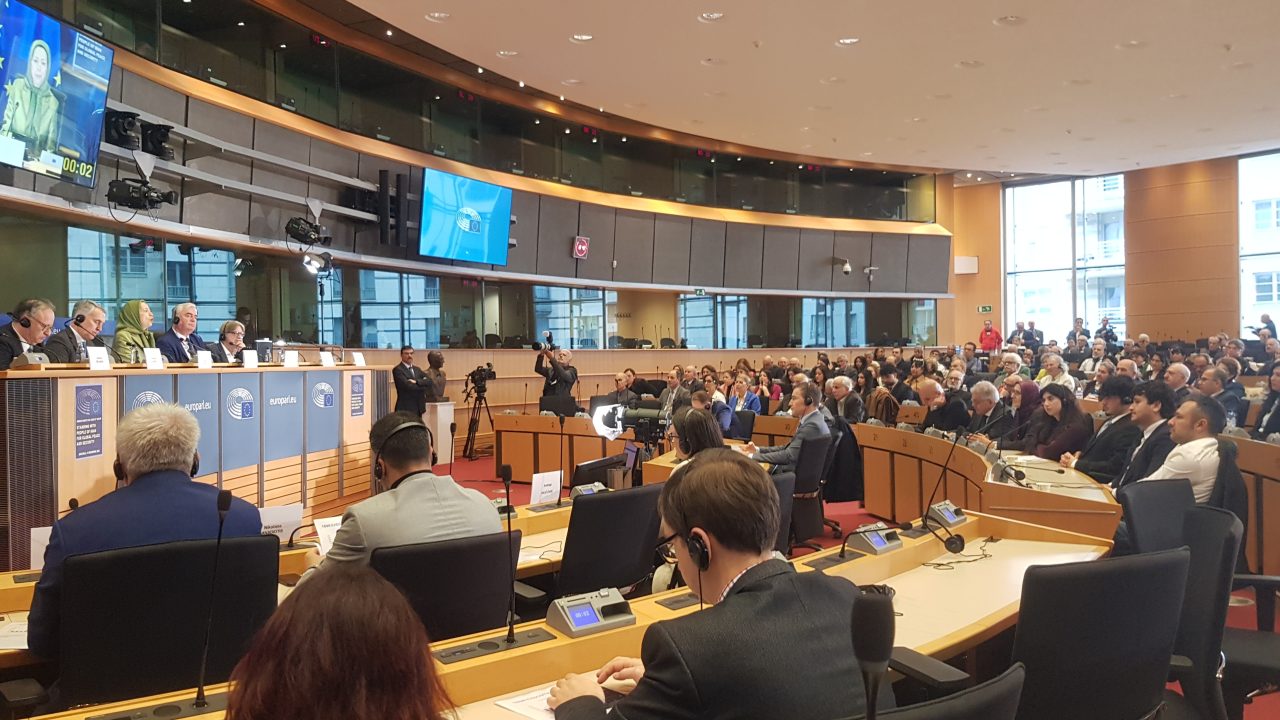
Over 400 Iranians from abroad gathered in the European Parliament to greet National Council of Resistance of Iran (NCRI) leader Maryam Rajavi, at an event attended by several leading MEPs and two former prime ministers – Verhofstadt and Italy’s Matteo Renzi.
The NCR is the major opposition force in Iran and several of its imprisoned activists are currently in death row. According to Amnesty International, the Iranian regime carried out 64 percent of documented executions worldwide in 2024. The situation has deteriorated dramatically in 2025.
The Iranian regime hanged 335 prisoners, including 7 women, in November. Two of the victims were publicly executed. The number of executions in November was more than double the 155 in 2024, three times the 115 in 2023, six times the 57 in 2022, and eleven times the 30 in 2021.
Verhofstadt, who served as the prime minister of Belgium from 1999 to 2008 and was a member of the European Parliament (MEP) from Belgium from 2009 until 2024, said that the situation was rapidly worsening and demanded a strong European reaction.
He said that the regime in Iran executed 2,600 in the last month, and 16 executions were carried out in the first week of December.
Verhofstadt denounced what he called “a continuation of Western appeasement” vis-à-vis the regime in Iran and appealed for the EU institutions, including the External Action Service led by Kaja Kallas, to change strategy and impose new sanctions on Iran “as soon as possible”.
“The more executions, the more sanctions” he said.
In particular, NCRI and its leader Maryam Rajavi call on the EU to designate Iran’s repressive instrument, the Revolutionary Guards (IRGC), as a terrorist organisation. The European Parliament has adopted resolutions in that sentence, and national parliaments in Sweden, the Netherlands and Belgium have also voted for such a move.
The European Union has expressed “deep concern” about the alarming rate of executions in Iran, but has refrained from adopting new sanctions against the Iranian repressive apparatus.
According to diplomatic sources, Kallas doesn’t want to create antagonism that could compromise the chances to give another chance to the nuclear talks.
The Iran nuclear negotiations, aimed at curbing Tehran’s atomic program in exchange for sanctions relief, are currently suspended and at an impasse, with no active rounds scheduled amid heightened regional tensions, stalled diplomacy, and the looming October 2025 expiration of key UN safeguards under the 2015 Joint Comprehensive Plan of Action (JCPOA).
Diplomats say off the record that the regime in Tehran has long used this tactic to buy time and avoid sanctions.
Several other speakers said that Iran would not relinquish its nuclear program until it is overthrown. Both Verhostadt and Renzi said that the June U.S. strikes on Iran didn’t produce a nuclear-free Iran, with Renzi arguing that “bombing from abroad is not a solution”.
Mariam Rajavi, an Iranian dissident politician and the leader of the People’s Mujahedin of Iran (MEK), an organization advocating the overthrow of the Iranian government, and president-elect of its National Council of Resistance of Iran, was enthusiastically acclaimed by the audience.
She said that the Resistance movement is expanding across various provinces and that the population was increasingly converging to the program advocated, which includes the overthrow of the regime by the people, not through the intervention of any foreign power, a firm rejection of both the mullahs and the Shah, and the separation of religion and state.
Last April Maryam Rajavi announced her “Ten-point plan for Future Iran”, which has become a manifesto for the Iranian opposition.
After the publication of this article, the Commission sent a longish commentary outlining the EU’s policy approach towards Iran. It says that in her exchanges with her counterpart, the HRVP raises topics on critical areas of concern for the EU, including Iran’s military cooperation with Russia, the arbitrary detention of EU citizens and the human rights situation in Iran.
However, in the position, nothing addresses the main criticism expressed during the event at the European Parliament: that the EU is shying away from tougher sanctions by enlisting the regime’s repressive apparatus as a terrorist organisation.
The position reads:
“Human rights continues to be central in EU’s policy approach towards Iran and we remain gravely concerned by the overall situation in the country. The EU supports the fundamental aspiration of the people of Iran to a future where their universal human rights and fundamental freedoms are respected, protected and fulfilled. We seize every opportunity, both publicly and through diplomatic channels, to convey our concerns to Iranian authorities with the aim to have a meaningful impact.
“We also have robust sanctions related to human rights violations in Iran, bother under a specific sanctions regime and under the EU Global Human Rights Sanctions Regime. The EU has a strong, unequivocal and longstanding opposition to the death penalty at all times and in all circumstances.
“The death penalty as a tool of repression against political dissidents and protestors in Iran is a matter of serious concern, as is the dramatic increase in executions in the country. Against this backdrop, the EU continues to seize every opportunity, including most recently at the UN General Assembly in the EU statement together with all EUMS co-sponsoring a dedicated UNGA resolution, to urge Iran to reverse this worrying trend and pursue a consistent policy towards the abolition of capital punishment altogether.”
Caption: At the podium, Maryam Rajavi is third from left and also appears on the screen, Guy Verhofstadt is fifth from left [Georgi Gotev]
Updated: December 12, 2025 - 06:22


