 Edit
Ukrainian drone strikes disrupt Moscow’s Victory Day parade plans, stranding leaders and passengers
The timing of the attacks appears calculated to undermine Putin’s carefully orchestrated spectacle
As Russia gears up for its annual Victory Day parade on 9 May, a series of Ukrainian drone attacks has thrown the capital into chaos, grounding flights, stranding thousands of passengers, and complicating travel for world leaders invited to the high-profile event.
The assaults, targeting Moscow’s airports and military sites, have raised tensions and cast a shadow over President Vladimir Putin’s plans to showcase Russian pride on the 80th anniversary of the Soviet victory over Nazi Germany.
For three consecutive days, from 4 to 6 May, Ukrainian drones struck Moscow, forcing the closure of the city’s four major airports—Domodedovo, Sheremetyevo, Vnukovo, and Zhukovsky—along with others in Kaluga, Tambov, Yaroslavl, and Nizhny Novgorod.
The Russian defence ministry reported intercepting a record 524 drones in a single day, though no casualties were confirmed. The disruptions affected 350 flights, leaving approximately 60,000 passengers stranded across Russia, according to Russia’s Association of Tour Operators. Posts on social media described chaotic scenes at airports, with long lines and cancelled flights as far away as St. Petersburg and Sochi.
The timing of the attacks, just days before the parade, appears calculated to undermine Putin’s carefully orchestrated spectacle, which includes military units from 13 countries and the attendance of at least 29 world leaders, including China’s Xi Jinping and Brazil’s Luiz Inácio Lula da Silva.
Ukrainian President Volodymyr Zelenskyy heightened tensions by warning that Kyiv could not guarantee the safety of foreign delegations traveling to Moscow, citing Russia’s history of violating ceasefires.
Zelenskyy warns that those who will attend Moscow’s 9 May parade risk their security
“They kill until May 7th, pause for a couple of comfortable days, then start attacking again on the 11th,” Zelenskyy said, prompting sharp criticism from Slovakia’s Prime Minister Robert Fico, who called the remarks disrespectful to Russia’s WWII sacrifices.
The drone strikes have particularly complicated travel for Fico and Serbia’s President Aleksandar Vučić, the only European leaders planning to attend the parade despite EU warnings that their presence could jeopardize Slovakia’s standing and Serbia’s EU membership bid. Vučić’s journey was disrupted when his plane, en route to Moscow, was forced to make an emergency stop in Baku, Azerbaijan, after several regional states, including Lithuania, Latvia, and Estonia, barred his flight from crossing their airspace. Local media reported that Vučić eventually landed in Moscow, but the detour underscored the logistical challenges posed by the drone attacks and regional tensions.
Fico, the only EU leader attending, faced similar hurdles. Estonia refused to allow his plane to traverse its airspace, a move he decried as “extremely disruptive.” The Slovak prime minister, a vocal critic of EU sanctions on Russia, defended his decision to attend, stating, “I will go to Moscow to honour the Red Army soldiers who liberated Slovakia.” His participation, alongside Vučić’s, has drawn sharp rebuke from Brussels, with EU foreign policy chief Kaja Kallas warning that such visits “will not be taken lightly” given Russia’s ongoing war in Ukraine.
The drone attacks have also targeted strategic sites, including the Kubinka airfield west of Moscow, where aircraft and personnel slated for the parade are stationed. A Russian military Telegram channel, Fighterbomber, acknowledged the strikes, noting that Ukraine was “trying to spoil our parade” by hitting parade-related targets. The closures and security measures have fuelled speculation about the safety of high-profile guests, with posts on X suggesting that leaders like Xi could face delays if the attacks persist.
For Putin, the Victory Day parade is a cornerstone of national pride, a chance to project strength and rally support amid the war in Ukraine. This year’s event, featuring 102 Chinese soldiers – the largest foreign contingent- and a guest list including leaders from Cuba, Vietnam, and several African nations, was meant to defy Western isolation. However, Ukraine’s drone campaign has exposed vulnerabilities, with Zelenskyy’s warnings amplifying doubts about Moscow’s ability to ensure security.
Ukraine’s foreign ministry condemned the participation of foreign troops in the parade, calling it “unacceptable” and accusing Moscow of using the event to “whitewash its war crimes.” In response, Russia accused Kyiv of orchestrating the drone strikes to sabotage the celebrations, even as a self-declared three-day ceasefire, announced by Putin, was set to begin on 7 May. The barrage of Russian retaliatory strikes on Kyiv, which killed two people overnight, further eroded trust in the truce.
As Moscow prepares for tomorrow’s parade, the city remains on edge. Airport operations are gradually resuming, but the disruptions have left a lasting mark. For Putin, the drone attacks are a stark reminder that Ukraine’s resistance extends beyond the battlefield, threatening to dim the luster of his Victory Day extravaganza.
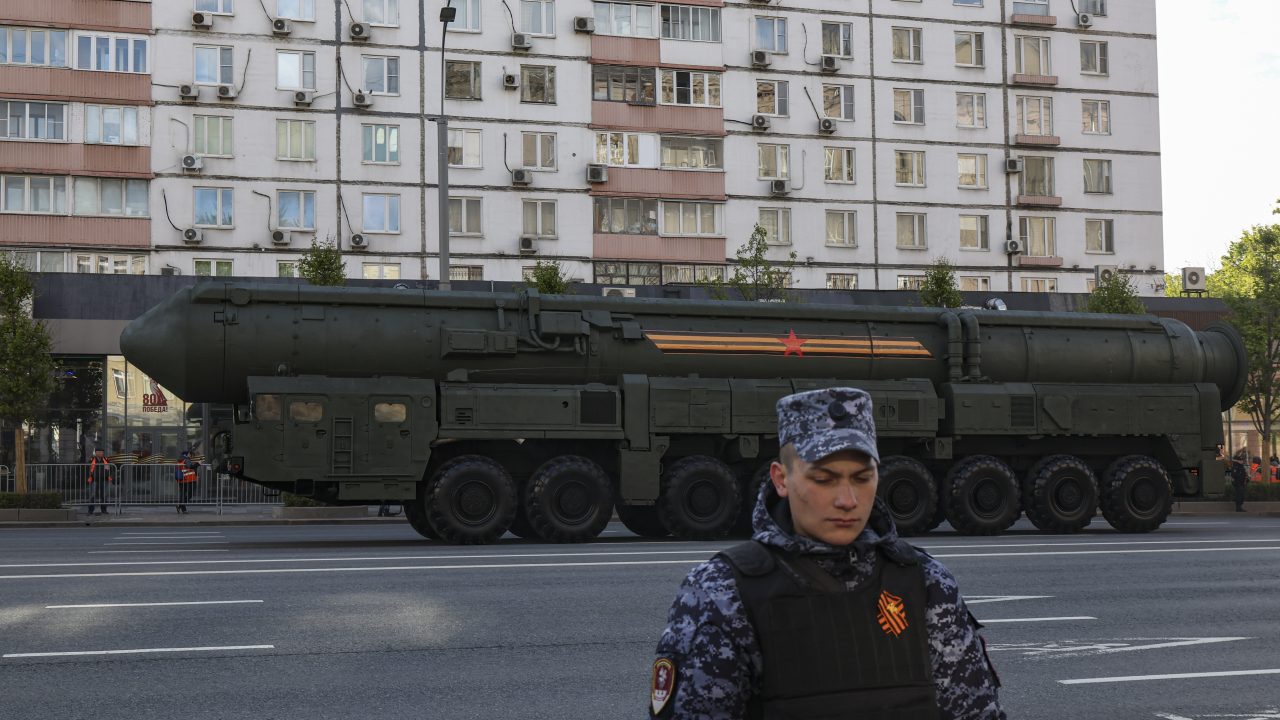
Caption: A Russian Yars intercontinental ballistic missile launcher drives during preparations for the general rehearsal of the annual military parade ahead of Victory Day celebrations, in downtown Moscow, Russia, 07 May 2025. Russia is preparing to mark the 80th anniversary of Nazi Germany’s unconditional surrender in World War II (WWII). The military parade will take place in Moscow’s Red Square on 9 May. [EPA-EFE/MAXIM SHIPENKOV]
Updated: May 8, 2025 - 07:10