 Edit
Trump’s nuclear Marriott: inside the radioactive empire of delusion
“The man who wanted to buy Greenland now wants to franchise Chernobyl”
The continent’s most dangerous game is being played by men who mistake endurance for immortality, writes Sed Tkachuk.
Volodymyr (Sed) Tkachuk is a communications specialist and free-lance journalist, signing Sed Tkachuk.
When Donald Trump proposed “American ownership” of Ukraine’s nuclear power plants — including the occupied Zaporizhzhia facility — he didn’t sound like a statesman restoring order. He sounded like a real-estate developer pitching a luxury resort chain.
Welcome to the Nuclear Marriott, where breakfast is complimentary, democracy optional, and the fallout cleanup is “locally sourced.”
Trump called it a plan for “stability.” In practice, it looked like an auction of sovereignty with free parking. The former president, now again in power, seems convinced that if you can’t end a war, you can at least profit from it.
When Russian troops stormed into Enerhodar, the city where the Zaporizhzhia nuclear power plant is situated, in March 2022, the city of engineers went silent. The firefight that raged around Europe’s largest nuclear plant was unprecedented — artillery glowing against cooling towers, tracer rounds ricocheting off the walls that once supplied half of Ukraine’s electricity.
No army had ever tried to capture a nuclear power plant before, but there’s a first time for every apocalypse.
Inside, Ukrainian operators worked at gunpoint, manually keeping the reactors in “cold shutdown.” Those who kept the lights on became hostages of Russia and the very power they once generated. Biden administration voiced only concerns.
In occupied Enerhodar, being an engineer was suddenly a crime. Dozens of Zaporizhzhia nuclear power plant workers were arrested, beaten, and accused of “terrorism” for refusing Russian passports. One of them, Serhiy Potyng, an engineer of the thermal-automation division, was beaten so severely that he was taken for surgery “so he wouldn’t die.” His offence was loyalty — to physics and his country, not to propaganda.
“For them, anyone without a Russian passport is already a terrorist,” said one colleague. Others were forced to sing Russian Katyusha and other Russian pop songs between interrogations.
By 2023, the Zaporizhzhia plant had turned into a fortress. Russian forces dug in, placing tanks and ammunition under turbine halls, anti-aircraft guns near the reactor domes, and sniper nests atop cooling towers.
From this “safe zone,” they shelled Ukrainian towns across the Dnipro river — fully aware that Kyiv couldn’t return fire without risking a continental catastrophe.
Priests from the Russian Orthodox Church even arrived to bless the site, bringing icons to “protect critical infrastructure.” Faith met fission; the result was equal parts theatre and blasphemy.
It wasn’t just occupation — it was blackmail by reactor. The same geopolitical trolling that sent drones into Polish and Moldovan (and others) skies now glowed from a new launchpad: the nuclear core.
Moscow’s energy czars soon promised a “restart.” Alexei Likhachev, head of Rosatom, spoke of reconnecting ZNPP to Russian grids. The plan, experts said, was fantasy bordering on suicide.
Engineer Andriy Ozhаrovskyi put it plainly: the plant’s six VVER-1000 reactors are decades old, half-mined, and reliant on Ukrainian-built systems that Russian staff can’t operate. “You don’t reboot a reactor like an iPhone,” he said. “You don’t press Power + Home and pray.”
The metaphor fits too well — the Kremlin treats technology the way it treats soldiers: disposable, misunderstood, and easily overheated.
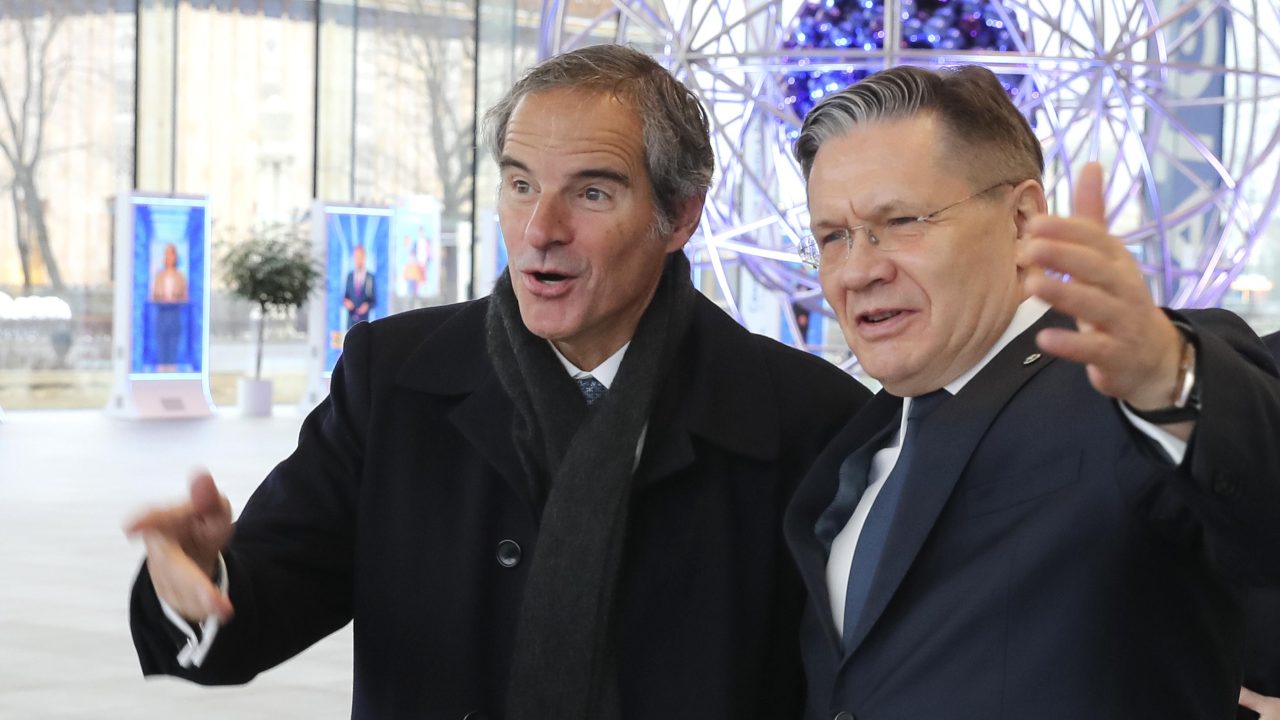
Since September 2022, the IAEA has maintained a permanent mission at the site — or so it claims. Its chief, Rafael Grossi, made headlines hugging Russian officials, while reports spoke of “violations on both sides.”
Inspectors are allowed to watch water levels and count bullet holes, but not to enter reactor control rooms or turbine halls. The IAEA’s neutrality has become its own radiation shield.
If radiation had PR handlers, they’d sound exactly like the IAEA. The organisation keeps issuing “principles,” while Europe quietly stocks iodine tablets.
Collaboration has its own physics. Former Ukrainian managers who once swore oaths to state service now manage press conferences for Rosatom. Vladimir Bronnikov, former head of Energoatom, parades through Enerhodar in a Soviet-era suit preaching that the plant has “returned to its motherland.”
Others — less famous, more frightened — sign contracts to avoid the confinement to the basement. In the new moral equation, survival decays faster than uranium. Even atoms hold their integrity longer than some men.
Then came Trump, returning to the stage with his favourite line: “I alone can fix it.”
Earlier this year, the White House floated what it called “a stabilisation framework” — effectively an offer for U.S. oversight of Ukraine’s nuclear sector. The proposal framed it as “best protection,” but the subtext was obvious: America would manage, profit, and, naturally, brand it.
To Kyiv’s weary diplomats, the absurdity was almost welcome. After years of waiting for advanced weapons, the same president who delayed billions in military aid now offered managerial services — a sort of Marriott International of megawatts.
Trump is slow to deliver missiles, but the Ukrainian government, desperate for political optics, still whispered about nominating him for a Nobel Peace Prize. A peace built on delayed shipments and radioactive franchising.
He once promised “fire and fury” sanctions against Russia, then quietly shelved them. Now, his fire burns only for deals.
If Zaporizhzhia’s reactors ever hum again, it might be to the sound of a Trump-branded theme tune. “Make Fallout Great Again.”
The tragedy of Zaporizhzhia isn’t just local. Europe lives downwind.
Every time the site loses power — as it did twice this year — diesel generators take over, and the countdown begins: 20 days before fuel runs out, 5.5 hours before the core melts. That’s without counting in the Kakhovs’ke reservoir that was cooling the station before being blown up by Russian forces.
Both Russia and the West pretend to control the situation. Moscow threatens to restart the reactors under Russian law; NATO calls it “unacceptable” and moves on to the next press conference. The continent’s most dangerous game is being played by men who mistake endurance for immortality.
The truth is simpler: nobody controls the atom. It only tolerates us — until it doesn’t.
Today, the Zaporizhzhia Nuclear Power Station sits like a sleeping god — silenced, wounded, surrounded by trenches and prayer banners. Its Ukrainian engineers are scattered across Europe; some dig trenches near Kupiansk, others wash dishes in Berlin.
Inside the plant, Rosgvardia patrols hallways that once echoed with turbine hum. The control panels flicker under dust. The gauges still move — faintly, almost mockingly — as if the reactor is breathing in its sleep.
And far away, politicians trade its future like a stock option. Trump calls it “an opportunity.” Putin calls it “ours.” The IAEA calls it “stable.” Ukraine calls it what it is: occupied — and dangerous for Europe and the world.
Every empire thinks it can master energy. Every generation learns it can’t.
The atom does not serve, it waits. It remembers every hand that struck its panels, every oath broken, every lie broadcast under the hum of containment systems.
Zaporizhzhia doesn’t only need rescuing — it needs remembering.
One night, a Russian Shahed drone deliberately struck the shelter of the Chernobyl Nuclear Power Plant. The safety arch — that monument to Europe’s painstaking redemption — was pierced and set ablaze.
It had taken decades for Europe to build that sarcophagus over its past, and a single Russian “Ivan” decided to ignite it again — as if reenacting Dostoevsky with a drone, striking at Europe’s conscience with an axe.
Maybe one day, the Zaporizhzhia nuclear power plant will hum again under a free sky. Or maybe it will just stand there, a monument to our collective delusion: that control is possible, that justice is optional, and that power, in any form, can ever truly belong to us.
Caption: handout picture made available by State Atomic Energy Corporation Rosatom press service shows International Atomic Energy Agency (IAEA) Director General Rafael Mariano Grossi (L) taking to Rosatom CEO Alexey Likhachev during their meeting at the Atom Museum at the VDNKh exhibition center in Moscow, Russia, 7 February 2025. EPA/ROSATOM PRESS SERVICE HANDOUT
Updated: October 10, 2025 - 06:08


